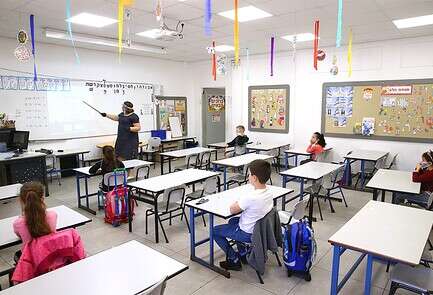
On Sunday, Israel's school system took an important step toward a return to normalcy. Along with the comparative success and the parents' willingness to send their students back to the system, there are a number of other steps that need to be taken for the return to routine to be effective, and most of them have to do with re-opening the economy.
Full-length school days and after-school programs: The first to third graders who returned to school went back for five hours a day only, and thus far the after school programs that usually operate until four or five haven't been re-launched. This means that parents, even ones who don't have other children at home, aren't free to return to work because they need to pick up their children in the early afternoon. The decision to re-open after school programs needs to be made jointly by the Education Ministry and local authorities. Right now, they want to re-launch "after school" starting next week, with up to 15 children in each group.
Follow Israel Hayom on Facebook and Twitter
This means that additional staff will have to be hired to oversee the smaller groups, which means more money to operate the programs under the new format. If money is found, the change will be implemented by the companies that run the after school programs.
According to Ofer Orenstein of the Israel Association of Community Centers,"We want to re-open even more than the government does, it allows the parents to breathe. The kids and the staff miss it and want to go back, but the way [the programs] operate requires a change to meet the demands for smaller groups, which makes them more expensive to operate. Without the government covering the extra costs, we won't be able to re-open the after school programs, because we aren't allowed to go into a deficit."
Arrangements for children of teachers: One of the most absurd aspects of the schools being reopened is that many of the teachers who were supposed to come back to teach are themselves parents of young children whose nursery schools or daycares, even those run by the Education Ministry, haven't reopened yet. Where the Education Ministry was unprepared, local authorities have stepped in, and some have launched their own babysitting services for children of educators, much like the services offered to health care workers.
The city of Afula was the first to offer babysitting for its teachers, with five children per group. The babysitters are the nursery school classroom aides, and the services were opened in nursery schools located adjacent to where the parents teach and will operate until the city's nursery schools and daycare centers resume normal activity. Other cities have announced they will be launching similar programs: Rishon Lezion, Tel Aviv-Jaffa, Ofakim, Sderot, and Modi'in. More cities are expected to join the initiative.
It should be noted that the lack of frameworks for young children has given many teachers little choice, since both teachers of first to third grades and teachers of 11th and 12th-grade matriculation students may have young children. The problem will likely only get worse once nursery schools re-open for half-weeks only, meaning that the nursery teachers who have children won't have any place to put them on the days the children are supposed to be at home but they are expected to teach.
Subsidized daycare, with oversight: These frameworks are vital to allowing many parents to go back to work, and this issue is still being discussed by the education and welfare ministries, in conjunction with the Treasury.
Returning toddlers to subsidized daycare centers that are subject to supervision and operated by Naamat, Emunah, WIZO, etc., won't require far-reaching changes, but on the other, won't really free up parents, especially mothers, for half of each week. If we really want to free up all parents to work, we need frameworks for all their children, which will require extensive changes: splitting classrooms, adding daycare workers, and bigger budgets. Today, there is one daycare workers for nine children in a nursery group of 27 kids, meaning three workers per class. But the new circumstances, which allow only 15 children in a class, mean that each class, divided into two, will now need four workers rather than three. This means finding more workers and more money to pay them. In addition, daycare centers are demanding that the government compensate them for March and April, when they were closed and did not charge parents.
Naamat Chairwoman Hagit Peer, said, "We didn't wait for the government, and two weeks ago we submitted to the Treasury a detailed plan that would allow us to re-open the daycare centers in accordance with the Health Ministry instructions. I very much hope that the government will approve the plan immediately, as it entails the minimum budget needed to operate the system under the Health Ministry restrictions."
Meanwhile, nursery schools and kindergartens are slated to re-open on Sunday, May 10. According to the original plan, those children will be divided into two groups of 15-17 children, each of which will spend three days in school and three days at home, doing online school. This, of course, is problematic because it doesn't allow parents to go back to work full-time, and will also complicate things for the teachers who have children in nursery school or kindergarten.
The best solution might be to find additional buildings and enlist more workers, such as university students studying education, who can operate the school frameworks for all ages, but that scenario is far from coming to pass. This is in part due to the fact that the children are so young and will have a hard time getting used to new staff. But it could also be a chance for local authorities to prove themselves effective in finding solutions that will allow them to re-open schools and daycare, letting parents go back to work.