

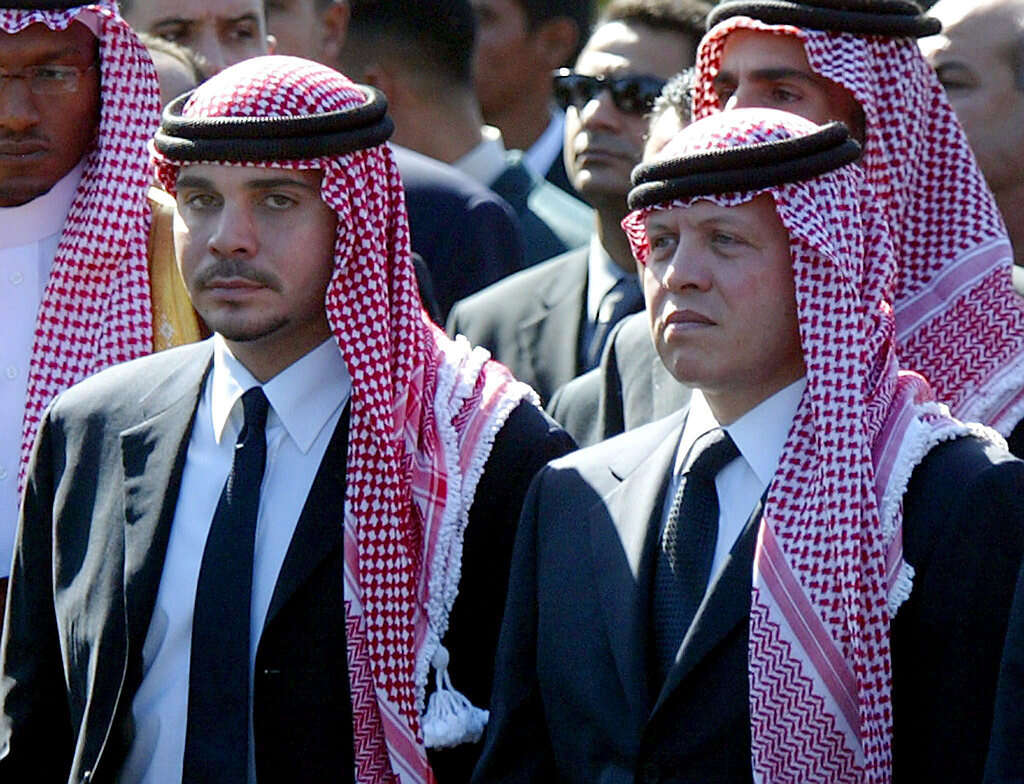
Unprecedented public criticism of Jordan's monarchy by a senior royal who has been placed under house arrest has shaken the country's image as an island of stability in the Middle East. On Saturday, Jordan's military told King Abdullah's half-brother Prince Hamza bin Hussein to halt actions targeting "security and stability" in the key US ally.
Follow Israel Hayom on Facebook and Twitter
In unusually tough language recorded on a video passed by his lawyer to the BBC, Prince Hamza, 41, said he had been placed under house arrest and criticized Jordan's leaders as a corrupt few who have placed their interests above those of the public.
"Damage has happened. For the first time we have someone rocking the image of that peaceful, stable kingdom," said a former minister.
King Abdullah, 59, removed Hamza from his position as crown prince in 2004, thwarting the ambitions of his stepmother Queen Noor who had groomed her eldest son for the throne since childhood.
Stripped of any power, Hamza was subsequently sidelined. King Abdullah consolidated his power by making his son Hussein the heir apparent and in the past year has appeared to be preparing him intensively for his future role as king.
Meanwhile Hamza has been building ties with disgruntled tribal leaders at the head of loose anti-government protest movement called the Herak, which in recent weeks resumed its calls for protests against corruption.
The COVID-19 pandemic has dealt a severe blow to Jordan's economy, pushing unemployment to record levels and deepening poverty.
"The king is a red line ... we will confront firmly any trembling hand that seeks to tamper with the country's security," former Prime Minister Faisal al Fayez told parliament in an indirect reference to Hamza.
It is unclear why the kingdom decided to crack down on Prince Hamza at this moment, but political sources say he put himself at risk with frequent visits to tribal gatherings where people openly criticise the king.
Hamza is not seen to have any real clout and those detained as part of what the military said was an ongoing security investigation mostly number his close aides.
"He is allowing himself to be part of a critical machine against the ruling system, when he was going to tribal gatherings who were criticising the ruling establishment even when he was not saying anything," said a senior politician.
"When he talked about deteriorating governance and silencing of critics, this was very confrontational," he added, referring to the video.
Although unprecedented, Hamza's open dissent is unlikely to pose a serious threat to the monarchy, especially without the support of Jordan's powerful military where the king enjoys widespread loyalty, analysts and political sources said.
"You can't carry out a coup in a country like Jordan without the involvement of the military. As of now, there is no such indication," Oded Eran, a former Israeli ambassador to Jordan and now senior research fellow at Tel Aviv University's Institute for National Security Studies, told Army Radio.
"This is the only force with any kind of significance, with the ability to take over government ministries, over power centres. With all due respect to the prince - he does not have this ability."
A former US official with knowledge of events in Jordan said these did not involve a coup. Rather, he said, those taking part were planning to push for protests that would appear to be a "popular uprising with masses on the street" with tribal support.
Any attempt to seize power would most probably have failed without the support of the United States and regional powers, who expressed support for King Abdullah and any measures needed to ensure Jordan's security.
Nevertheless, Jordanians are trying to make sense of the palace intrigue.
"There is nothing local I can see that triggered this so there could be the foreign element," said the former minister.
The senior politician said Prince Hamza was out of his league. "A foolish, troublesome prince who has not weighed matters well, seeking comfort in this little flirtation with angry tribal elements," he said.
Subscribe to Israel Hayom's daily newsletter and never miss our top stories!


