The US is continuing to build up forces in the Middle East amid the possibility that President Donald Trump will decide in favor of military action against Iran. As this buildup continues, including heightened air activity involving assets and capabilities moving into the region, the most volatile theater at present, and the one drawing the bulk of the threats from Tehran as well as attention from the White House, appears to be the maritime theater.
On Friday, the IDF announced that a US destroyer had docked at the port of Eilat as part of security cooperation between the two countries. Trump himself said on Friday, as he has repeatedly over the past week, that "we have a large armada on the way to Iran right now."
The most immediate flashpoint, even before any decision on military action, may be Iran's announcement that the naval arm of the Islamic Revolutionary Guard Corps will conduct a live-fire exercise in the Strait of Hormuz on Sunday and Monday. The strategic waterway carries about 20 percent of the world's oil supply.

The Strait of Hormuz
Iran frequently exploits the strategic value of the straits along its coastline in an attempt to deter the US, and in the past has threatened to block the Strait of Hormuz to maritime traffic in the event of an American strike. Given the enormous implications of disrupting shipping there, the strait is sometimes viewed as Iran's "doomsday weapon." Any attempt to use it would almost certainly trigger a harsh response and could also harm Iran's allies, such as China, because of the impact on the global economy.

US Central Command issued an unusually blunt statement on Friday ahead of the exercise, calling on Iran "to conduct the exercise in a safe and professional manner, avoiding unnecessary risk to the freedom of international maritime navigation."
The US naval deployment
At present, according to official statements, around 10 major US vessels are deployed in the Middle East. At the core of the American naval force is the aircraft carrier USS Abraham Lincoln, which arrived in the Arabian Sea on Monday after being redirected from a planned deployment in the South China Sea.
The vessel is one of the US Navy's 10 nuclear-powered Nimitz-class aircraft carriers. It is 333 meters long and carries a crew of about 5,700.
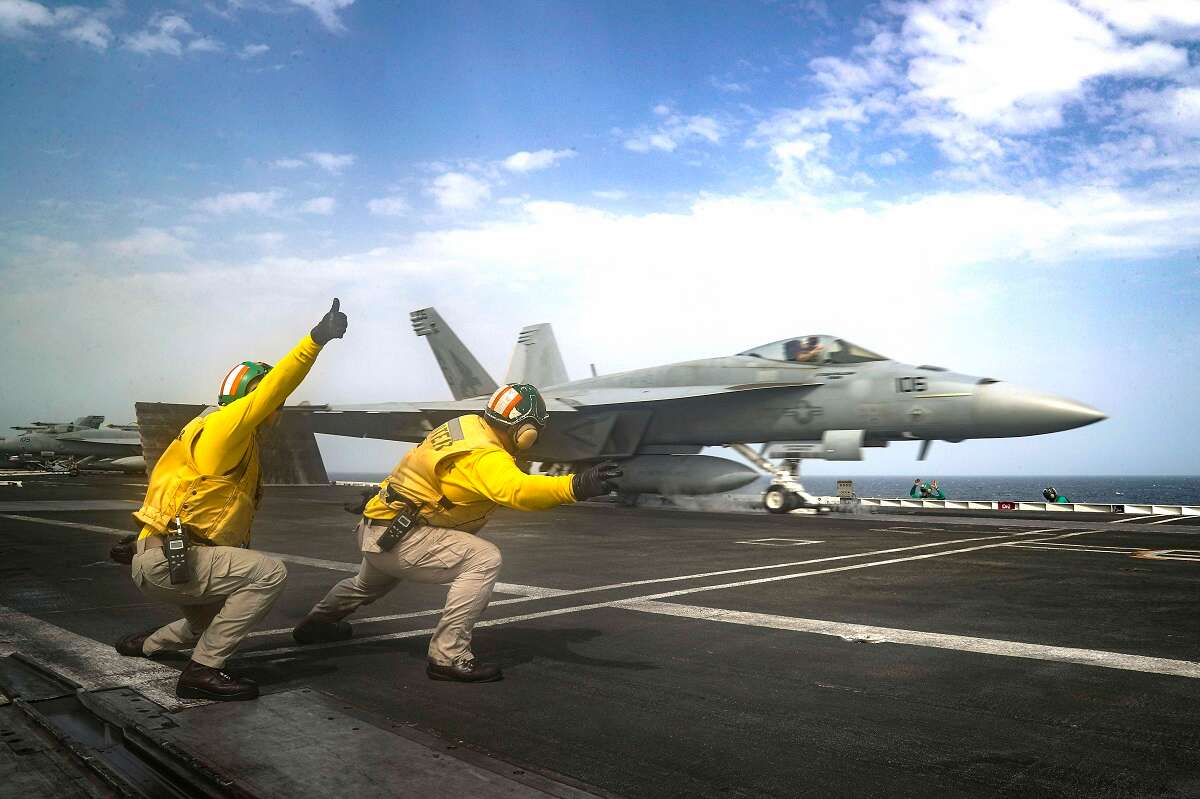
The carrier operates as part of a carrier strike group, a formation that includes escorting destroyers, an air wing and a helicopter squadron. In its current configuration, the Abraham Lincoln is accompanied by three destroyers in the Arabian Sea.
The strike group's airpower comes from the Abraham Lincoln's air wing, which includes more than 60 aircraft: naval variants of F-35 fighter jets and F/A-18 Super Hornets, EA-18 Growler electronic warfare aircraft, early warning planes, and reconnaissance and search-and-rescue helicopters.
Destroyers, Tomahawks and multi-layered defense
In addition to the three destroyers operating with and defending the Abraham Lincoln, four more destroyers are operating under Central Command's authority in the Middle East: one in the eastern Mediterranean (USS Roosevelt), one in the Red Sea (USS Delbert D. Black, which docked in Eilat on Friday), and two in the area of the Strait of Hormuz and the Persian Gulf (USS McFaul and USS Mitscher). In addition, three littoral combat ships are operating in the Persian Gulf: USS Canberra, USS Tulsa and USS Santa Barbara, all equipped with capabilities to neutralize naval mines.
All of the destroyers are Arleigh Burke-class vessels, the most common type in the US Navy. Each is capable of launching Tomahawk cruise missiles at targets up to 1,600 kilometers away, as well as defending itself and other ships and assets by intercepting threats such as drones and missiles, using advanced detection systems for deterrence and target tracking.
Despite the strength and superiority of the US naval force in the region, Iran has continued to issue threats against the vessels. Earlier this week, a billboard in central Tehran showed a destroyed US aircraft carrier, and throughout the week official Iranian media aired threatening footage. In December, the Revolutionary Guards held an exercise in the Gulf of Oman that included the launch of cruise missiles (Qader-110, Qader-380 and Ghadir) and a ballistic missile at mock targets, which they claimed were all hit "with high precision."
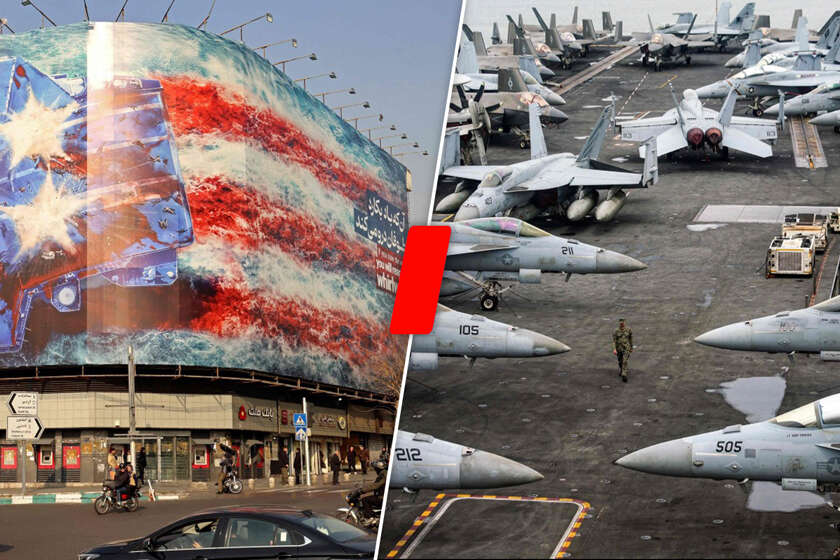
Any scenario in which an American aircraft carrier is struck would be a historic achievement for Iran. No US aircraft carrier has sunk in combat since World War II, 80 years ago. Even a hit that does not affect the ship's operational capability could serve as a significant propaganda asset. The question is how feasible such a strike really is.