Friday Dec 5, 2025
NEWSLETTER
www.israelhayom.com
  • Home
  • News
    • Israel
    • Israel at War
    • Middle East
    • United States
  • Opinions
  • Jewish World
    • Archaeology
    • Antisemitism
  • Lifestyle
    • Food
    • Travel
    • Fashion
    • Culture
  • Magazine
    • Feature
    • Analysis
    • Explainer
  • In Memoriam
www.israelhayom.com
  • Home
  • News
    • Israel
    • Israel at War
    • Middle East
    • United States
  • Opinions
  • Jewish World
    • Archaeology
    • Antisemitism
  • Lifestyle
    • Food
    • Travel
    • Fashion
    • Culture
  • Magazine
    • Feature
    • Analysis
    • Explainer
  • In Memoriam
www.israelhayom.com
Home Health & Wellness

Israeli AI solution beneficial to early detection of certain lung cancer, study finds

Research published in American Journal of Respiratory and Critical Care Medicine indicates model from Medial EarlySign is able to detect non-small cell lung cancer with 40.3% sensitivity and 95% specificity.

by  ILH Staff
Published on  05-28-2021 13:05
Last modified: 05-29-2021 16:59
Israeli AI solution beneficial to early detection of certain lung cancer, study findsGetty Images

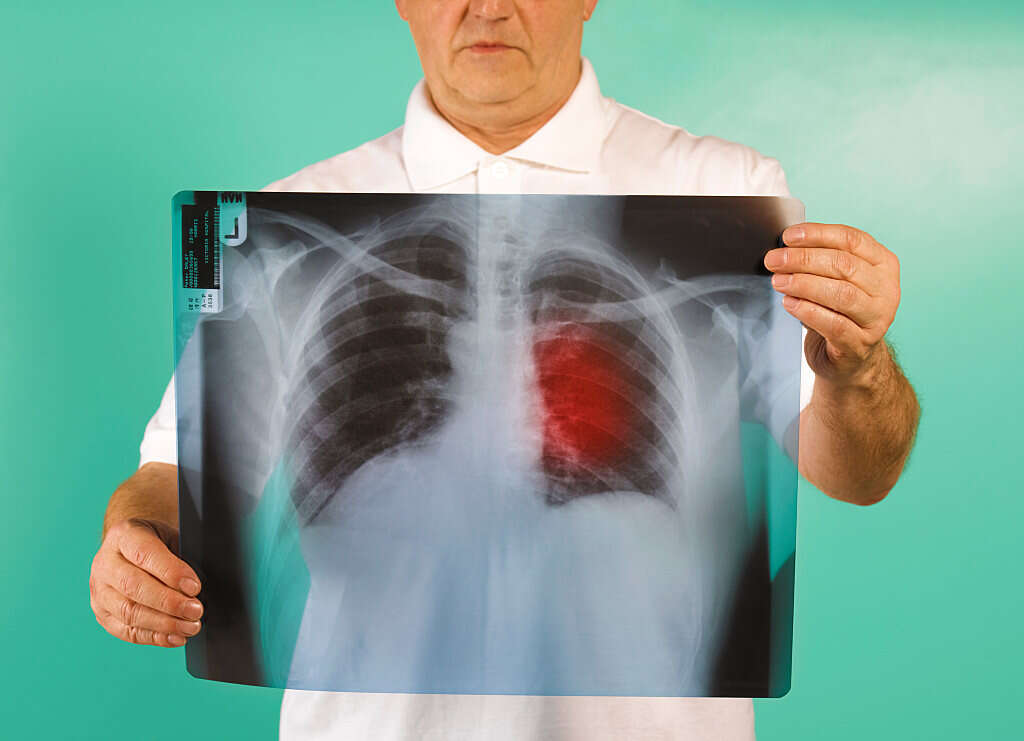
A man examines an X-ray showing the presence of lung cancer | File photo: Getty Images

Share on FacebookShare on Twitter

Israeli biotech firm Medial EarlySign, which develops artificial intelligence (AI)-based clinical data solutions for early detection and prevention of high-burden diseases, announced this week the publication of new research impacting the early diagnosis of non-small cell lung cancer (NSCLC).

Follow Israel Hayom on Facebook and Twitter

Together with researchers from Kaiser Permanente Southern California, the Department of Health Systems Science from Kaiser Permanente Bernard J. Tyson School of Medicine, and the Department of Health Sciences, Brock University, St. Catharines, ON, Canada, study authors found that EarlySign's machine-learning model was more accurate for early diagnosis of NSCLC than either standard eligibility criteria for screening or the modified PLCOm2012, demonstrating the potential to help prevent lung cancer deaths through early detection.

The peer-reviewed retrospective data study, "Machine Learning for Early Lung Cancer Identification Using Routine Clinical and Laboratory Data," was published in the American Journal of Respiratory and Critical Care Medicine.

The rationale for the study is that most lung cancers are diagnosed at an advanced stage, while pre-symptomatic identification of high-risk individuals can prompt earlier intervention and improve long-term outcomes. The objective was to develop a model to predict a future diagnosis of lung cancer based on routine clinical and laboratory data, using machine-learning.

Results of the study indicated that based on clinical characteristics and laboratory testing performed nine to 12 months before a clinical diagnosis of cancer, the EarlySign model was able to identify lung cancer with a sensitivity and specificity of 40.3% and 95%, respectively, with a positive test result indicating a 13-fold elevation in the odds of lung cancer. With further validation and refinement, this model has the potential to help prevent lung cancer deaths through earlier diagnosis.

"Lung cancer is the leading cancer killer of both men and women in the US with over 150,000 deaths expected each year," commented Michael K. Gould, MD, MS, and a professor of Health System Science from Kaiser Permanente Bernard J. Tyson School of Medicine.

"Earlier identification of high-risk individuals has the potential to improve lung cancer survival rates by finding the disease at a localized stage when it is more likely to be curable.  The machine learning models from EarlySign can help advance lung cancer identification by nine to twelve months which can lead to earlier diagnosis and treatment, when it matters the most," Gould said.

According to EarlySign VP of Clinical Research Eran Choman, "The recent pandemic has led to significant delay of diagnosis and treatment across the board, with delays in screening meaning that cancers may be more advanced and with more serious consequences."

Choman noted that "the collaborative efforts with the research team have been extraordinary in revealing how advanced AI predictive modeling can increase the predictive power of a model that could have a significant beneficial impact leading to additional early diagnosis and treatment of this serious disease."

Ori Geva, co-founder and CEO of EarlySign, said the company was "seeking to harness these results to further establish the value of this model to partner with providers, payers and life cciences and augment the identification of lung cancer and thus the treatment and better outcome for patients."

Subscribe to Israel Hayom's daily newsletter and never miss our top stories!

Tags: AIartificial intelligencecancerearly detectionlung cancer

Related Posts

Amazon's new product: A doctor's appointmentREUTERS/Dado Ruvic; Stockbyte/Getty Images;

Amazon's new product: A doctor's appointment

by Erez Linn

Amazon launches pay-per-visit pediatric telehealth service eliminating insurance barriers for families seeking immediate medical care for children's common conditions, with...

COVID is back – with brain fogGetty Images/iStockphoto/SB Arts Media

COVID is back – with brain fog

by Erez Linn

Stratus follows the Nimbus strain, which demonstrates high infectiousness and "razor blade" sore throat symptoms.

Researchers discover Israeli coronavirus variant, but risk lowGetty Images / fotomay

Doctors shocked after coronavirus infects patient for 2 years

by Erez Linn

This extended infection differs significantly from long COVID cases: Instead of post-viral symptoms, this patient continued experiencing the active infectious...

Menu

Analysis 

Archaeology

Blogpost

Business & Finance

Culture

Exclusive

Explainer

Environment


Features

Health

In Brief

Jewish World

Judea and Samaria

Lifestyle

Cyber & Internet

Sports


Diplomacy 

Iran & The Gulf

Gaza Strip

Politics

Shopping

Terms of use

Privacy Policy

Submissions

Contact Us

About Us

The first issue of Israel Hayom appeared on July 30, 2007. Israel Hayom was founded on the belief that the Israeli public deserves better, more balanced and more accurate journalism. Journalism that speaks, not shouts. Journalism of a different kind. And free of charge.

All rights reserved to Israel Hayom

Hosted by sPD.co.il

  • Home
  • News
    • Israel at War
    • Israel
    • United States
    • Middle East
    • Sports
  • Opinions
  • Jewish World
    • Archaeology
    • Antisemitism
  • Lifestyle
    • Food
    • Travel
    • Fashion
    • Culture
  • Magazine
    • Feature
    • Analysis
    • Explainer
    • Environment & Wildlife
    • Health & Wellness
  • In Memoriam
  • Subscribe to Newsletter
  • Submit your opinion
  • Terms and conditions

All rights reserved to Israel Hayom

Hosted by sPD.co.il

Newsletter

[contact-form-7 id=”508379″ html_id=”isrh_form_Newsletter_en” title=”newsletter_subscribe”]

  • Home
  • News
    • Israel at War
    • Israel
    • United States
    • Middle East
    • Sports
  • Opinions
  • Jewish World
    • Archaeology
    • Antisemitism
  • Lifestyle
    • Food
    • Travel
    • Fashion
    • Culture
  • Magazine
    • Feature
    • Analysis
    • Explainer
    • Environment & Wildlife
    • Health & Wellness
  • In Memoriam
  • Subscribe to Newsletter
  • Submit your opinion
  • Terms and conditions

All rights reserved to Israel Hayom

Hosted by sPD.co.il