Friday Dec 5, 2025
NEWSLETTER
www.israelhayom.com
  • Home
  • News
    • Israel
    • Israel at War
    • Middle East
    • United States
  • Opinions
  • Jewish World
    • Archaeology
    • Antisemitism
  • Lifestyle
    • Food
    • Travel
    • Fashion
    • Culture
  • Magazine
    • Feature
    • Analysis
    • Explainer
  • In Memoriam
www.israelhayom.com
  • Home
  • News
    • Israel
    • Israel at War
    • Middle East
    • United States
  • Opinions
  • Jewish World
    • Archaeology
    • Antisemitism
  • Lifestyle
    • Food
    • Travel
    • Fashion
    • Culture
  • Magazine
    • Feature
    • Analysis
    • Explainer
  • In Memoriam
www.israelhayom.com
Home Health & Wellness

How traumatizing are rocket attacks? Israeli researchers could have the answer

Ben-Gurion University of the Negev scientists worked with residents of southern Israel communities near the Gaza Strip, where frequent rocket fire requires them to find shelter in 30 seconds or less.

by  JNS and ILH Staff
Published on  06-23-2021 09:46
Last modified: 06-23-2021 11:38
How traumatizing are rocket attacks? Israeli researchers could have the answerDudu Grunshpan

Israelis caught outside during rocket fire on Beersheba on May 13, 2021, hit the ground | File photo: Dudu Grunshpan

Share on FacebookShare on Twitter

Researchers at Ben-Gurion University of the Negev have developed the first methodology to assess symptoms associated with continuous exposure to traumatic stress from rocket attacks and other security threats not currently measured by diagnostic criteria.

Follow Israel Hayom on Facebook and Twitter

Published in the journal PLOS ONE, the study identified three distinct factors: exhaustion/detachment, rage/betrayal and fear/helplessness.

"Exposure to ongoing life risk exists wherever people experience continuous terror, rampant crime and civil war," says lead researcher Dr. Aviva Goral, a graduate of the BGU School of Public Health, Faculty of Health Sciences, and a researcher at the PREPARED Center for Emergency Response Research (PREPARED).
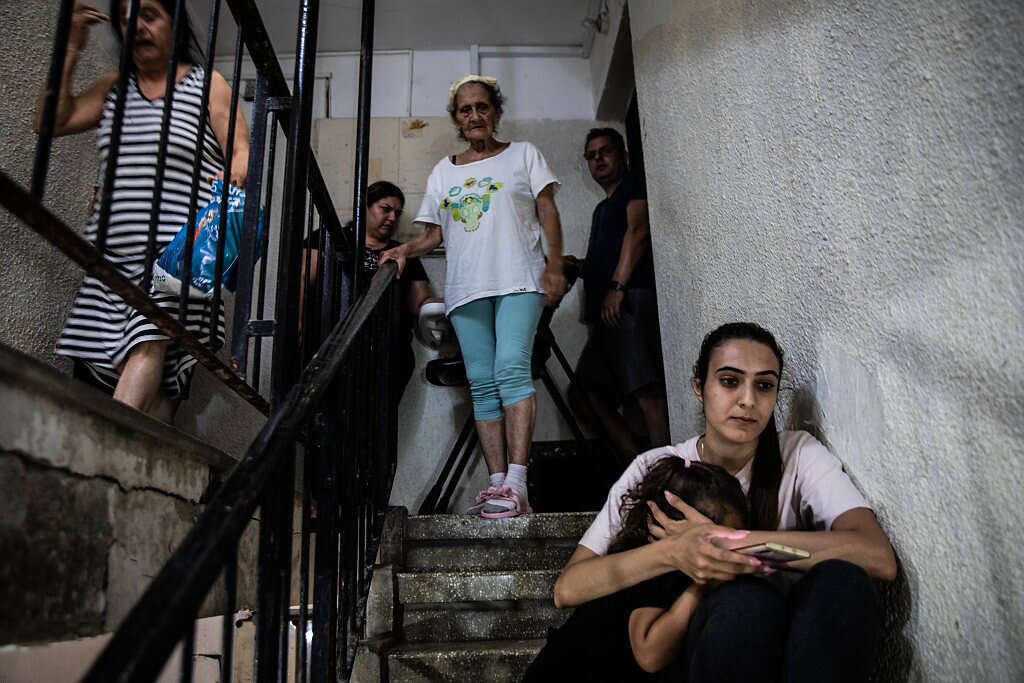
Residents of an apartment building in Ashdod seek shelter from incoming rocket fire from the Gaza Strip on May 18, 2021 (AP/Heidi Levine) AP/Heidi Levine

"Current scales assess the more commonly known effects of exposure to traumatic stress, mainly post-traumatic stress disorder (PTSD). This limits patient assessment and may lead to misdiagnoses and ineffective treatment," says Goral.

"The research was conducted to address this gap by developing a validated, comprehensive assessment tool, the Continuous Traumatic Stress Response (CTSR) Scale."

In the study, researchers sampled 313 adults who were and were not exposed to ongoing security threats between December 2016 and February 2017. Respondents lived in southern Israel communities bordering the Gaza Strip, where frequent rocket fire requires them to find shelter in 30 seconds or less. Researchers compared the concurrent validity of CTSR relative to the Post-traumatic Diagnostic Scale (PDS).

The findings indicated that the CTSR measures a construct related to, but distinct from PTSD; responses to ongoing exposure to threat are wider and more intensive than those associated with single traumatic exposure and may include cognitive, behavioral and emotional effects that are not part of traditional PTSD criteria.

Among CTSR criteria, a reduced sense of safety, distrust and mental exhaustion emerged with ongoing exposure to stressors. Other symptoms include social withdrawal, feelings of emptiness, hopelessness, estrangement and feelings of constantly being threatened.

"These findings imply that it is not exposure to ongoing threats per se, but rather the level of perceived threat (i.e., likelihood of injury or harm) that accounts for the difference in the prevalence and severity of CTSR stress symptoms," says Goral.

"Compared with distant communities, border-adjacent communities are much more vulnerable to rockets and tunnel infiltration, creating an atmosphere of tension and fear."

Professor Limor Aharonson-Daniel, head of PREPARED and Goral's Ph.D. supervisor, notes that "further studies are being conducted with larger samples and in broader populations around the Gaza Envelope. Future research will include international implementation in various languages and with other populations exposed to ongoing conflict or persistent civil war (e.g., Syria). This cross-cultural research will help identify the similarities and differences between conflict zones and cultures and facilitate the generalization of the CTSR scale."

"This study, and the diagnostic tool it yields, could benefit Israel and people around the world who suffer from continuous trauma and related symptoms," says Doug Seserman, chief executive officer of Americans for Ben-Gurion University.

"We look forward to seeing new research and development from BGU that continues to build off of this work," Seserman adds.

Reprinted with permission from JNS.org

Subscribe to Israel Hayom's daily newsletter and never miss our top stories!

Tags: civilian casualtiesGaza StripHamasPTSDrocket firerocketsterroriststrauma

Related Posts

Amazon's new product: A doctor's appointmentREUTERS/Dado Ruvic; Stockbyte/Getty Images;

Amazon's new product: A doctor's appointment

by Erez Linn

Amazon launches pay-per-visit pediatric telehealth service eliminating insurance barriers for families seeking immediate medical care for children's common conditions, with...

COVID is back – with brain fogGetty Images/iStockphoto/SB Arts Media

COVID is back – with brain fog

by Erez Linn

Stratus follows the Nimbus strain, which demonstrates high infectiousness and "razor blade" sore throat symptoms.

Researchers discover Israeli coronavirus variant, but risk lowGetty Images / fotomay

Doctors shocked after coronavirus infects patient for 2 years

by Erez Linn

This extended infection differs significantly from long COVID cases: Instead of post-viral symptoms, this patient continued experiencing the active infectious...

Menu

Analysis 

Archaeology

Blogpost

Business & Finance

Culture

Exclusive

Explainer

Environment


Features

Health

In Brief

Jewish World

Judea and Samaria

Lifestyle

Cyber & Internet

Sports


Diplomacy 

Iran & The Gulf

Gaza Strip

Politics

Shopping

Terms of use

Privacy Policy

Submissions

Contact Us

About Us

The first issue of Israel Hayom appeared on July 30, 2007. Israel Hayom was founded on the belief that the Israeli public deserves better, more balanced and more accurate journalism. Journalism that speaks, not shouts. Journalism of a different kind. And free of charge.

All rights reserved to Israel Hayom

Hosted by sPD.co.il

  • Home
  • News
    • Israel at War
    • Israel
    • United States
    • Middle East
    • Sports
  • Opinions
  • Jewish World
    • Archaeology
    • Antisemitism
  • Lifestyle
    • Food
    • Travel
    • Fashion
    • Culture
  • Magazine
    • Feature
    • Analysis
    • Explainer
    • Environment & Wildlife
    • Health & Wellness
  • In Memoriam
  • Subscribe to Newsletter
  • Submit your opinion
  • Terms and conditions

All rights reserved to Israel Hayom

Hosted by sPD.co.il

Newsletter

[contact-form-7 id=”508379″ html_id=”isrh_form_Newsletter_en” title=”newsletter_subscribe”]

  • Home
  • News
    • Israel at War
    • Israel
    • United States
    • Middle East
    • Sports
  • Opinions
  • Jewish World
    • Archaeology
    • Antisemitism
  • Lifestyle
    • Food
    • Travel
    • Fashion
    • Culture
  • Magazine
    • Feature
    • Analysis
    • Explainer
    • Environment & Wildlife
    • Health & Wellness
  • In Memoriam
  • Subscribe to Newsletter
  • Submit your opinion
  • Terms and conditions

All rights reserved to Israel Hayom

Hosted by sPD.co.il