Saturday Dec 13, 2025
NEWSLETTER
www.israelhayom.com
  • Home
  • News
    • Israel
    • Israel at War
    • Middle East
    • United States
  • Opinions
  • Jewish World
    • Archaeology
    • Antisemitism
  • Lifestyle
    • Food
    • Travel
    • Fashion
    • Culture
  • Magazine
    • Feature
    • Analysis
    • Explainer
  • In Memoriam
www.israelhayom.com
  • Home
  • News
    • Israel
    • Israel at War
    • Middle East
    • United States
  • Opinions
  • Jewish World
    • Archaeology
    • Antisemitism
  • Lifestyle
    • Food
    • Travel
    • Fashion
    • Culture
  • Magazine
    • Feature
    • Analysis
    • Explainer
  • In Memoriam
www.israelhayom.com
Home News World News

Rabbis troubled by pope's remarks questioning Torah's validity

Rabbi Rasson Arousi, chair of the Commission of the Chief Rabbinate of Israel for Dialogue with the Holy See, says comments on the Torah by Pope Francis appear to suggest Jewish law was obsolete.

by  Reuters and ILH Staff
Published on  08-26-2021 08:57
Last modified: 08-26-2021 08:57
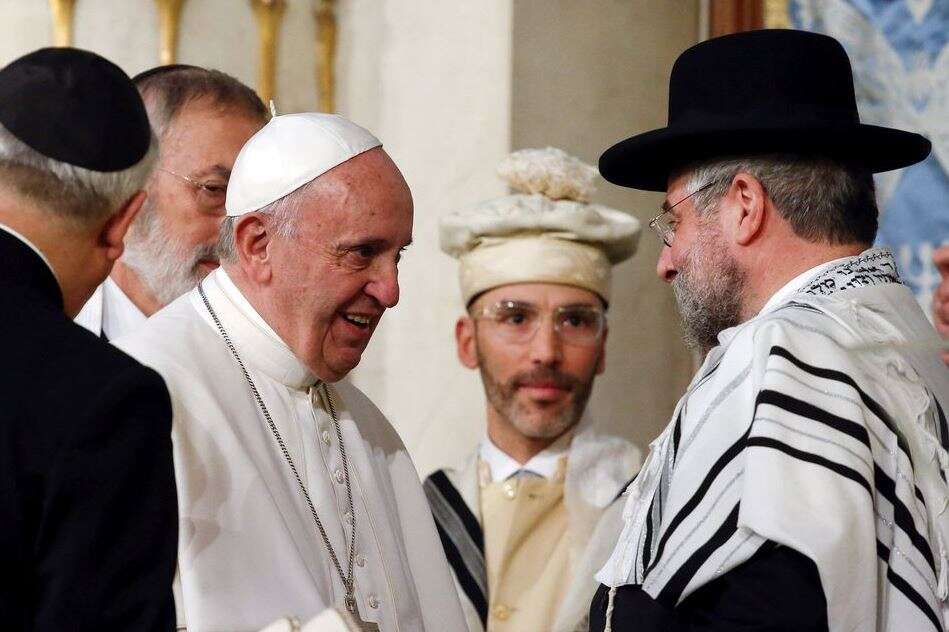
Rabbis troubled by pope's remarks questioning Torah's validityReuters/Alessandro Bianchi

Pope Francis is greeted as he arrives at Rome's Great Synagogue, Jan. 17, 2016 | File photo: Reuters/Alessandro Bianchi

Share on FacebookShare on Twitter

Israel's top Jewish religious authorities have told the Vatican they are concerned about comments that Pope Francis made about their books of sacred law and have asked for a clarification.

Follow Israel Hayom on Facebook and Twitter 

In a letter sent to the pontiff, Rabbi Rasson Arousi, chair of the Commission of the Chief Rabbinate of Israel for Dialogue with the Holy See, said the comments appeared to suggest Jewish law was obsolete.

Vatican authorities said they were studying the letter and were considering a response.

Arousi wrote the letter a day after the pope spoke about the Torah, the first five books of the Hebrew Bible, during a general audience on Aug. 11.

The Torah contains hundreds of commandments, or mitzvot, for Jews to follow in their everyday lives. The measure of adherence to the wide array of guidelines differs between Orthodox Jews and Reform Jews.

At the audience, the pope, who was reflecting on what St. Paul said about the Torah in the New Testament, said: "The law (Torah) however does not give life.

"It does not offer the fulfillment of the promise because it is not capable of being able to fulfill it ... Those who seek life need to look to the promise and to its fulfillment in Christ."

Arousi sent the letter on behalf of the Chief Rabbinate – the supreme rabbinic authority for Judaism in Israel – to Cardinal Kurt Koch, whose Vatican department includes a commission for religious relations with Jews.

"In his homily, the pope presents the Christian faith as not just superseding the Torah; but asserts that the latter no longer gives life, implying that Jewish religious practice in the present era is rendered obsolete," Arousi said in the letter.

"This is in effect part and parcel of the 'teaching of contempt' towards Jews and Judaism that we had thought had been fully repudiated by the Church," he said.

Relations between Catholics and Jews were revolutionized in 1965, when the Second Vatican Council repudiated the concept of collective Jewish guilt for the death of Jesus and began decades of inter-religious dialogue. Francis and his two predecessors visited synagogues.

Two leading Catholic scholars of religious relations with Jews agreed that the pope's remarks could be seen as a troublesome setback and needed clarification.

"To say that this fundamental tenet of Judaism does not give life is to denigrate the basic religious outlook of Jews and Judaism. It could have been written before the Council," said Father John Pawlikowski, former director of the Catholic-Jewish Studies Program at the Catholic Theological Union in Chicago.

"I think it's a problem for Jewish ears, especially because the pope's remarks were addressed to a Catholic audience," said Professor Philip Cunningham, director of the Institute for Jewish-Catholic Relations at St. Joseph's University in Philadelphia.

"It could be understood as devaluing Jewish observance of the Torah today," Cunningham said.

Arousi and Pawlikowski said it was possible that at least part of the pope's teaching homily, known as a catechesis, was written by aides and that the phrase was not properly vetted.

Koch's office said on Wednesday he had received the letter, was "considering it seriously and reflecting on a response".

Francis has had a very good relationship with Jews. While still archbishop in native Buenos Aires, he co-wrote a book with one of the city's rabbis, Abraham Skorka, and has maintained a lasting friendship with him.

In his letter to Cardinal Koch, Arousi asked him to "convey our distress to Pope Francis" and asked for a clarification from the pope to "ensure that any derogatory conclusions drawn from this homily are clearly repudiated."

Subscribe to Israel Hayom's daily newsletter and never miss our top stories!

Related Posts

Rubio bans 'woke' font after Biden's Calibri revolutionOren Ben Hakoon

Rubio bans 'woke' font after Biden's Calibri revolution

by Erez Linn

Rubio orders return to serif font Times New Roman for official papers, citing need for formalism.

Hoboken mayor sparks outrage by raising Palestinian flag on First Intifada anniversary

Hoboken mayor sparks outrage by raising Palestinian flag on First Intifada anniversary

by Or Shaked

Outgoing mayor raised flag without consulting city council, drawing swift condemnation from incoming mayor and Jewish community in New Jersey...

Mamdani, Louvre among 2025's most mispronounced wordsAP/Heather Khalifa

Mamdani, Louvre among 2025's most mispronounced words

by ILH Staff

The catalog features terms that news broadcasters, political officials, and prominent individuals struggled to articulate correctly throughout the year.

Menu

Analysis 

Archaeology

Blogpost

Business & Finance

Culture

Exclusive

Explainer

Environment


Features

Health

In Brief

Jewish World

Judea and Samaria

Lifestyle

Cyber & Internet

Sports


Diplomacy 

Iran & The Gulf

Gaza Strip

Politics

Shopping

Terms of use

Privacy Policy

Submissions

Contact Us

About Us

The first issue of Israel Hayom appeared on July 30, 2007. Israel Hayom was founded on the belief that the Israeli public deserves better, more balanced and more accurate journalism. Journalism that speaks, not shouts. Journalism of a different kind. And free of charge.

All rights reserved to Israel Hayom

Hosted by sPD.co.il

  • Home
  • News
    • Israel at War
    • Israel
    • United States
    • Middle East
    • Sports
  • Opinions
  • Jewish World
    • Archaeology
    • Antisemitism
  • Lifestyle
    • Food
    • Travel
    • Fashion
    • Culture
  • Magazine
    • Feature
    • Analysis
    • Explainer
    • Environment & Wildlife
    • Health & Wellness
  • In Memoriam
  • Subscribe to Newsletter
  • Submit your opinion
  • Terms and conditions

All rights reserved to Israel Hayom

Hosted by sPD.co.il

Newsletter

[contact-form-7 id=”508379″ html_id=”isrh_form_Newsletter_en” title=”newsletter_subscribe”]

  • Home
  • News
    • Israel at War
    • Israel
    • United States
    • Middle East
    • Sports
  • Opinions
  • Jewish World
    • Archaeology
    • Antisemitism
  • Lifestyle
    • Food
    • Travel
    • Fashion
    • Culture
  • Magazine
    • Feature
    • Analysis
    • Explainer
    • Environment & Wildlife
    • Health & Wellness
  • In Memoriam
  • Subscribe to Newsletter
  • Submit your opinion
  • Terms and conditions

All rights reserved to Israel Hayom

Hosted by sPD.co.il