

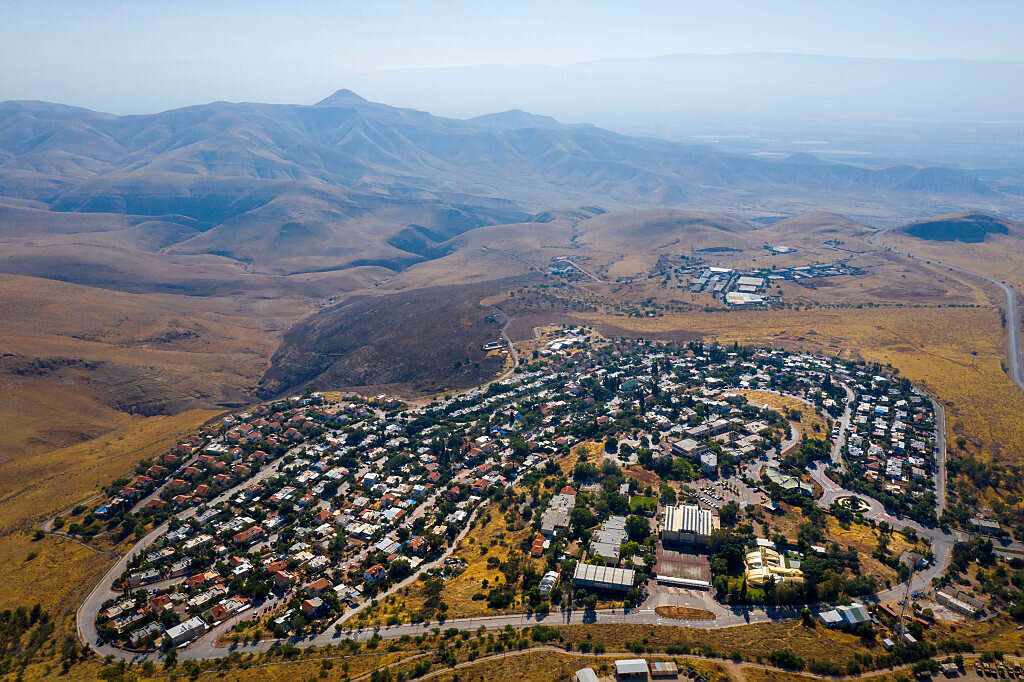
Surprising data on the public's perception of Israeli communities in Judea and Samaria has emerged from a survey commissioned by the Israel Defense and Security Forum (IDSF), published on the occasion of the Israel Security Conference, to be held on Tuesday, May 9, in Jerusalem, as a joint venture of Israel Hayom and the IDSF.
Follow Israel Hayom on Facebook, Twitter, and Instagram
The survey, which was conducted among a representative sample of 1,191 citizens, revealed that 70% of the Jewish public feel a historical connection to Judea and Samaria, 63% an emotional connection, and 48% a religious connection. In contrast, only 37% of Israeli Arabs feel a historical connection to the West Bank, while 33% and 32%, respectively, feel a historical and religious affinity to it. At the same time, 90% of right-wing voters answered that they have a historical affinity towards Judea and Samaria, and 46% of the center party voters answered the same. Among the supporters of the left-wing parties, 27% of those sampled agreed that they have a historical affiliation with the disputed region.
The security conference will be held on Tuesday in the presence of Prime Minister Benjamin Netanyahu, Defense Minister Yoav Galant, Police Commissioner Yaakov Shabtai, along with other ministers and members of Knesset. The conference will host about 300 senior members of the IDSF, leading government officials and politicians, senior functions from the defense establishment as well as heads of different organizations, and the event will also be open to the general public. The conference participants are expected to discuss the Iranian issue, the Abraham Accords, relations with the Palestinians, the challenges to governance, personal security, and along with other issues too.
It's all a question of Left or Right
It is clear that many Israelis tend to shy away from visiting the Jewish communities in Judea and Samaria, either for security reasons or due to technical considerations. 80% of the Israelis in the survey responded that traveling along the roads in Judea and Samaria is dangerous. However, only 9% admitted to visiting there on a weekly basis over the course of the last three years. 20% of the survey respondents had not even paid one visit to Judea & Samaria in the last three years.
It appears that a person's family circle is a key factor influencing whether or not that individual visits this area. 48% of right-wing respondents visit Judea & Samaria to meet family compared with only 20% of those identified with the left. The surveyors examined why the public comes to Judea & Samaria and discovered that the most popular reason is for visiting family (42%), historical sites (36%), taking part in hikes (31%), work and business (28%) and both military and security-related service (27%).
The historical sites of Jewish heritage in Judea & Samaria are a popular attraction for visitors. Some 47% admitted to having visited the Cave of Machpelah in Hebron and 37% have visited Rachel's Tomb at the entrance to Bethlehem. 27% have visited the Prophet Samuel's Tomb and 25% have been to the site of Ancient Shiloh, Israel's spiritual center in the time of the Judges. 12% of those taking part in the survey had visited Joseph's Tomb in Nablus, a site that can only be reached by bullet-proof bus and with a sizable military escort.
The Israelis do not take part in the boycott
In relation to the calls for boycotting products from Judea and Samaria, the survey found that 4% of Jews completely avoid purchasing products produced there, while in contrast, 71% have no problem purchasing such products. Some 37% of the survey respondents even said they prefer to purchase products produced in this region.
Among Israeli Arabs, 19% completely avoid buying the produce of Judea and Samaria, while 53% see no problem in purchasing such products, of whom 21% even actually prefer to buy products made in Judea and Samaria. A figure of 41% of those individuals who identify as being left-wing endeavor to avoid purchasing products manufactured in Judea & Samaria or avoid it completely, compared with 32% of Israeli Arabs who provided a similar response.
As far as living in Judea and Samaria is concerned, 47% of the Jewish survey respondents answered that they would consider moving there. However, 8% of them said that they would only do so if this involved a move to communities on the Israeli side of the security fence, and 12% stipulated a condition of moving to settlements or large cities.
Those who responded in the negative (43%) were asked whether the application of sovereignty over Judea and Samaria would change their mind, and roughly one third of them (29%) replied that in such an eventuality, they would change their mind or possibly reconsider it. Similarly, 66% of the Jewish population in Israel believe that the land reserves in Judea and Samaria could provide the solution to the current housing crisis.
"Potential solution to the housing crisis"
"The survey points to two key findings," says the founder and chairman of the IDSF, Brigadier General (Res.) Amir Avivi. "First, the majority of the Israeli public today has a special and deep connection to Judea and Samaria. Secondly, today it is impossible to separate the Israeli public from Judea and Samaria, as there is a deep bond that ties between them economically, geographically, and socially. This is true for both the Jewish public and the Israeli Arabs."
"In addition, the majority of the Jewish population regards Judea & Samaria as a potential solution to the housing crisis, with a high degree of willingness to move there."
Subscribe to Israel Hayom's daily newsletter and never miss our top stories!


