Thursday Dec 4, 2025
NEWSLETTER
www.israelhayom.com
  • Home
  • News
    • Israel
    • Israel at War
    • Middle East
    • United States
  • Opinions
  • Jewish World
    • Archaeology
    • Antisemitism
  • Lifestyle
    • Food
    • Travel
    • Fashion
    • Culture
  • Magazine
    • Feature
    • Analysis
    • Explainer
  • In Memoriam
www.israelhayom.com
  • Home
  • News
    • Israel
    • Israel at War
    • Middle East
    • United States
  • Opinions
  • Jewish World
    • Archaeology
    • Antisemitism
  • Lifestyle
    • Food
    • Travel
    • Fashion
    • Culture
  • Magazine
    • Feature
    • Analysis
    • Explainer
  • In Memoriam
www.israelhayom.com
Home Commentary

Israel must ensure regional de-escalation efforts don't lead to nuclear concessions

Israel must ascertain what concessions Iran seeks from the US, especially on an issue so crucial to its future.

by  Meir Ben Shabbat
Published on  08-30-2024 10:18
Last modified: 03-21-2025 10:28
Israel must ensure regional de-escalation efforts don't lead to nuclear concessions

Iran's Supreme Leader Ayatollah Ali Khamenei addressing an audience from Kerman and Khuzestan in Tehran on December 23, 2023 (Photo: AFP)

Share on FacebookShare on Twitter

"Diplomacy complements the field, and the field complements diplomacy. Together, we will move forward in such a way that the country's national interests, complete security, and national dignity are fully realized.," summarized Abbas Araghchi, Iran's new Foreign Minister, encapsulating Tehran's approach to the conflict with Israel and Middle East developments.

In a series of interviews this week, Araghchi reiterated Iran's commitment to supporting all "resistance" groups. Like other regime spokespersons, he vowed that the "Zionist terrorist action" resulting in Haniyeh's death would not go unanswered.

The anxious anticipation of Iran's response is taking a toll on Israel psychologically, socially, and economically – a price Iranian officials claim is intentional. Some analysts justified the delay, citing the need to complete investigations into the intelligence breach that enabled the assassination in Tehran, allow for Gaza ceasefire negotiations, and meticulously prepare operational plans to achieve precisely the desired effect – no more, no less.

Amid this turmoil, diplomatic exchanges between Doha and Tehran persisted. Mohammed Al Thani, Qatar's Prime Minister and Foreign Minister, made an unusual visit to the Iranian capital, meeting with President Masoud Pezeshkian and Foreign Minister Araghchi. Media reports offer little insight into their discussions about "regional arrangement." Particularly unclear are the concessions Iran seeks from the Americans, beyond the credit it's already partially receiving for linking its response against Israel to Gaza ceasefire talks.
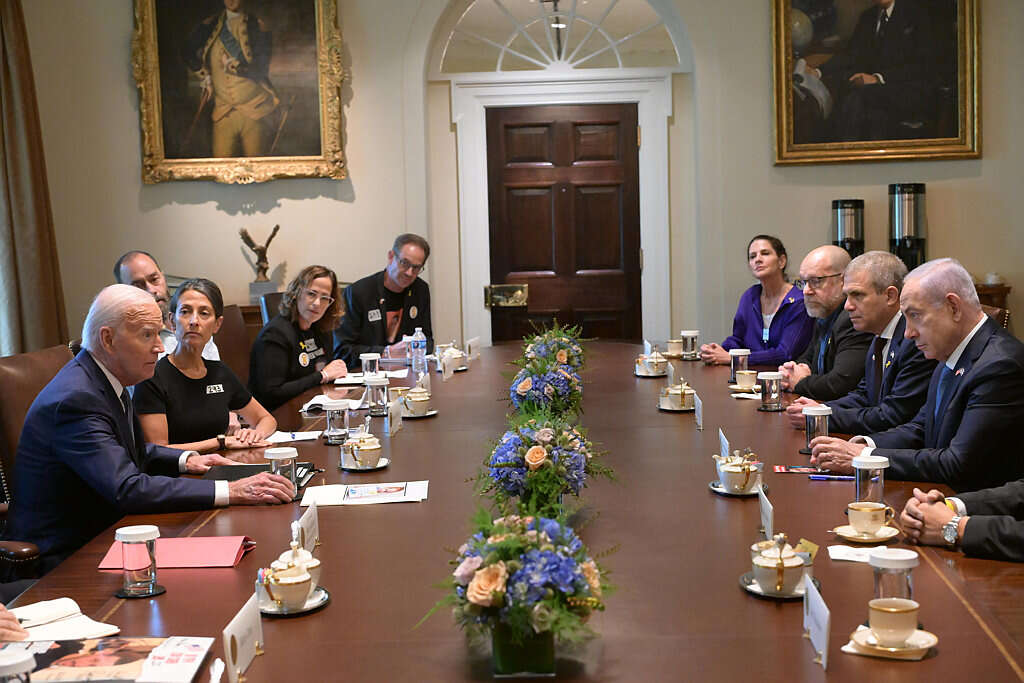
US President Joe Biden meeting with Israeli Prime Minister Benjamin Netanyahu and families of Israeli hostages held in Gaza, July 25 , 2024. Photo credit: GPO/Amos Ben Gershom

While information is scarce, indications suggest that returning the Iranian nuclear issue to the negotiating table is being considered. Statements by Iran's Supreme Leader Ali Khamenei on the possibility of interacting with the enemy were interpreted as a signal of willingness to renew negotiations with the US on the nuclear issue. Choosing Pezeshkian and Araghchi for these key positions further signals this shift in approach. Iran seeks an agreement that would ease sanctions and improve its economic situation. For its part, the Biden administration seeks to prevent a regional war, which could complicate matters ahead of the elections, and attempts to derive political and diplomatic gains from the regional situation.

A State Department spokesperson said this week: "We will judge Iran on their actions, not words. If Iran wants to demonstrate seriousness or a new approach, they should stop nuclear escalations and start meaningfully cooperating with the IAEA." We should welcome this stance, hoping it is not just an opening move in negotiations. To some extent, it forms part of the undeclared talks. The subsequent threats by Iranian spokespersons, reiterating their commitment to respond to Israel, should be seen not only as an expression of true intentions and an attempt to preserve national dignity but also as part of indirect negotiation tactics with the US. Naturally, Israel must prepare for all response scenarios without making lenient assumptions.

Israel cannot afford to be caught off guard by talks – if indeed they are taking place – on an issue so crucial to its future. Now is the time to examine these matters through direct dialogue with US administration officials and formulate its position accordingly. Iran, too, recognizes the urgency from elements in the Biden administration to achieve a diplomatic breakthrough. We must not pay an unbearable price for this.

Meir Ben Shabbat is head of the Misgav Institute for National Security & Zionist Strategy, in Jerusalem. He served as Israel's national security advisor and head of the National Security Council between 2017 and 2021, and prior to that for 30 years in the General Security Service (the Shin Bet security agency or "Shabak").

Tags: Gaza WarIranUnited States

Related Posts

Netanyahu is gambling with Israel's security

Netanyahu is gambling with Israel's security

by Yoav Limor

Prime Minister Benjamin Netanyahu has named Roman Gofman as director of the Mossad, despite Gofman having no background in intelligence...

Netanyahu's Washington visit comes with a hard decisionChip Somodevilla / POOL / AFPף EPA/WILL OLIVERף Stephanie Lecocq/Pool via AP

Netanyahu's Washington visit comes with a hard decision

by Danny Zaken

While the US is set to request curbs on IDF operations, officials acknowledge that no comprehensive Middle East arrangement is...

Netanyahu spoke with Qatari prime minister, apologizes for Doha strikeAP

The real meaning behind Netanyahu's White House invitation

by Danny Zaken

Prime Minister Benjamin Netanyahu is expected to travel to Washington in the coming weeks to meet President Donald Trump. On...

Menu

Analysis 

Archaeology

Blogpost

Business & Finance

Culture

Exclusive

Explainer

Environment


Features

Health

In Brief

Jewish World

Judea and Samaria

Lifestyle

Cyber & Internet

Sports


Diplomacy 

Iran & The Gulf

Gaza Strip

Politics

Shopping

Terms of use

Privacy Policy

Submissions

Contact Us

About Us

The first issue of Israel Hayom appeared on July 30, 2007. Israel Hayom was founded on the belief that the Israeli public deserves better, more balanced and more accurate journalism. Journalism that speaks, not shouts. Journalism of a different kind. And free of charge.

All rights reserved to Israel Hayom

Hosted by sPD.co.il

  • Home
  • News
    • Israel at War
    • Israel
    • United States
    • Middle East
    • Sports
  • Opinions
  • Jewish World
    • Archaeology
    • Antisemitism
  • Lifestyle
    • Food
    • Travel
    • Fashion
    • Culture
  • Magazine
    • Feature
    • Analysis
    • Explainer
    • Environment & Wildlife
    • Health & Wellness
  • In Memoriam
  • Subscribe to Newsletter
  • Submit your opinion
  • Terms and conditions

All rights reserved to Israel Hayom

Hosted by sPD.co.il

Newsletter

[contact-form-7 id=”508379″ html_id=”isrh_form_Newsletter_en” title=”newsletter_subscribe”]

  • Home
  • News
    • Israel at War
    • Israel
    • United States
    • Middle East
    • Sports
  • Opinions
  • Jewish World
    • Archaeology
    • Antisemitism
  • Lifestyle
    • Food
    • Travel
    • Fashion
    • Culture
  • Magazine
    • Feature
    • Analysis
    • Explainer
    • Environment & Wildlife
    • Health & Wellness
  • In Memoriam
  • Subscribe to Newsletter
  • Submit your opinion
  • Terms and conditions

All rights reserved to Israel Hayom

Hosted by sPD.co.il