Friday Dec 5, 2025
NEWSLETTER
www.israelhayom.com
  • Home
  • News
    • Israel
    • Israel at War
    • Middle East
    • United States
  • Opinions
  • Jewish World
    • Archaeology
    • Antisemitism
  • Lifestyle
    • Food
    • Travel
    • Fashion
    • Culture
  • Magazine
    • Feature
    • Analysis
    • Explainer
  • In Memoriam
www.israelhayom.com
  • Home
  • News
    • Israel
    • Israel at War
    • Middle East
    • United States
  • Opinions
  • Jewish World
    • Archaeology
    • Antisemitism
  • Lifestyle
    • Food
    • Travel
    • Fashion
    • Culture
  • Magazine
    • Feature
    • Analysis
    • Explainer
  • In Memoriam
www.israelhayom.com
Home News Israel at War Lebanon War

Killing of Nasrallah reshapes Middle East 

Analysts say this could leave Israel feeling less threatened and put pressure on Iran to decide whether to respond directly.

by  Miri Weissman
Published on  09-29-2024 04:30
Last modified: 09-29-2024 13:11
Killing of Nasrallah reshapes Middle East EPA/Wael Hamzeh

Portraits of Hezbollah leader Hassan Nasrallah are hung on a building in the southern suburbs of Beirut, one day after the announcement of his death, Beirut, Lebanon, 29 September 2024 | Photo: EPA/Wael Hamzeh

Share on FacebookShare on Twitter

The death of Hassan Nasrallah, the longtime leader of Hezbollah, in an Israeli airstrike has pushed the conflict in the Middle East into uncharted territory, according to reporting by The New York Times. Hezbollah confirmed Nasrallah's death on Saturday after Israeli bombs destroyed three apartment buildings in Beirut that were shielding what Israel said were Hezbollah's underground headquarters.

The killing of Nasrallah represents a significant escalation of Israel's campaign against Iran-backed forces in the region. Iran has long relied on proxy groups like Hamas in Gaza, Hezbollah in Lebanon, and the Houthis in Yemen to serve as the front line in its conflict with Israel.

However, the death of Nasrallah deals a major blow to Hezbollah, one of Iran's most important military assets in the region. Analysts say this could leave Israel feeling less threatened and put pressure on Iran to decide whether to respond directly.

It is by now safe to say that October 7th was the greatest miscalculation since Hitler's invasion of the Soviet Union. Oct 7th was the beginning of the fall of Iran's proxies, which they invested billions in. They thought Israel would take the hit, bomb a few sites, and call it a…

— AP (@AP_from_NY) September 29, 2024

So far, Iran's leaders have fiercely condemned the attack but have not taken any retaliatory steps. They also did not respond militarily to Israel's killing of Hamas leader Ismail Haniyeh in Tehran last month. Some experts interpret this restraint as a sign that Iran wants to avoid direct confrontation with Israel. Iran's supreme leader, Ayatollah Ali Khamenei, released a statement on Saturday saying, "All the resistance forces in the region stand with and support Hezbollah."
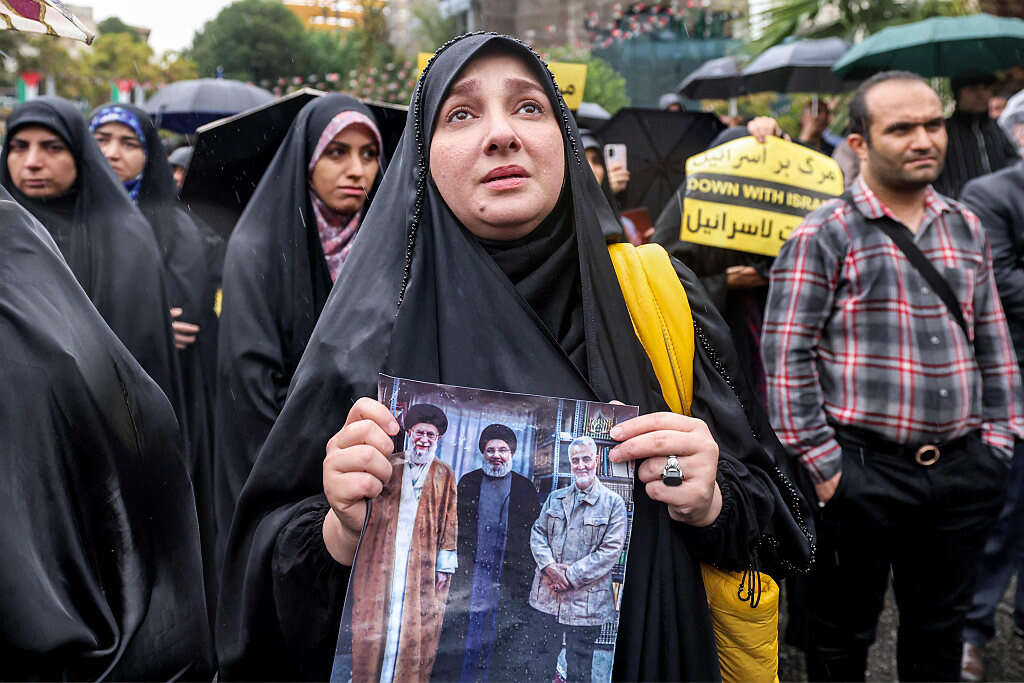
A demonstrator stands in the rain holding a picture depicting (L to R) Iran's Supreme Leader Ali Khamenei; late Lebanese Hezbollah leader Hassan Nasrallah, who was killed by an Israeli air strike on September 27, 2024; and Iran's Islamic Revolutionary Guard Corps (IRGC) Quds Force commander Qasem Soleimani who was killed by a US drone strike in January 2020; during an anti-Israel protest in Tehran's Palestine Square on September 28, 2024 (Photo: Atta Kenare / AFP) AFP

The strike has cast doubt on the future of ceasefire negotiations between Israel and Hezbollah. Up until the day of the bombing, the Biden administration and other mediators had been attempting to broker a diplomatic agreement to resolve the 11-month battle between the two sides, with little success.

The attack appeared to bolster Israeli Prime Minister Benjamin Netanyahu, who gave a defiant speech at the United Nations on Friday declaring "we are winning" just before the bombs began falling in Beirut. This came despite growing international calls for a ceasefire.

On Saturday, in his first remarks since Nasrallah's killing, Netanyahu said Israel had "settled the score" with the man responsible for killing "countless Israelis and many citizens of other countries." He added that Nasrallah "was not just a terrorist. He was the terrorist."

US President Joe Biden said the killing of Nasrallah "is a measure of justice for his many victims," including Americans. Still, he again called for a diplomatic agreement to end the fighting.

The New York Times reported that Israeli leaders had been aware of Nasrallah's location for months but decided to strike after learning he would soon move. Over 80 bombs were dropped in several minutes during the operation, according to Israeli officials. Lebanon's Health Ministry said at least 11 people were killed and more than 100 injured, with the toll expected to rise.
Tags: Benjamin NetanyahuGaza WarHamasHassan NasrallahHezbollahIranJoe BidenLebanon

Related Posts

Israel-Lebanon agreement may turn into strategic trap

In first ever civilian talks, Israel and Lebanon confront Hezbollah's grip

by Danny Zaken

Civilian representatives from Israel and Lebanon met for the first time in US-mediated discussions aimed at advancing economic cooperation. The...

Israel, Lebanon launch non-military economic talksAFP; AP Photo/Bilal Hussein; Gideon Markowicz;

Israel, Lebanon launch non-military economic talks

by ILH Staff

Netanyahu instructs envoy to meet Lebanese governmental-economic officials in rare move. This marks a first attempt to establish a foundation...

Trump sets disarmament deadline for HezbollahArab media

Trump sets disarmament deadline for Hezbollah

by Ariel Kahana

Diplomatic sources reveal the Trump administration has set a deadline for Lebanon to disarm Hezbollah, warning that failure to act...

Menu

Analysis 

Archaeology

Blogpost

Business & Finance

Culture

Exclusive

Explainer

Environment


Features

Health

In Brief

Jewish World

Judea and Samaria

Lifestyle

Cyber & Internet

Sports


Diplomacy 

Iran & The Gulf

Gaza Strip

Politics

Shopping

Terms of use

Privacy Policy

Submissions

Contact Us

About Us

The first issue of Israel Hayom appeared on July 30, 2007. Israel Hayom was founded on the belief that the Israeli public deserves better, more balanced and more accurate journalism. Journalism that speaks, not shouts. Journalism of a different kind. And free of charge.

All rights reserved to Israel Hayom

Hosted by sPD.co.il

  • Home
  • News
    • Israel at War
    • Israel
    • United States
    • Middle East
    • Sports
  • Opinions
  • Jewish World
    • Archaeology
    • Antisemitism
  • Lifestyle
    • Food
    • Travel
    • Fashion
    • Culture
  • Magazine
    • Feature
    • Analysis
    • Explainer
    • Environment & Wildlife
    • Health & Wellness
  • In Memoriam
  • Subscribe to Newsletter
  • Submit your opinion
  • Terms and conditions

All rights reserved to Israel Hayom

Hosted by sPD.co.il

Newsletter

[contact-form-7 id=”508379″ html_id=”isrh_form_Newsletter_en” title=”newsletter_subscribe”]

  • Home
  • News
    • Israel at War
    • Israel
    • United States
    • Middle East
    • Sports
  • Opinions
  • Jewish World
    • Archaeology
    • Antisemitism
  • Lifestyle
    • Food
    • Travel
    • Fashion
    • Culture
  • Magazine
    • Feature
    • Analysis
    • Explainer
    • Environment & Wildlife
    • Health & Wellness
  • In Memoriam
  • Subscribe to Newsletter
  • Submit your opinion
  • Terms and conditions

All rights reserved to Israel Hayom

Hosted by sPD.co.il