

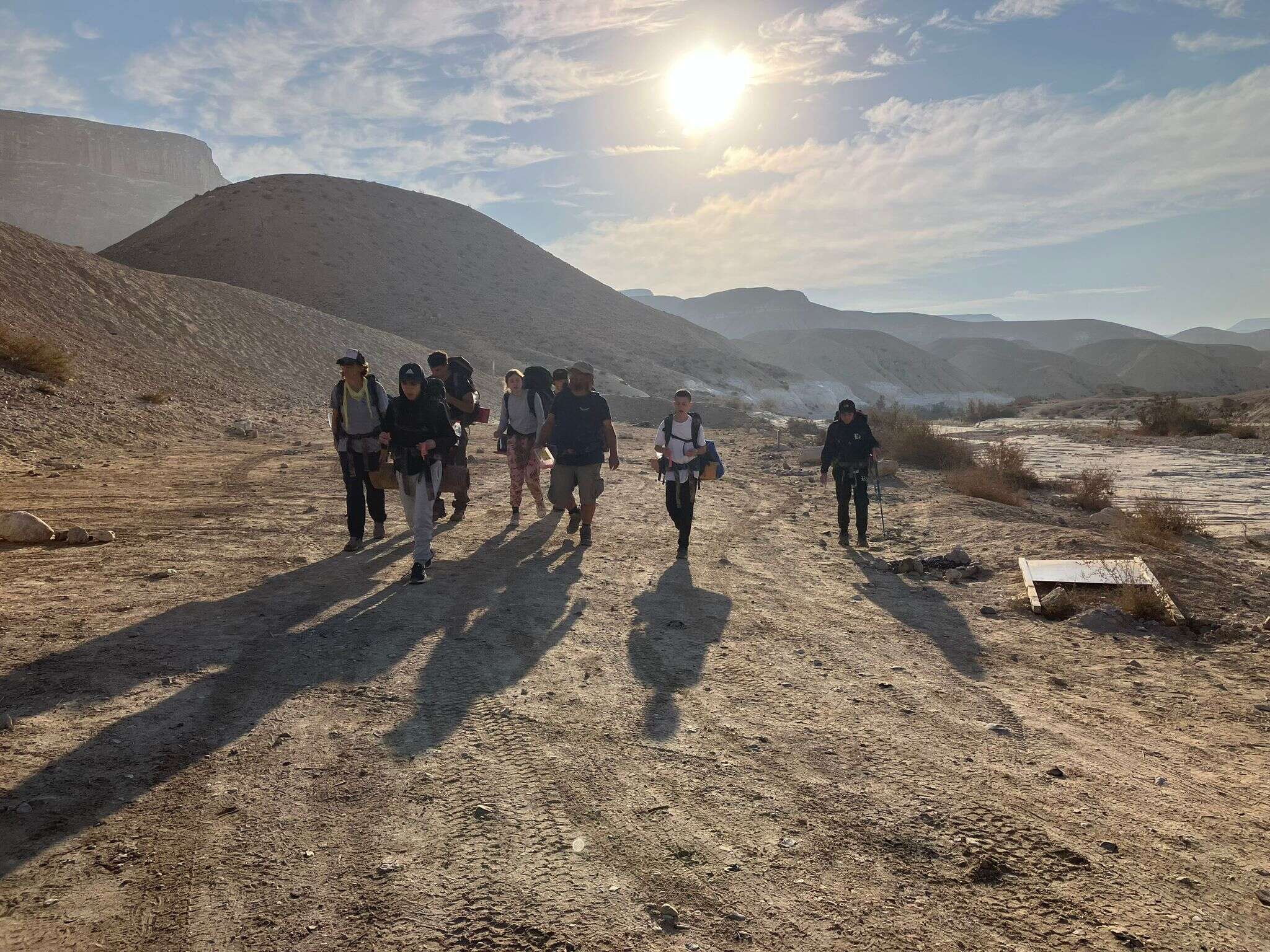
For Vered Libstein from Kibbutz Kfar Aza, even a simple conversation with her son's teachers in Ruhama has become difficult. "You are asked for something reasonable – for example that each child brings a Torah book for tomorrow," she said. "You need to understand that's a challenge. In my old home, I had dozens of copies. We had a huge library. So I gathered courage, went home, and saw the stacks of books in boxes. I just could not pull a single one out. That's the whole story, in one simple example."
"From the outside it looks like we're functioning normally," she added. "But when you look closer, you see that neither the teachers nor the children are functioning. The whole education system isn't functioning."
Yael Israel-Cohen, Planning Director at the UJA-Federation of New York, sees the wider picture: a school system that had to rebuild itself, children who matured a decade in a single year, and teachers who became therapists as much as educators. She calls this "trauma-informed education" – a language that brings compassion and deep emotional connection in the classroom, while still demanding progress.
Behind these words stands a large-scale movement of resources and partnerships, from teachers to informal education coordinators, from the Gaza Envelope to ultra-Orthodox and Bedouin communities. The UJA-Federation of New York, the largest Jewish Federation in the US, represents tens of thousands of donors. "Since the war began, the federation raised $215 million for emergency needs in just days," said Gabriel Sod, Director of Government Relations. "In Israel's first year of crisis, the local authorities, civil society, and philanthropy held the country together."
From hotels to classrooms
The investment began in hotels, in the first days after the children evacuated from the Gaza Envelope. "We immediately saw the importance of placing children in a positive educational framework," Israel-Cohen explained. "Our grants to youth movements saved kids during that time."
Amichai Hass, head of education in the Eshkol Regional Council and part of the Gaza Envelope, clearly remembers those first moments. "October 7 created a complex management crisis in Eshkol. Students were scattered across the country and the staff dispersed, while schools and other establishments stood empty. Within that chaos, school principals had to rebuild their schools from scratch. We met UJA representatives at the Dead Sea where we had been evacuated. They asked how they could help, and I said: principals. We must strengthen the school principals."
The support they received turned out to be unique. "UJA funded a group of professionals stayed close to the principals. They rode with them in cars, slept with them in the same rooms, and supported them both professionally and emotionally. They turned the principal into a 'super-principal,' because the task demanded superhuman effort."
Flexibility made the difference
The UJA-Federation of New York set itself apart through the speed of its actions. "Government money gets bogged down in bureaucracy. In war, there's no time for that," said Hass. Israel-Cohen from UJA added, "In Eshkol they asked for help managing trauma.' We built a program and responded quickly."
This approach also reached communities that had never previously dealt with emotional support, including ultra-Orthodox schools and the Bedouin community. "For the first time ever, these communities had to provide trauma care for children," Israel-Cohen said. "In Ofakim, after the program began, they said it opened their eyes to a whole new educational perspective."
In practice, this meant more staff in classrooms – an extra teacher who could reach out to a child refusing to enter class, or an additional manager to run trauma programs.
Social fractures and the demand for excellence
Libstein described what her son's group of friends endured. "My son Uri had his circle of friends. Michael – his parents were murdered. Tal – kidnapped with his mother, while his sister and father were murdered. Uri – lost his father and brother. Saar spent 20 hours in the shelter. They were a group on October 6." Again and again, their circles shattered. "When you're this age, when friendships break, it affects life forever."
The new trauma-informed education approach stresses expectations, not concessions. "Another therapeutic club just doesn't work," Libstein emphasized. "Don't give up. Demand that children aim high."

Horizon, up ahead
In Kibbutz Kfar Aza, as part of UJA's Project Horizon, one of the largest phuilantropic initatives helping communities in the South, the Federation supported "Ofir's Sprouts," a program for youth in memory of the late Ofir Libstein (Vered's husband). As the New Year begins, the focus moved toward a long-term strategy. "Now we look for gaps, not just resilience programs," Israel-Cohen explained.
Hass outlined their next step. "In Eshkol, we're organizing a learning journey for education leaders to New York, to study the city's 25 years of coping with collective trauma after 9/11. The goal is to build the best education system in Israel. The test for Eshkol is to serve as a model for the entire country."
Libstein added, "The terrible events created an opportunity to bring education to the highest level. In the end, education creates community."
Israel-Cohen concluded, "No doubt this is part of who we are. You cannot look at Israel the same way as before October 7. The Gaza Envelope must be part of the national agenda for the long term."

Now, with the school year underway, the true test begins: can trauma recovery and the pursuit of excellence come together, hand in hand? The answer may shape the future of Israel's entire education system.
Published in partnership with the UJA-Federation of New York


