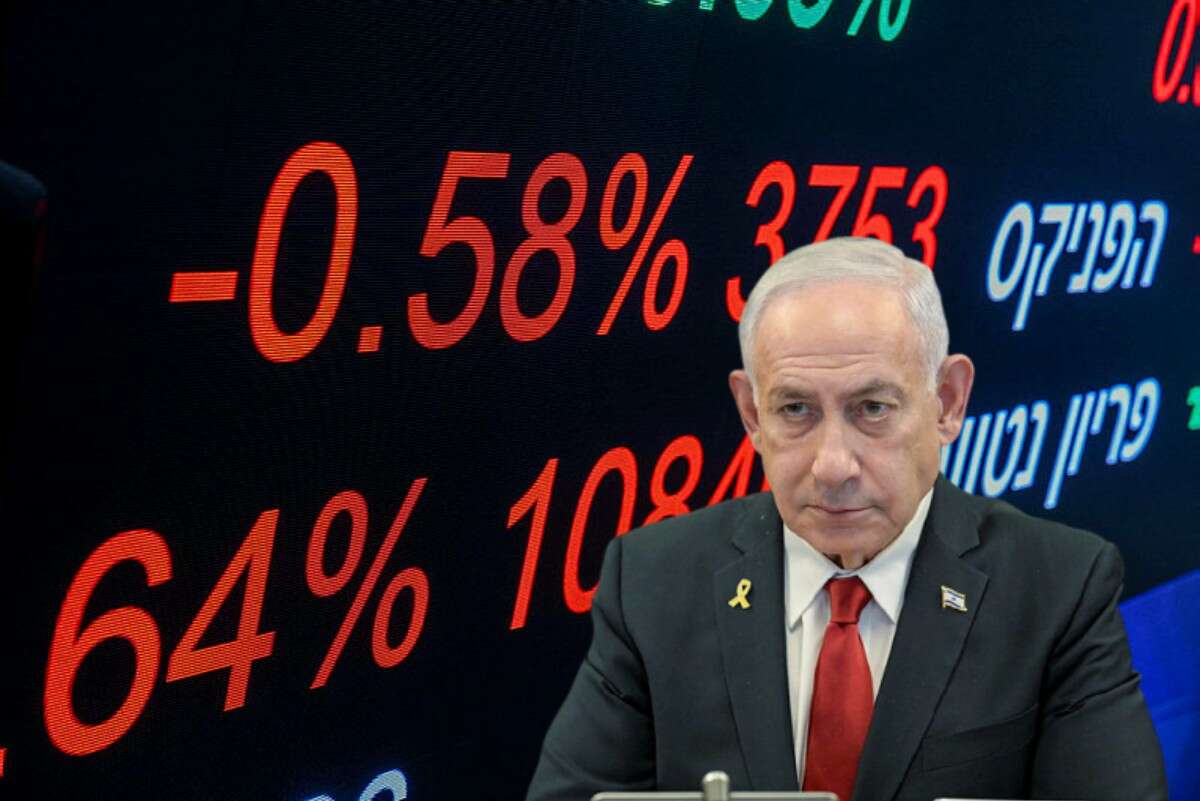
Following Prime Minister Benjamin Netanyahu's "Sparta speech" on Monday, the screens on the Tel Aviv Stock Exchange started the trading session on Tuesday with a sharp selloff, with investors fearing Israel would move away from international trade in order to prepare for international isolation.
Major indices saw steep declines after the opening bell, falling by nearly 3%. This represents a very steep drop for the major stocks, for which every fraction of a percent entails the liquidation of significant capital. The TA-90 index, the most popular index on the exchange in recent years, is shedding almost 3% and is thereby completing a decline of over 5% since Prime Minister Benjamin Netanyahu's warning on Monday that Israel should brace for international isolation and make sure it won't have to rely on the world for trade, to the point of adopting some autarkic economic postures. Netanyahu's speech was full of pessimism, with warnings that 'Israel is facing diplomatic isolation, we will have to deal with a closed economy," referring to the ongoing attitude by some countries to limit trade with Israel over the war in Gaza. But several hours later, after the surprise among the public in the media, he stressed that he was very optimistic about the prospects of Israel's economy, saying "Israel is the best place to invest" and that he was opposed to Israeli severing its trade ties with the world. "Israel's stock market is the strongest in the world; the shekel has become stronger and the deficit has shrunk despite the war...investing in Israel is the smart thing to do." He said that he meant to sound the alarm to the efforts by Iran and other countries to place an economic siege on Israel, "but we broke free."
In the trading rooms of the large banks, it is said that mutual funds, reflecting the activity of the general public, are particularly active on Tuesday. Sources in the trading rooms indicate that a substantial number of sell orders built up overnight in the mutual funds, and investment managers are liquidating assets to prepare for continued offerings until the afternoon, which is when the window closes for submitting additional sell or buy orders for the day.

At the same time, it is important to note that at this point, there were almost no visible activity from the institutional investors, which typically acquire assets when the public sells them off. In theory, should the declines deepen, an investment opportunity would arise for investment managers, known as "strong hands," but this remains theoretical, as a common adage in the capital market suggests that "one should not attempt to catch a falling knife." The Israeli stock market, despite the almost two-year war since Oct. 7, 2023, has largely outperformed the rest of the world since then.
Insurance stocks were leading the declines at the opening, having already been trading with volatility of late, with Harel's stock dropping by almost 1.5% and Clal Insurance decreasing by more than 1%. The stock of Azrieli, one of Israel's largest shopping mall operators, has also slipped by approximately 1% amid fears of a negative impact on Israelis' purchasing power.
Teva is down 2.4%, extending the stock's recent falls, which are driven by concerns that insurance companies worldwide will, for diplomatic and political considerations, favor recommending prescriptions from rival firms. Conversely, shares of Elbit Systems are up by nearly 1%, based on the belief that for the weapons maker, such days are actually beneficial for business.
In the bond market, price decreases were also noted, aligning with the working hypothesis that mutual funds are accumulating cash Tuesday out of concern for significant redemptions by the end of the day.