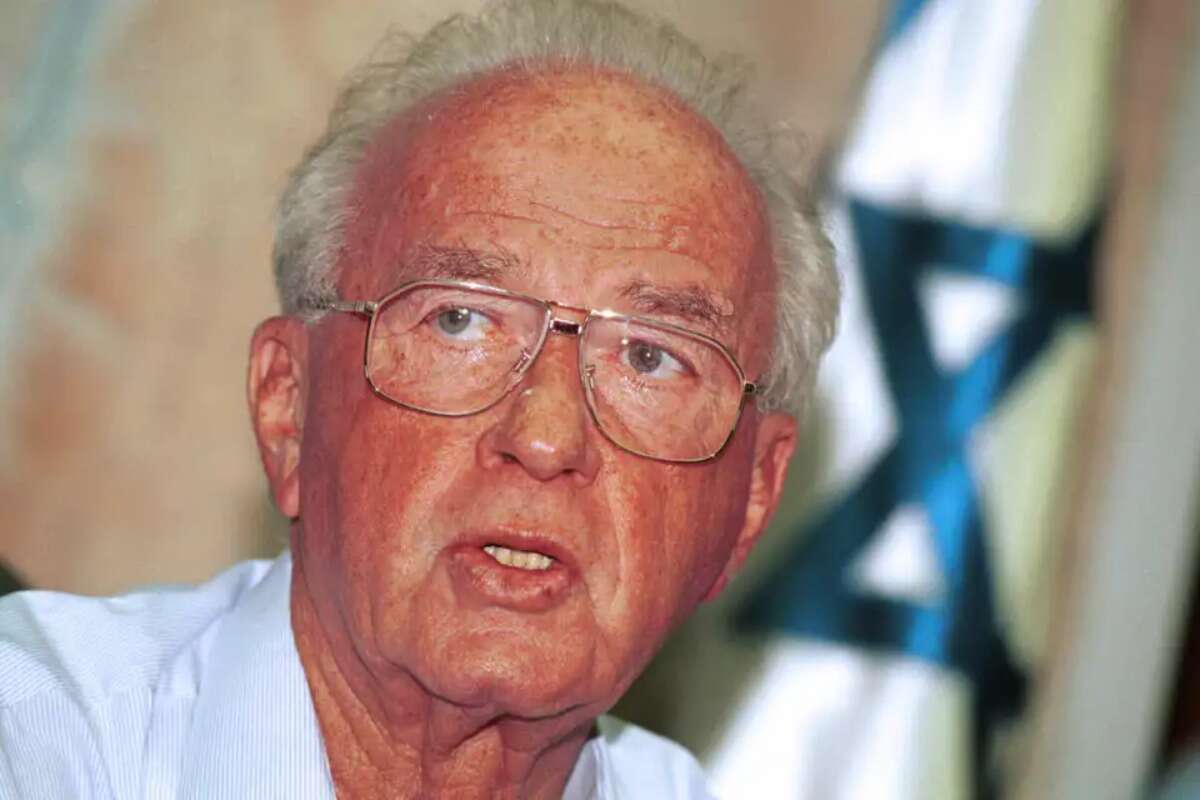
The man who stayed close
Yitzhak Rabin was a chief of staff beloved by his soldiers. Looking back across the decades, it's striking to see him in an old Yoman Hatzahal newsreel from just after the 1967 Six-Day War, attending an officers' graduation ceremony. As the event ended, soldiers and their parents crowded around him, forming warm circles of admiration. You could see in their eyes the affection and respect he inspired. There were no such scenes around Moshe Dayan. He commanded admiration, but not closeness.
Looking back, Rabin was a military leader whose relationship with his soldiers felt almost intimate. He studied at Kadoorie Agricultural School, on the slopes below Mount Tabor. The old Chizbatron troupe once sang about the calf stolen from Kadoorie by the guys from Sejera as a gift for their beloved Hedva. Locals still recall stories of how, in 1942, Rabin and his men from the Palmach scoured the hills near Juara in a frantic search for his lost pistol. That says it all.
There are probably Israelis today who no longer recognize his distinctive voice. Years ago, when I asked a colleague to check a recording for me, he came back puzzled: "Who's speaking on this tape?" It was Moshe Dayan. I was stunned that someone could fail to recognize such a familiar sound. Rabin's voice was equally distinctive, a firm, authoritative baritone, clipped and decisive, lending him an air of analytical intelligence.
Behind that commanding tone, though, lay shyness and vulnerability. His role in the Six-Day War was less prominent than legend suggests, and the postwar struggle over credit soon began. Within the Israeli Labor establishment, the old Palmach elite, academia, and cultural circles, a battle raged between the camps of Rabin and Dayan. Levi Eshkol, the prime minister during the war, was largely forgotten, even though he was the one who declared, "We have returned to our holiest places, never to part from them again."
Later, the group calling itself "Citizens Supporting Eshkol" became "Citizens Supporting Rabin." Along with his achievements, the war left Rabin with a scar that would follow him for life, his breakdown after a bitter meeting with David Ben-Gurion, who accused him of having dragged Israel into the war through poor judgment. Ben-Gurion, curiously, always had a soft spot for Rabin. He despised the Palmach and Yigal Allon, yet liked Rabin deeply, perhaps because of Rabin's conduct during the Altalena Affair, when he acted according to Ben-Gurion's wishes.
Because of that Oslo
For three decades, memorial ceremonies and community events commemorating Rabin have drawn their meaning largely from the fact that Benjamin Netanyahu has dominated Israeli politics since his assassination. Some argue that the unspoken "charge" behind the legal campaign against Netanyahu has always been his supposed moral responsibility for Rabin's death, a kind of modern blood libel that reenergized the Left.
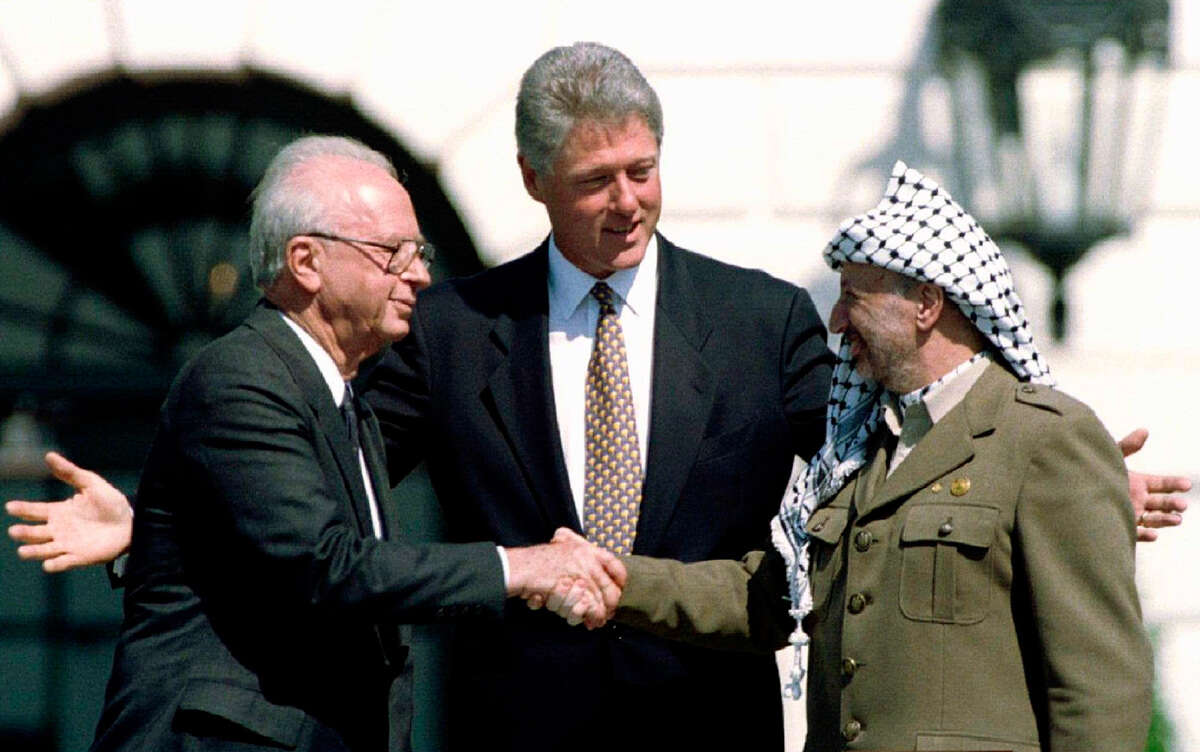
Unlike other countries where leaders have been assassinated, in Israel an entire segment of society was blamed collectively. The tragedy is that Rabin's death enshrined the Oslo Accords as a sacred legacy of the Left, while for the Right they symbolized deception and national endangerment. Rabin himself had long resisted the idea of negotiating with the Palestine Liberation Organization. Only two months before the signing ceremony on the White House lawn did he agree to meet Yasser Arafat and accept the PLO as a partner. Until then, he remained committed to the official Washington talks with the joint Jordanian-Palestinian delegation he inherited from Prime Minister Yitzhak Shamir.
Many on the Right felt betrayed, that Rabin had concealed his true intentions during the 1992 election campaign. True, he repeatedly ruled out direct talks with the PLO, but he did say publicly that he planned to grant the Palestinians autonomy in the territories within nine months of taking office. That was his policy, not a capitulation to Shimon Peres or Yossi Beilin, except insofar as he later signed that autonomy agreement with Arafat.
I followed Rabin closely during that 1992 campaign as a reporter for Tel Aviv Weekly. I heard him speak about Palestinian autonomy at a house meeting in Beersheba and again at a gathering of Arab mayors in Shfaram. His spokesman, Gad Ben-Ari, who was a friend of mine from the army, got me in. Labor was betting heavily on Arab voter turnout, as Rabin was not especially popular in that sector. Four years earlier, at another rally, he had bluntly said: "No one expelled more Arabs than I did." But by 1992, he was conciliatory and pragmatic. To Tel Aviv's bourgeois voters he promised "to take Gaza out of Tel Aviv," a slogan born of the wave of stabbings that had struck the city.
"Rabinism" encouraged
Rabin's worldview embodied the spirit of the 1948 generation and the victory of 1967: peace would come, eventually, but only when the Arabs were ready. Israel would hold the territories until then. In his final Knesset speech, a month before his assassination, he insisted that "the Jordan Valley, in the broadest sense of that term, will remain Israel's security border" and that Jerusalem "will remain united under Israeli sovereignty." He declared repeatedly that Israel would never return to the pre-1967 lines.
But Rabin and his colleagues failed to foresee that the territories handed to the PLO, the Palestinian Authority, would become bases for rocket fire and terrorism. He dismissed warnings from Netanyahu and Ariel Sharon that rockets would one day be launched from Gaza toward Ashkelon. "From Gaza? Impossible," he scoffed.
During that same period, Meretz MK Yossi Sarid declared, "Rabin must be encouraged." And indeed, as Labor shifted leftward, the Israeli Left was already legitimizing contact with Hamas, the terrorist arm of the Muslim Brotherhood. In December 1992, Rabin's government expelled 415 Hamas leaders to southern Lebanon. The move was turned by the Left and by US President Bill Clinton into a propaganda victory for Hamas. Israel was forced to bring the deportees back, and left-wing activists, led by Uri Avnery, protested in solidarity with Hamas in Jerusalem. Avnery later boasted that their campaign had proven that Israel could never again carry out such expulsions.
That episode marked a turning point. The return of Hamas leaders from Lebanon inspired a wave of suicide bombings between 1994 and 1996 and signaled the collapse of the Oslo process. Ironically, Clinton, who sent Rabin off with the words "Shalom, chaver" – "Goodbye, friend" in Hebrew – helped undermine Oslo even before it began.
A battle over legacy
Today, Rabin's legacy has hardened into dogma. Figures like Prof. Uri Bar-Joseph, a leading voice in Israel's old defense establishment, still promote the formula of ending "the occupation" through a Palestinian state and land swaps, the same thinking that would bring Hamas tunnels within meters of Kibbutz Be'eri. To them, even the October 7 massacre was not a historical rupture but merely another large-scale terrorist attack, on a continuum with Maalot, Munich, or the 1978 Coastal Road attack.
The old Left still refuses to see the Palestinians as a jihadist, antisemitic enemy bent on Israel's destruction. Just as Rabin saw parts of the right "murderers of peace," the Left today brands "messianic annexationists" as the main problem for Israel's future.

After Rabin's assassination, the upper echelons of the IDF and the defense establishment were dominated by his loyalists, including successive chiefs of staff Amnon Lipkin-Shahak and Ehud Barak. They passed down a worldview that dismissed military solutions to terrorism and treated the conflict as a "manageable confrontation." Settlers were framed as obstacles to peace. In later negotiations, Rabin was even willing to withdraw from most of the Golan Heights – back to the June 4, 1967 lines – when the Assad regime still appeared powerful.
Ultimately, Rabin's true directive was not peace, but the defense of the Jordan Valley and Jerusalem, and rejection of a sovereign Palestinian state. That is the mission facing Israel's next generation of leaders: to unite the nation across political lines in firm opposition to Palestinian statehood, and to accept the price, even sanctions, that such unity may entail. In that struggle, Israel can still draw on Rabin's spirit as a source of national strength.