

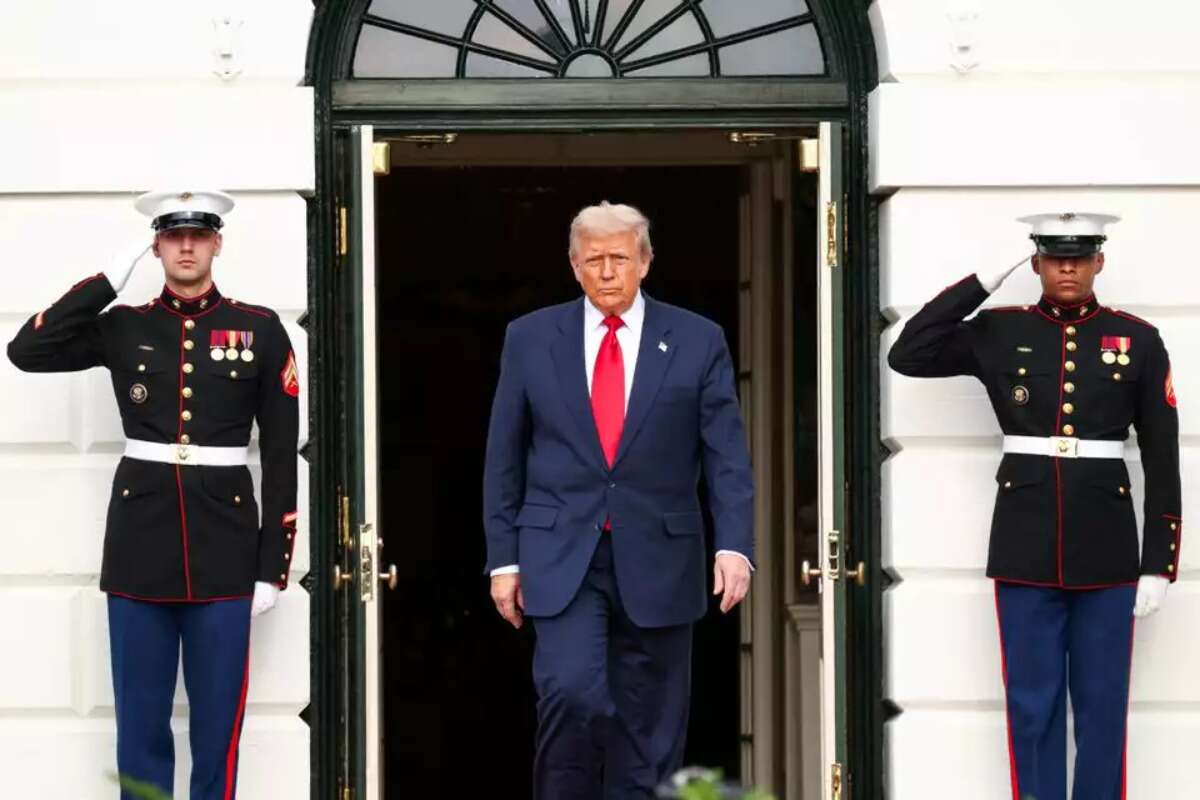
A 29 page policy document released Friday by the White House outlines the Trump administration's National Security Strategy. It delivers sharp criticism of Europe, emphasizes an "America First" approach that prioritizes defending the immediate US sphere, and assigns the Middle East only secondary importance.
The policy paper opens with sharp criticism of the administrations that preceded Trump. According to the White House, since the end of the Cold War, American "elites" convinced themselves that permanent American dominance worldwide was good for the country but in practice were mistaken. They overestimated Washington's ability to finance both a sprawling welfare state and an enormous military diplomatic machine at the same time, bet on "globalization" and "free trade" that hollowed out the middle class and industrial base, and allowed allies to shift their defense costs onto the American public.
Under the new approach, the United States seeks to remain "the greatest and most successful nation in human history." It aims to protect its own sovereignty and exercise full control over its borders. Among the goals listed are a military that is "the strongest, deadliest and most advanced in the world," a modern nuclear deterrent, a dynamic economy, a robust industrial base and leadership in energy. Abroad, Washington seeks stability in the Western Hemisphere, to keep the Pacific free and open, to support allies in protecting Europe, to prevent any hostile power from dominating the Middle East, and to preserve America's technological leadership in fields such as artificial intelligence and quantum computing.

The Monroe Doctrine and China
The strategy reasserts the Monroe Doctrine, articulated by President James Monroe in 1823, which held that the Western Hemisphere is the natural sphere of US influence and that any foreign interference would be seen as hostile. Trump adds his own extension to that doctrine that outside competitors must be prevented from controlling strategic assets in the region. This view has been reflected in the administration's public interest in buying Greenland from Denmark, in escalating tensions with Nicolás Maduro's regime in Venezuela, and in friction with Panama over Chinese activity in ports near the canal.
Competition with China also features prominently, though without surprise. Past administrations frequently spoke of a "pivot to Asia" as they shifted strategic attention away from the old Cold War and Middle East theaters toward rising confrontation with Beijing. China is defined as a major economic threat, and the White House promises to end "unfair trade practices," "large scale intellectual property theft and industrial espionage," and "propaganda, influence operations and other forms of cultural subversion."
At the same time, a key goal is preventing military conflict. The document calls for "strong and sustained deterrence to prevent war" in the region and states that "deterring conflict over Taiwan, ideally by maintaining military superiority, is a priority."

"Civilizational erasure"
What has generated the strongest reaction among experts is the section addressing Europe, which sets out what appears to be a US national security interest in Europe's internal political trajectory.
The document warns of Europe's potential "civilizational erasure" and cites several contributing factors. These include policies of the European Union and other multinational bodies that it says undermine political freedom and sovereignty, migration policies that change the continent and fuel tensions, censorship of free speech and suppression of political opposition, collapsing birth rates, and the loss of national identities and self-confidence.
It adds that Washington should work to "cultivate resistance to Europe's current trajectory from within European states." These themes echo the speech US Vice President J. D. Vance delivered at the Munich Security Conference in February, where he said that "the threat that most worries me in the context of Europe is not Russia, not China, not any external actor. What concerns me is the threat from within." Vance also urged European governments to remove the "firewalls" that block parties seen as far right from joining governing coalitions. He met with Alice Weidel, leader of the Alternative for Germany party (AfD). Across Europe, these statements are widely viewed as blatant interference in domestic politics.
Security demands of Europe
The document also addresses more conventional expectations of Europe, chief among them bearing its own defense burden. The White House cites the "Hague Commitment," under which NATO members agreed to raise defense spending to 5 percent of GDP, and calls on Europe "to stand on its own feet and act as a coordinated group of sovereign states, including by taking primary responsibility for its own defense."
In this context, Reuters reported Friday that the Pentagon has presented European governments with a deadline requiring them to assume most of NATO's conventional defense capabilities by 2027, ranging from intelligence capabilities to missile systems. The message was delivered during a meeting in Washington this week between the Pentagon officials overseeing NATO policy and European delegations.
According to the report, American defense officials warned that if Europe fails to meet the deadline, the United States may stop participating in some of the alliance's coordination mechanisms. European officials at the meeting told Reuters the timeline is unrealistic because Europe needs far more than money and political will to replace certain American capabilities in the near term. These include unique intelligence and information gathering assets that proved crucial during the war in Ukraine.

The pressure is already being felt in Europe. In March, European Commission President Ursula von der Leyen unveiled an 800 billion euro rearmament plan and declared that "we are in an era of rearmament." Germany announced a new recruitment model to expand its military to 260,000 soldiers and Chancellor Friedrich Merz set a goal to make the Bundeswehr "the strongest conventional military in Europe." France also announced the creation of a voluntary military service program for young people.
The document addresses the war in Ukraine as well and defines as a US "core interest" the achievement of a "rapid cessation of hostilities" to stabilize European economies, prevent unintended escalation or broader war, "restore strategic stability with Russia," and allow Ukraine to rebuild "as a viable state." Among Washington's policy objectives is "to end the perception, and prevent the reality, of NATO as an alliance that expands endlessly," a clear signal of US opposition to admitting Ukraine, which has been a central Russian demand.
The Middle East and Israel
The document defines Washington's core regional interests as ensuring that Gulf energy supplies do not fall into hostile hands, that the Strait of Hormuz and the Red Sea remain open to shipping, that the region does not serve as a platform for exporting terrorism to the United States, and finally and explicitly that "Israel remains secure."
The White House presents the Middle East as a success story for the Trump administration. "The days when the Middle East dominated American foreign policy have fortunately ended," it states. "Not because the Middle East is no longer important, but because it is no longer the constant irritant and source of potential disaster it once was. It is becoming a place of partnership, friendship and investment." The strategy pledges to avoid "endless wars" of nation building, such as in Iraq and Afghanistan, and to encourage reforms "when they grow organically, without trying to impose them from the outside."
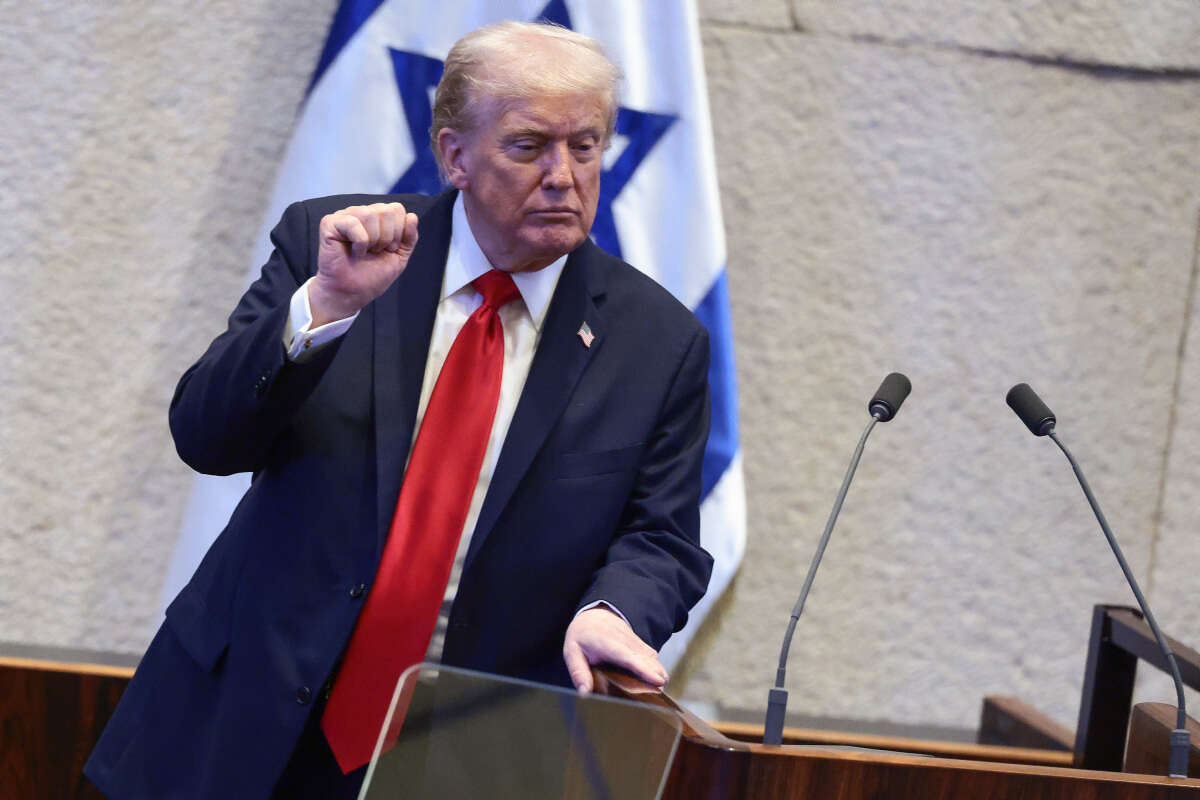
Israel appears in the document five times, always in a positive context. Along with defining its security as an American interest, the White House cites the Abraham Accords from Trump's first term as a historic achievement and sets a goal of expanding them "to additional states in the region and the Muslim world." As for the Israeli Palestinian conflict, the document says the situation "remains complicated," but thanks to the ceasefire and the release of hostages that Trump brokered, "progress has been made toward a more lasting peace."
The paper also lists the regional accomplishments the administration credits to itself. These include "Operation Midnight Hammer" in June 2025, which damaged Iran's nuclear enrichment capabilities, "peace between Israel and Iran," the end of the Gaza war and the return of all living hostages to their families. It adds that Iran, described as "the central destabilizing force in the region," has been significantly weakened by Israeli actions since 7 October 2023 and by the American operation.


