

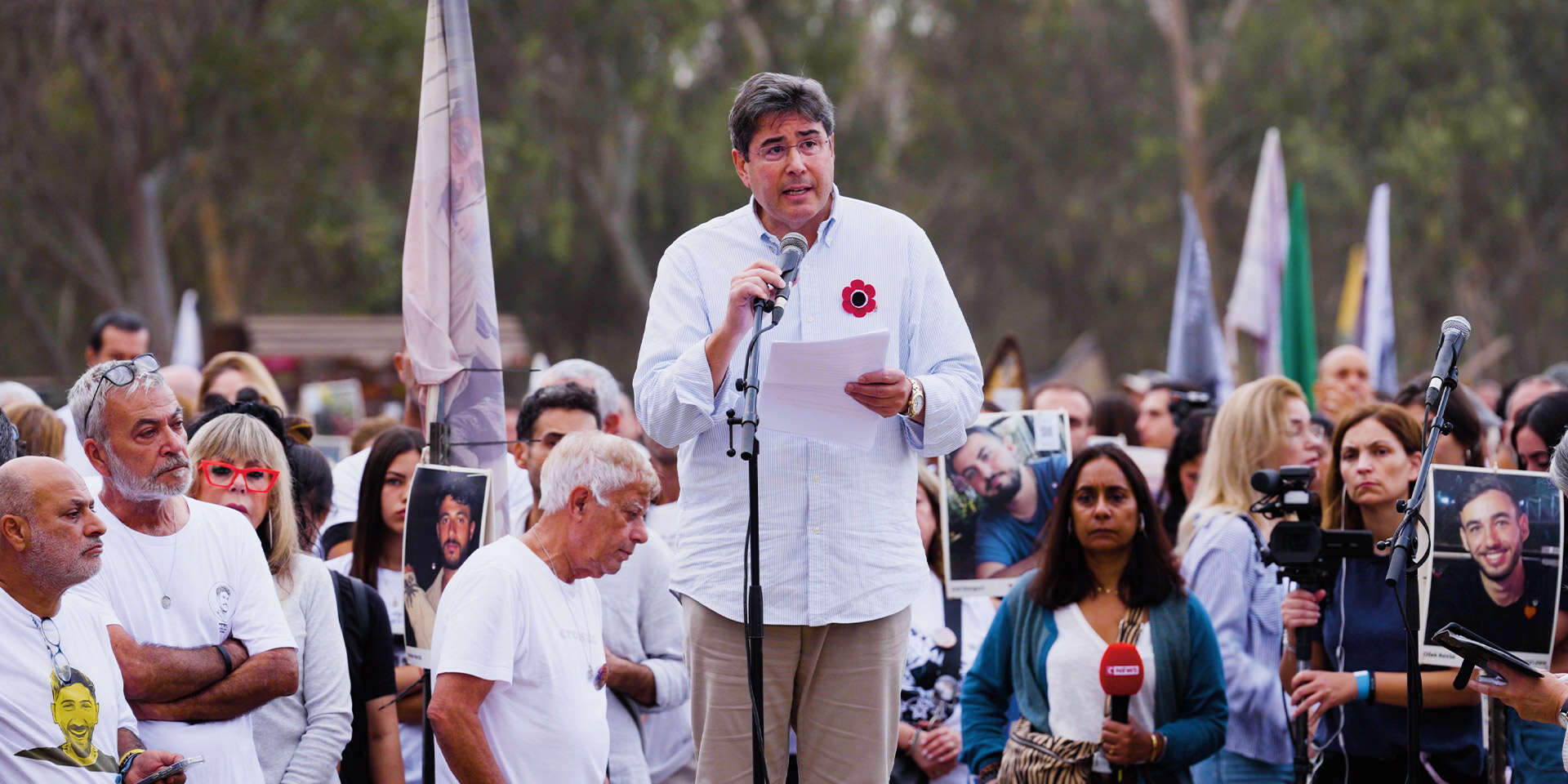
In October 2023, Israel found itself facing unprecedented challenges: a prolonged war on multiple fronts, the grief of bereaved parents, the anguish of families of the hostages, and the hardship of tens of thousands of citizens displaced from their homes. Stepping forward to help meet these national challenges — dedicating significant resources and supporting countless organizations — was UJA-Federation of New York, the largest Jewish communal philanthropic organization in the world.
UJA-Federation of New York's CEO Eric S. Goldstein looked back and described the love and solidarity shown by the Jewish community in the United States, detailing how more than $300 million were allocated for Israelis in need through UJA since October 7, 2023. The support went far beyond funds. Members of the Jewish community came to Israel, volunteered, and even fought in the IDF. Behind the scenes, they used every possible connection to help Israel win the war.
To understand how things looked from the perspective of American Jews who mobilized on that black Simchat Torah morning, we sat down for a special interview with Goldstein. He was visiting Israel at the time and staying in Jerusalem when he got a call from his son, a lawyer in the IDF, who told him he had been ordered to report to the Kirya base in Tel Aviv by 7 a.m.
"It was immediately clear this was something on a completely different scale from anything we'd ever seen," Goldstein recalled. That phone call set things in motion. UJA leadership met that same day and decided to immediately send $10 million from our endowment to address urgent needs in Israel. "It was unprecedented," he said. "By Saturday night we understood we had to act, not with words, but with funds and real action."
As the war in the south and north intensified, UJA-Federation of New York acted quickly. After the initial emergency aid, Goldstein and his team developed a detailed multi-stage plan for further assistance. "The first stage was complete emergency response, helping families who lost everything, providing food, medicine, money, and basic supplies. Our Israel office was in direct contact with mayors, regional councils, and local NGOs," he said.
The second stage focused on evacuees from the south and north, and the third, as residents gradually began returning home, shifted toward social and community rehabilitation. "It wasn't about rebuilding structures, it was about rebuilding lives," Goldstein said with a smile. "Better kindergartens, stronger community systems, more support. Not just to survive—but to come back stronger."
Born in Brooklyn, Goldstein has served as CEO of UJA-Federation of New York since 2014. He lives in Manhattan with his wife Tamar. Two of their children have made aliyah; two remain in New York. In July this year, he announced that he would end his 12-year tenure in June 2026. A graduate of Columbia University and Cornell Law School, Goldstein was previously a senior partner at Paul Weiss, a major international law firm.
During the past two years, Goldstein and his team realized the need for flexibility due to the pace of events and the constantly changing needs on the ground. "Every stage required a different response," he said. "Even this past summer, during the 12-day war with Iran, we once again had to send emergency aid to deeply affected communities, such as Bat Yam and Beer Sheva. There's no straight line, it's an evolving reality."
When the war with Iran broke out, UJA-Federation of New York allocated an additional emergency $10 million. We saw the immediate instinct of New York's Jews to stand with Israel," Goldstein said.
Monitoring the mood
Community surveys conducted annually by UJA-Federation of New York reveal a complex picture. "On one hand, there's been a dramatic rise in antisemitic attacks in the US, especially in New York," Goldstein said. "On the other, there's increased Jewish engagement and identity. What began as shock turned into a catalyst for connection."
Still, he acknowledged, there is a countertrend. "Some young Jews feel more alienated, especially on college campuses where discourse can be harshly critical. Our job is to keep them connected, not give up on them."
One of the federation's major battles is against the rise in antisemitism across the US. "In 2017, it wasn't even a major topic," Goldstein recalled. "But within a few years, we saw Nazi marches in Charlottesville, synagogue shootings, assaults in Brooklyn—and the COVID-19 pandemic fed antisemitic conspiracy theories. October 7 was the biggest driver of all."
In response, UJA-Federation of New York established a Jewish security unit with 23 staff members, allocating around $20 million annually to combating antisemitism. At the same time, roughly $80 million are directed toward strengthening Jewish life. "It's not enough to fight for survival, we must also celebrate it. Protection matters, but joy in Jewish life is just as vital."
UJA-Federation of New York works with school administrations, faculty, and campus organizations to promote balanced protest rules and fund programs like Hillel and Chabad, which have expanded significantly on campuses. "We can't beat the internet alone, especially when some state actors fund disinformation, but we can invest in quality content and empower local institutions," he said.
A key takeaway from recent months, Goldstein added, is the need to "inoculate" younger generations well before college. UJA-Federation of New York is expanding its work with public and private schools across New York, training teachers to recognize modern antisemitism, developing age-appropriate materials, and offering incentives for teachers to pursue advanced education in the field. "The goal isn't just for kids to know about the Holocaust," he said. "They need to understand who Jews are and what our history and culture represent. If you haven't prepared a child before university—once they reach campus, it's already too late."
"Your front line, and ours"
Goldstein summed up the past two years as difficult and demanding but chose to focus on what lies ahead. He spoke with optimism and admiration for Israel's younger generation. "By the time the war truly ends, some challenges will only deepen," he said. "Yet the generation of fighters and volunteers that has risen since October 7 has been tested and proven itself. Like in the US after World War II, there's potential here for a 'great generation' that will foster leadership and shared responsibility."
Since the war began, Goldstein has visited Israel over twenty times. "Each time I leave, I carry more worry, but also more hope," he said, describing Israel today as "a country living in mourning and joy at once."
"At my nephew's wedding, a soldier who had lost seven of his comrades spoke about them under the chuppah, and then the dancing went on until dawn. The Jewish people know well how to grieve and celebrate in the same time."
He recalled the June 2024 Israel Day on Fifth parade in New York, where Israeli singer Eden Golan, who represented Israel at the Eurovision, sang October Rain. "Thousands sang with her in Hebrew and English, and she broke down in tears," Goldstein said. "Many don't realize how genuine and deep New York Jews' love for Israel truly is."

Goldstein concluded with a clear message to Israelis, a message he has carried throughout his 12 years as CEO. "You are not alone. We may be fighting on a different front—public opinion, antisemitism, identity—but it's the same war. The Jewish community of New York, the largest outside Israel, stands with you completely. Make no mistake, this is real love."


