


Ra'ad Saad was living on borrowed time. His elimination Friday caps an intelligence and operational triumph for Israel, but more importantly closes the book on one of October 7's chief architects.
For years, Saad topped Israel's target list, evading numerous assassination attempts until Saturday's successful strike. Together with Izz al-Din Haddad, who now leads Hamas' military apparatus in Gaza, he stood as the sole survivor among the organization's pre-war senior leadership and among the handful who knew the intimate details of Hamas' assault blueprint, which Israel designated "Wall of Jericho" (Hamas's operational code for the October 7 attack).
Israel justified Saad's elimination by pointing to his ongoing efforts to reconstitute Hamas' capabilities and an explosive device that injured two reserve soldiers near the southern Strip on Friday. Yet these explanations appear tailored for Washington's consumption: The authentic motivation boils down to a score Israel had to settle with him – or stated plainly, vengeance.
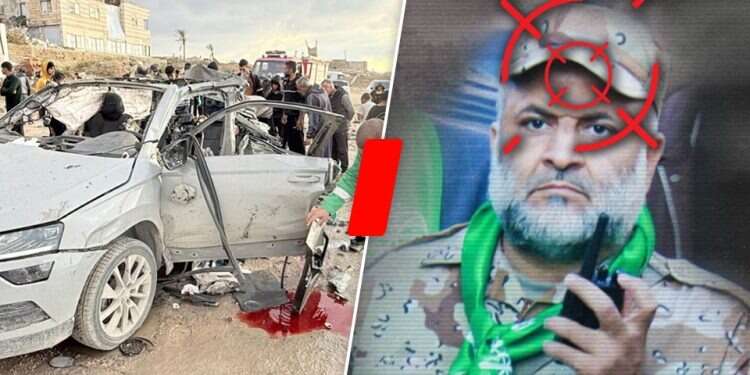
By Saturday evening, Hamas had yet to acknowledge Saad's death. The silence might reflect internal disarray, though questions remain whether the organization retains meaningful retaliatory capacity. Hamas has hemorrhaged most of its military strength alongside its military and civilian leadership throughout the war, leaving it organizationally shattered. Currently it channels its remaining resources toward consolidating control over the Strip's western sector, which stays under its authority. Israel presumably factored this weakness into its assassination calculus, which earned unanimous backing from the diplomatic-security establishment's uppermost echelons.
The singular gamble Israel appears to have accepted concerns the Washington administration. Saad's elimination provides Israel an opportunity to gauge President Donald Trump's temperature, for whom the Gaza accord stands as his first presidential term's marquee diplomatic accomplishment. Trump recently pressed Israel to throttle back its Gaza operations, affording space for the agreement's advancement; if he refrains from erupting now, Israel can interpret his silence as tacit authorization to persist in eliminating Gaza's senior hierarchy, mirroring its Lebanon approach.
Hamas will naturally strive to derail this trajectory, mobilizing its Qatari and Turkish sponsors hoping they'll persuade Trump to muzzle Israel. This contest for the president's attention – and by extension his policy direction – will dictate Gaza's near-term landscape. Israel seeks maximum postponement of transitioning to Phase 2, apprehensive it will mandate further withdrawals absent fundamental shifts in Gaza's circumstances. It partially attributes delays to Hamas' failure to return fallen hostage Ran Gvili, with Hamas contending that Israeli intelligence leads proved fruitless in pinpointing his location.
Three unpalatable paths
Meanwhile, Americans wrestle with assembling a multinational contingent to shoulder Gaza's security burden and execute its demilitarization. Simultaneously, mobilizing the billions required for the Strip's reconstruction proceeds at glacial speed: precisely as before, a chasm yawns between verbal pledges and written commitments. Trump must deploy his full leverage extracting promised funding – including from prosperous nations, principally Saudi Arabia – lest he grow tempted to embrace Qatari financing once more.
This tangle poses difficulties for Israel by generating three unpalatable paths. First, the grandiose promises yield nothing and Hamas continues governing overtly. Second, Americans declare victory prematurely, accepting a phantom governing structure masking Hamas' continued dominance. Third, the accord disintegrates entirely, forcing Israel back into comprehensive Gaza combat – bearing its physical, economic and diplomatic toll.
Israel will likely endeavor provisionally, at least publicly, to afford the agreement implementation opportunities as Trump desires. The assassination will be rationalized, as noted, through immediate operational necessity, simultaneously insisting Hamas cease its ongoing violations. Meanwhile, deliberately avoiding excessive administration irritation and projecting restraint, Israel shelved plans Friday to strike Hezbollah installations in Lebanon.
Israel maintained the scheduled operation was aborted because the Lebanese Armed Forces requested (and obtained) the intended target and pledged to address it independently. This signals encouragingly that threats of escalating military pressure toward renewed warfare are producing results, propelling the Lebanese Armed Forces toward action. Prudence nevertheless counsels withholding definitive conclusions: presently the probability of another Hezbollah confrontation remains elevated, merely deferred temporarily.


