

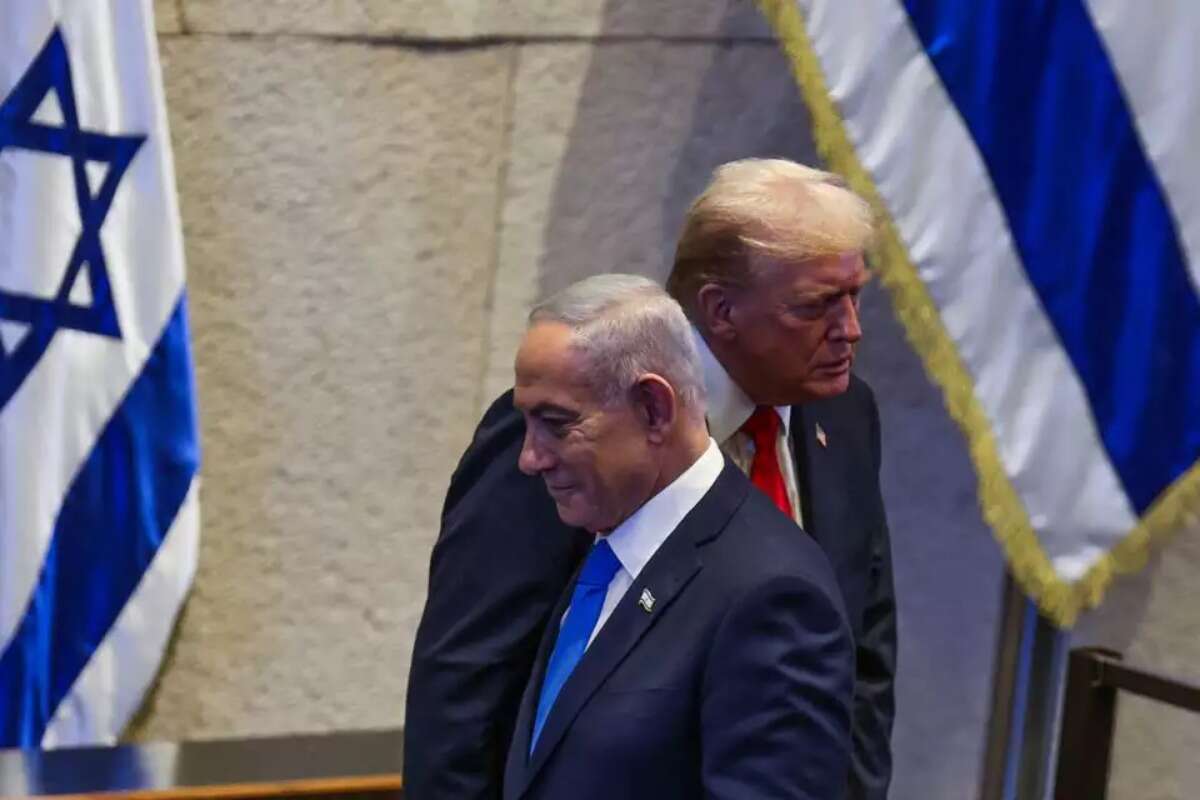
The upscale restaurant at Mar-a-Lago is expected to be especially crowded next week. That will not only be because Prime Minister Benjamin Netanyahu and his entourage are arriving at US President Donald Trump's estate, but mainly because both leaders' plates will be overflowing.
Netanyahu is expected to lay out the threats Israel faces and the possible courses of action, including with regard to Iran, Syria, Lebanon and Gaza. For dessert, if he does his job properly, he will remind his host that Egypt is systematically violating the peace treaty and playing a double game not only with Israel but also with the Americans.
Trump, for his part, will likely tell Netanyahu that his own military is fighting as well. In neighboring Syria, US forces carried out a wide-ranging airstrike on Saturday. At almost the same time, the US Navy seized an oil tanker that had sailed from Venezuela. This was another step in tightening the American stranglehold on the dictator who rules there, Nicolas Maduro.
Trump has taken these offensive actions while repeatedly declaring that he has no interest in wars. In this term, as the whole world knows, he sees himself as a global peacemaker. But Venezuela, he says, is flooding the US with lethal drugs, leaving no choice but to work toward toppling its president.

As for Syria, a soldier loyal to President Ahmed al-Sharaa, who remains affiliated with the Islamic State terrorist organization, killed three Americans there last week. Trump did not direct his anger at the Syrian president, his new friend. Instead, he sent the US Air Force to vent its fury on the Islamic State's renewed activity in Syria's desolate regions.
These developments, particularly given their timing, greatly ease Netanyahu's task. Start with Syria: Trump would like to reach some form of arrangement between Israel and the al-Sharaa regime. In theory, Israel would like that as well.
However, when "three American patriots," as Trump described them, are murdered on Syrian soil, Netanyahu will not need to labor the point about instability there. If Trump is forced to act in Syria, 10,000 kilometers (about 6,200 miles) from Washington, to protect his country, then all the more so Israel, right next door, must preserve its freedom of action there. It is that simple.

The same logic applies to Venezuela, which is also a friend of Iran. If Trump rightly defines drugs shipped to his country from 5,000 kilometers (about 3,100 miles) away as a threat, what would he say about Iranian cruise missiles stationed just 1,500 kilometers (about 930 miles) from Jerusalem?
The answers are obvious, and that is why Netanyahu will likely not need to deploy his famed powers of persuasion. Senior administration officials are already convinced. Consider the clear and important remarks made on Saturday by Marco Rubio, Trump's secretary of state and national security adviser, regarding Gaza's future.
"Everyone wants peace. No one wants to go back to war," Rubio said. But he made clear that if Hamas, a terrorist organization, is ever in a position to threaten or attack Israel, there will be no peace. He said it is impossible to persuade anyone to invest in Gaza if there is an assessment that another war will erupt in two or three years.

Rubio said the focus must be on the types of weapons and capabilities Hamas needs in order to threaten Israel, and that these should form the basis for defining disarmament. He stressed that if Hamas in the future launches rockets, kills Israelis or, God forbid, carries out another terrorist attack like the one on October 7, there will be no peace. Who would invest in rebuilding a place that will only be destroyed again in the next war, he asked, adding that this is why disarmament is critical. The secretary of state also said that no move would be taken without Israel's consent.
There is not an Israeli who would not sign on to Rubio's statement that "disarmament is critical." That is true for Gaza, for Hezbollah, and for every other challenge. The Americans were the first to understand that.


