


After months of anticipation, interdictions of drug vessels, oil tanker seizures, threats against the life of President of Venezuela Nicolas Maduro, and a military buildup of unprecedented scale, the United States launched a new phase in its conflict with the Caracas regime on Saturday.
Around 2:00 a.m. local time, reports flooded in from across the capital describing a series of explosions, fireballs, and smoke, accompanied by low-flying helicopters. A Venezuelan government statement confirmed that attacks took place in three states across the federation. US President Donald Trump announced that President Nicolas Maduro – along with his wife – had been captured and flown out of the country.
Since August, the US has massed a formidable military force in the Caribbean: the helicopter carrier USS Iwo Jima carrying thousands of Marines, the aircraft carrier USS Gerald Ford and its strike group, destroyers, a nuclear submarine, and amphibious ground forces. Puerto Rico has seen the deployment of F-35 fighter jets, UAVs, and Osprey aircraft.
In recent weeks, B-1 and B-52 bombers were spotted flying sorties off the Venezuelan coast. Simultaneously, American forces executed dozens of strikes against boats identified as drug smugglers, killing more than 100 people.
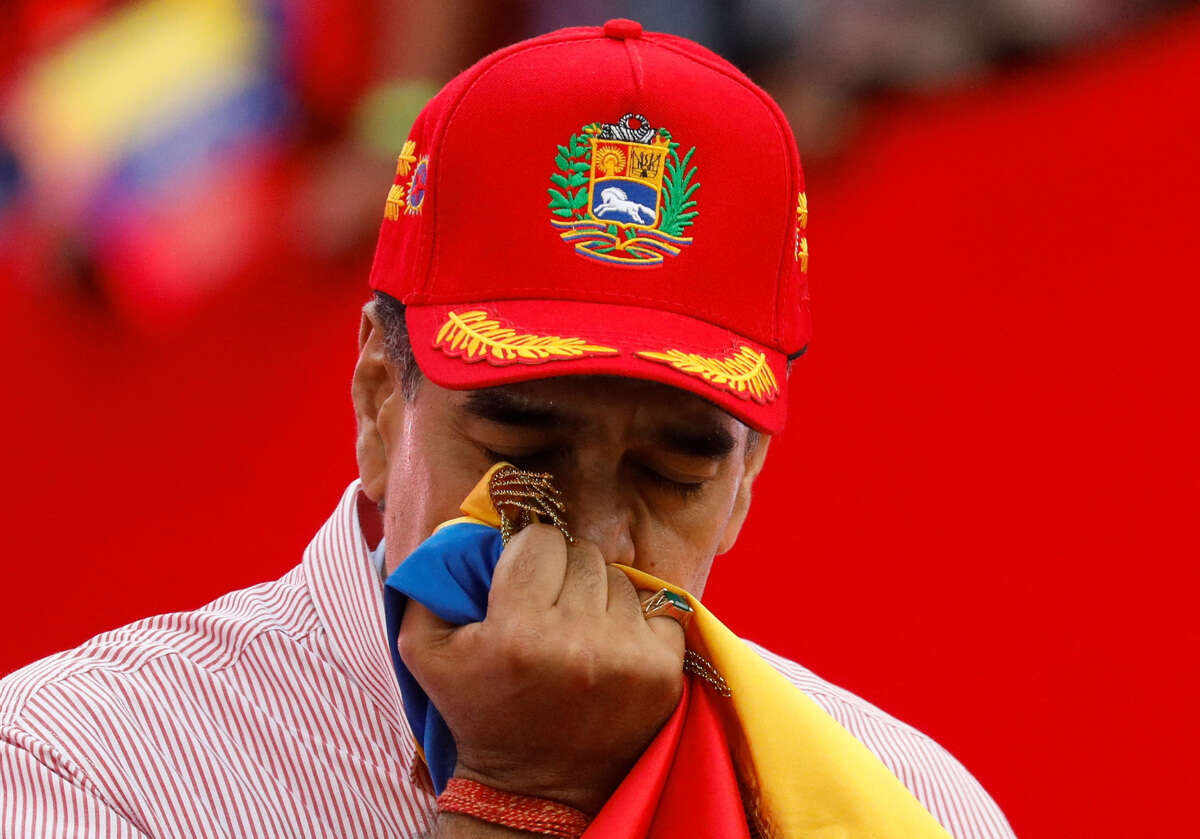
Donald Trump escalated his verbal offensive, occasionally threatening Maduro's life – including during a direct phone call – while declaring a closure of the country's air and maritime space. He designated the Caracas regime a foreign terrorist organization and doubled the bounty on Maduro's head to $50 million.
Throughout the summer and the early months of the troop concentration, Trump cited two primary justifications for the attacks: first, that Venezuela had "emptied its prisons into the US," and second, the drug trade allegedly orchestrated by the Caracas regime, which the White House claims costs hundreds of thousands of lives. "Every time I take out a boat, I save 25,000 American lives," Trump claimed. In December, he added that "Maduro's days are numbered" and refused to rule out a ground invasion. In a Truth Social post, Trump stated that strikes would continue "until Venezuela returns the oil, lands, and other assets stolen from the US in the past."
The slow-motion collapse
Venezuela has been a failed state for years, following decades as a regional economic powerhouse fueled by massive oil reserves. Hugo Chavez, the socialist leader who ruled from 1999, nationalized the oil industry and championed economic policies that triggered a slow-motion collapse. Upon his death in 2013, he handed power to his deputy, Nicolas Maduro, who continued this path while intensifying suppression of the opposition. Since 2014, roughly 8 million refugees – a quarter of the population – have fled the country carrying worthless Bolivar banknotes, the result of rampant inflation. The falsification of the July 2024 elections crushed what remained of the opposition, driving it into exile or the underground.
The regime rests on a narrow base: military officers controlling state companies, police, and "Colectivos" (armed pro-government gangs). The US and Western nations view Maduro as a dictator, and the Trump administration accuses him of running the "Cartel of the Suns" (a drug trafficking ring allegedly led by high-ranking military officials) – named after the insignia worn by Venezuelan generals. The administration also links him to "Tren de Aragua" (a violent Venezuelan criminal organization), which consolidated power in Venezuela's Tocoron prison before spreading across the continent after the facility was dismantled in 2023.

Trump designated the gang a terrorist organization due to its involvement in drug smuggling, human trafficking, and extortion. Concurrently, Caracas tightened ties with Iran – which established a drone factory on Venezuelan soil, deployed military advisors, and granted Hezbollah a foothold – as well as with Russia, which provides weapons and diplomatic backing.
How did a chronic regional crisis jump to the top of the White House target list? The answer lies deep within the administration's attempt to anchor its national security policy in the "America First" concept. In this regard, what appears to be the first US war in its own "backyard" fits the new administration – or at least the White House's perception – like a glove.
The "war on drugs" also aligns perfectly with the raison d'être of the MAGA movement: defending the American middle class from those the administration claims are "poisoning" it. "What you are doing now is not training," Secretary of Defense Pete Hegseth told troops on the USS Iwo Jima back in September. "This is a real mission for the vital interests of the US – to end the poisoning of the American people."
Yet despite this rhetoric, Venezuela plays a minor role in the drug trade reaching the US – Mexico and Colombia are far more significant vectors. The push to topple Maduro – preceded by months of "shaking the tree" in hopes the dictator would fall – is driven by diplomatic and geostrategic factors.
In its National Security Strategy released in December, the administration revived the "Monroe Doctrine" (a policy opposing European colonialism in the Americas) – the 1823 strategy articulated by President James Monroe declaring the Western Hemisphere the natural sphere of US influence, where foreign intervention is viewed as hostile.
The document, which aimed to "revive" that concept, asserted that competitors must be barred from controlling strategic assets in the region – a stance also reflected in the desire to acquire Greenland and friction with Panama over Chinese presence in ports near the canal.
A "classic" target
The launch of this operation marks a victory for Secretary of State Marco Rubio, the son of Cuban refugees who views Latin American socialist regimes as a strategic and moral threat – and is seen as the architect of the anti-Maduro campaign. For Rubio and administration neoconservatives, the confrontation fulfills a "classic" objective: cementing American dominance in the Western Hemisphere and battling communism – with the hope that the Cuban regime will crack next.
Sidelined in this shift is Special Envoy Rick Grenell, a prominent MAGA figure who held talks with the Caracas regime, visited the country, and secured the release of American prisoners. The renewal of Chevron's license in the region was part of that track, which was completely shattered when Trump declared a naval blockade.

Regardless, nearly 11 months before the midterms, the president who promised to "end wars" and publicly coveted a Nobel Peace Prize is executing a move that could define his administration.
Throughout the rising tensions, Maduro tried to project that his country feared no confrontation, primarily by singing peace songs in clips that became iconic. In November, he took the stage to sing John Lennon's "Imagine," and in December he surprised again with a rendition of "Don't Worry, Be Happy" featuring his own lyrics: "No war, be happy. Peace and love."
At the same event, sword in hand, he declared: "We must stand as warriors, ready to break the teeth of the North American empire if necessary." The regime released propaganda videos showing the "recruitment of popular militias" to block the Americans, but the footage mostly featured civil servants and pensioners dependent on the state participating in ridiculous displays.
This morning, following the explosions, he declared a state of emergency in a message accusing the US of looting the country's oil – and gave up on the peace songs.


