


The clock is ticking
Every so often, a notice is published about a conversation between the president of Russia and the prime minister of Israel. It is usually brief, always laconic, and never details who called whom or what was said. As is well known, the public's right to know is not Vladimir Putin's guiding star.
In recent months, there have been at least two calls initiated by Jerusalem. Their subject was the delivery of a clear message: Israel has no interest in another round of military exchanges and certainly will not initiate one. In at least one case, the immediate trigger was warnings by Yisrael Beiteinu chairman Avigdor Liberman of an imminent clash with Iran. The Iranians are not versed in the irreparable rift between him and Netanyahu, or between Bennett and the government. From their perspective, when a former defense minister calls on the public to stay near protected spaces, and a former prime minister posts a tweet with sand running out of an hourglass (try explaining that it's a countdown to a reservists' conference), these are pre-attack signals. Those who were scalded by boiling water in June, when they failed to read all the clear signals—including an explicit tweet by the U.S. embassy—are now cautious even of the cold water of opposition statements. For them, every tweet by the two is like a Hamas SIM card lighting up.
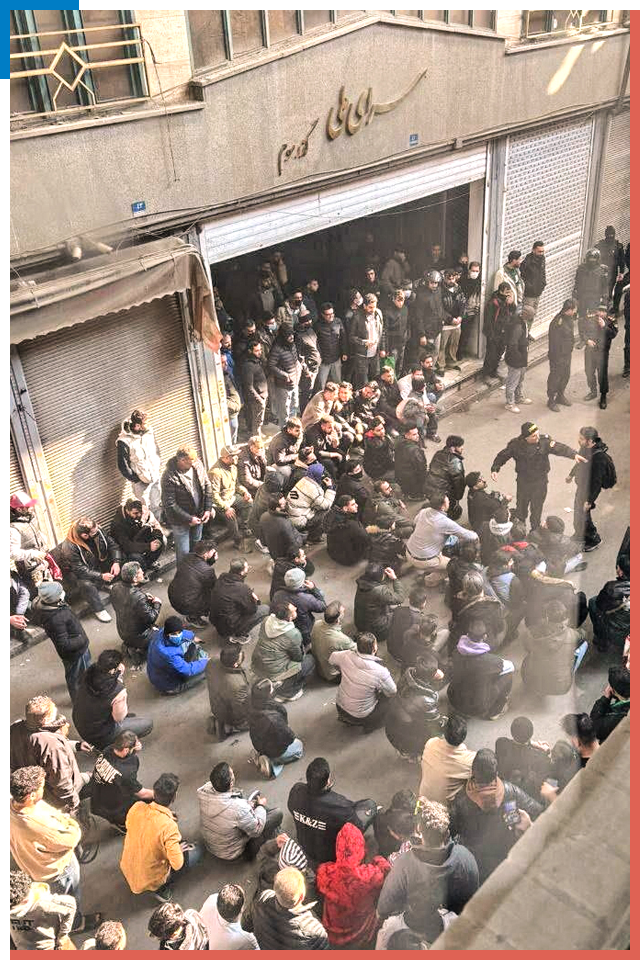
Putin passed the message to the Iranians again and again. The impression here was that it was internalized and absorbed. But the regime's enormous weakness, combined with post-trauma from "Rising Lions" still arouses concern. Were it not for that, one could say with confidence that Israel is not planning to strike soon. The unwillingness to be drawn into a cycle-based policy with Iran, together with the achievement of enlisting Trump also in the fight against ballistic missiles, plus American threats to intervene if the regime continues to murder protesters—all of these signal Israel to wait patiently on the sidelines. How much patience? The previous regime fell only after eleven months of protests. In Israel, they hope the digital age will accelerate processes, but estimate the timeline will not be measured in days, nor even weeks.
A more immediate and urgent matter is the expanding dispute extending to Lebanon and action against Hezbollah. The army has no shortage of aerial targets and would also be happy, on this occasion, to expand its ground presence to a few more commanding points. But the main question is, why hunt the mosquitoes if there is a chance that the swamp from which they drink is about to dry up anyway?
Not support, but time
"So what else can be done—who else can we talk to?"
The speaker is not an over-eager junior staffer brimming with motivation, but the prime minister himself. Again and again this week he called the Haredi politicians, trying to understand how it might be possible to influence the decision of the Council of Torah Sages, which will determine the fate of the draft law—and the fate of his government.
The math is simple: the coalition has 68 Knesset members. Four of them are already marked as certain opponents (Shkalim, Edelstein, Illouz, and Sofer). If the four Hasidic MKs are also instructed to oppose, the bill will die before it ever reaches a vote.
The Rebbe of Gur is pushing with all his might to bring down the law—and the government. For a year now, the Hasidic court has functioned as a full-fledged opposition faction. It is said this is also connected to a clause in the Arrangements Law that mandates a property tax on vacant assets. The Hasidic group holds enormous real-estate assets that are not being used, including in Arsuf. Coincidentally—or not—the director-general of the Ministry of Housing from Gur, Yehuda Morgenstern, has remained in his position and wrote a scathing minority opinion against the law. If there is no draft law, there is no budget; and if there is no budget, there is no tax. The desire to take revenge on Netanyahu and bring his rule to an end is merely a bonus.
The Council's decision not to decide gives Netanyahu the commodity he actually wanted—not support, but time. Had they announced their opposition the day before yesterday, elections would have been held in May. If the law passes, September. Granting time for negotiations with the non-Hasidic faction means that deliberations in the Knesset will continue and that the budget will, with high probability, pass. That is what Likud wanted, and with no small likelihood, that is what it will get.
The question throughout the week was who would prevail within Gur. Other rebbes—Belz and Sanz—believe the law should be given a chance, or at least that its fate should not be sealed now. Mixed together here are power struggles within Agudat Yisrael, the question of relations with Netanyahu, the intensity of opposition to conscription in any form, and above all the day after. They intend to continue with the right-wing bloc no matter what. In Gur they are not saying what the future plans are, but if a divorce has been finalized with Netanyahu, a new partnership with another figure will be required.
Bloodbath
One hundred and seventy thousand Likud members will go to the polls in the coming months. That is the highest number the party has seen since the days of Ariel Sharon's "box commanders", thousands of members registered only to vote, more than twenty years ago. The prevailing assumption is that most of them belong to organized groups. After all, for most of the past two years, the trend in the polls was desertion from the ruling party, not a broad popular influx.
A completely new Likud will choose a new list. There is no point trying to survey it or predict who will be elected. About ten central registrars will determine the top of the list and consign many others to early retirement.
There has not been such atomic pressure in the party for twenty years. Back in 2006, some thirty MKs and ministers competed for roughly ten realistic slots after Likud collapsed at the polls to an unprecedented low. Now the party is gradually recovering and approaching its previous electoral result—but the number of those pushed out will be even higher.
The reason is the Norwegian Law, which allows ministers to resign from the Knesset and be replaced by lower-ranked party members, that has been used wholesale. As a result, 43 ministers and MKs are competing, at best, for twenty realistic places. Netanyahu himself is guaranteed a spot and is asking for five additional realistic placements. Gideon Sa'ar is guaranteed the 15th slot. That means that even if the national list is significantly expanded, at least half will be sent home.
It can already be concluded that the Norwegian Law improved the quality of life of senior Likud figures but severely damaged the quality of Likud's governance. Ministers do not need to spend entire nights in the Knesset, but their replacements—the night-shift workers—are in a particularly wild season of "Survivor." That is why, for example, a party that once boasted of free markets now has a group that repeatedly tries to sabotage every important consumer reform: from concern for the dairy cartel that leaves supermarket shelves empty, through socialist initiatives for government-mandated price reductions of basic goods, to the fight to cancel the VAT exemption on purchases of up to $150 from abroad. Coalition discipline at this stage is merely a recommendation. From their perspective, the term is already over and the primaries have already begun.
Comic relief
Avichai Mandelblit, who vanished from view with the outbreak of the military advocate general affair, finally resurfaced. He came to the studio this week to lament the end of democracy, only to encounter a format less familiar to him: a tough question. Keren Marciano asked him how he himself had determined during the Bennett–Lapid period that a government decision was sufficient to shut down Galei Tzahal, while now his successor, Baharav-Miara, demands primary legislation to do so.
"No, no," Mandelblit replied, then stalled: "I suggest reading the opinion that… honestly, I don't remember all the details, but it's not that simple, not that simple. They cut out a very small component and—and—and—and brought it. I, I'm not getting into the specific decision about Galei Tzahal now, but, but, I think that… that… it's… it's… my opinion also included the statement that this is public broadcasting; this situation of stopping Galei Tzahal's broadcasts is very problematic."
Oh—so why didn't you say that earlier?
Mandelblit is the comic relief in the serious affair of his successor. The response submitted by the attorney general last week, which in effect demanded that Netanyahu be ordered to dismiss Minister Ben-Gvir from his post, is a stunning document in its lack of self-awareness and its anti-democratic nature. Among the grounds for the minister's dismissal appears Ben-Gvir's appeal to the police commissioner requesting clarification of the policy that prohibits blocking major traffic arteries. Baharav-Miara dares to brand this as incriminating evidence. Hold tight: the minister demanded equal enforcement of the rules. Such anti-democratic audacity—because according to the attorney general, "the exercise of authority derives from the characteristics of each demonstration… in the concrete circumstances on the ground."

Ben-Gvir's additional demand for equality on the Temple Mount is also cited as grounds for dismissal: "The minister expressed on several occasions a desire to change policy regarding Jewish prayer on the Temple Mount, even though policy in this sensitive context is determined by the government and has not changed for years."
But the most far-reaching determination is that a minister is forbidden to tweet consistent criticism of the Police Internal Investigations Department or the courts: "When the minister responsible for the rule of law systematically, on principle and immediately, comes out against the activities of the law-enforcement system when those activities do not align with the minister's political position, this constitutes significant harm to the principle of the rule of law… The minister also attacked judges in a manner that harms the rule of law." Bottom line: "The minister's references to concrete investigations concurrent with their opening, alongside unqualified support for suspects—especially when voiced by the minister responsible for the rule of law—send police officers a message regarding the propriety of the suspects' actions."
If ministers—particularly those responsible for law enforcement—are forbidden to question its judgment, the road to dismissing Minister Yariv Levin is short. After all, he too expressed "unqualified support for suspects," including "Defendant Netanyahu." He too "attacked judges in a manner that harms the rule of law." This is what a dictatorship looks like—one in which it is forbidden to criticize the rulers.
For a dictatorship develops when, instead of equal law applied to different people, different laws are applied to equal people; when the ruler changes the rules day by day, without explanation and without an orderly, transparent process. Israel is not a judicial dictatorship—yet—but it has moved closer this year. On every issue on the agenda, what governs is political outlook, not legal principles. When convenient, ancient, rickety arrangements patched together with used chewing gum become sacred and untouchable (such as the continued existence of Galei Tzahal, prayer arrangements on the Mount, or the method of appointing the attorney general), while Basic Laws passed by the Knesset in three readings and by an absolute majority are voided like a clerk's decision at the National Insurance Institute.
A constitutional crisis is a terrible thing. But if the High Court is tempted to detonate the charge placed at its doorstep by Attorney General Baharav-Miara, responsibility will rest with it alone. The prime minister must clarify, promptly and in the strongest possible terms, that this madness will stop.


