


The issue of the protests in Iran was a significant part of the meeting between US President Donald Trump and Prime Minister Benjamin Netanyahu in Florida, and of the presentation of what officials described as the "Iran file." Israel Hayom previously reported on the preparation of that file, and on the core need to weaken or change the regime in Tehran, as part of Trump's strategic plan to reshape the Middle East.
The position presented was that the current regime is the foundation for the overwhelming majority of wars and terrorist attacks in the region and constitutes an obstacle to progress on almost every front. Iran's internal protest movement, which at the time was in its early stages, was presented as one of the paths toward weakening the regime on the way to possible change.
Those discussions were dominated by the understanding that Israel should not intervene in the protests and that the United States would lead policy toward Iran's rulers as they sought to suppress the demonstrations.

Trump set the tone. On at least three occasions he issued warnings to the regime over its repression of the protests, and over the weekend he released a statement saying, "Iran is in big trouble. It looks like the protesters are taking over several cities, which did not seem likely a few weeks ago. If they kill protesters, we will hit them very hard. That does not mean boots on the ground."
Protesters are already being killed in Iran, and the world, especially the demonstrators themselves, is waiting to see whether the president's threats will be carried out. Trump's remarks can be interpreted simply as an air strike against strategic sites in Iran. But a different, non-military move, in the economic and diplomatic sphere, that would further damage the regime's financial reserves appears more likely.
Such a move was also raised in talks with Israel as the "cleaner" option for weakening or toppling the regime. Over the weekend, IDF Chief of Staff Lt. Gen. Eyal Zamir conducted several situation assessments. Security officials say Israel is closely following developments but has no offensive intentions. At the same time, the IDF says Israel is prepared for any surprise.
In any case, among Israeli intelligence and assessment officials, the belief is growing that the current protests will lead to real change in Iran. Even if not necessarily the fall of the regime, at least a substantial weakening.
Position papers from recent days outline several scenarios, with a common denominator that the regime will fight for its survival through an escalating use of live fire against protesters. But that weapon is far less effective than in the past.

According to assessments, a key reason is the broad range of sectors participating in the protests and the effective organization of the demonstrations, both in Tehran and especially in the periphery, in minority regions led by Kurds, Baluchis and others.
Another factor is the combination of protest grievances, first and foremost economic ones: inflation, poverty, unemployment, shortages of basic goods and severe infrastructure problems. These are compounded by social protests against the compulsory wearing of the hijab and other restrictions, as well as political protests against the Islamist dictatorship.
Assessments also point to the exceptional resilience of the protesters in harsh weather conditions and under live fire from the Basij militia and the Islamic Revolutionary Guard Corps as a major factor that could bring about change. Even the most optimistic estimates, however, foresee a struggle lasting at least several weeks before results are achieved.
The concern is that without external support for the protesters, the regime will ultimately succeed in containing the unrest, at the cost of significant bloodshed. Even in that case, a campaign of sanctions and economic and diplomatic isolation that the US is expected to lead would significantly weaken the regime's power and influence.
The most consequential sanction would be an almost total shutdown of oil exports, Iran's main source of income. Such a move is expected to severely damage, potentially to the point of collapse, the economy and the regime's ability to govern the country, let alone support external terrorist organizations that depend on it.
Beyond the street protests, the torching of government buildings and attacks on security forces, the unrest is expanding into strikes across the economy, including industrial workers, public transportation drivers, teachers and others.
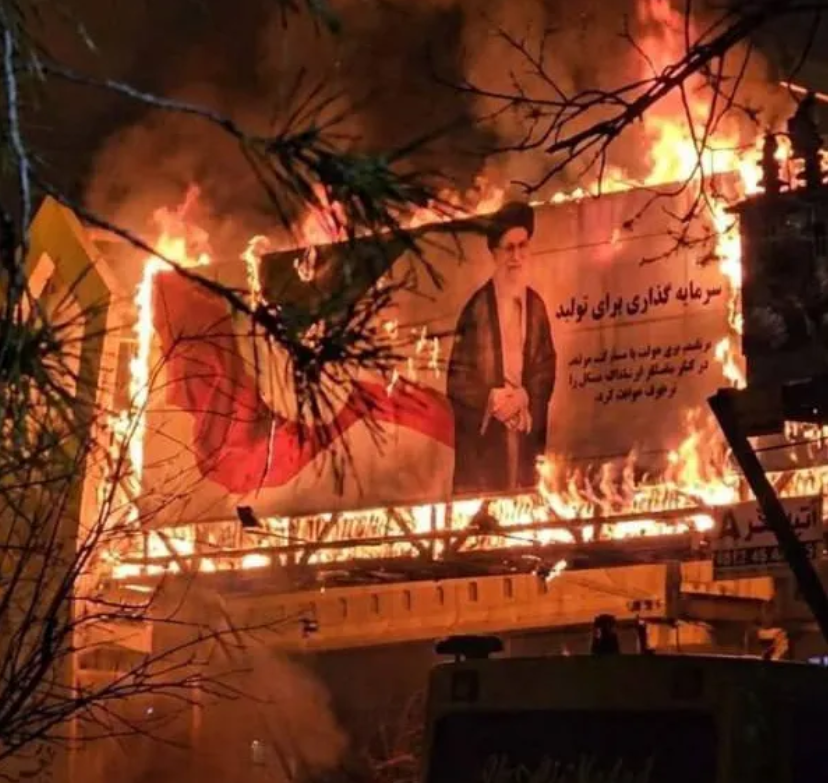
Meanwhile, according to a report in the British Telegraph, Iran's supreme leader, Ali Khamenei, ordered the Islamic Revolutionary Guard Corps to take control of the street protests and raised the organization's alert level to its highest setting.
This episode also highlights what is described as hypocrisy and blatant bias in parts of the international media, with a focus on the UK. The BBC, for example, has so far relied almost exclusively on reports sourced from the authorities, emphasizing the regime's claim that "Israeli and American agents" are inciting the unrest.
The BBC operates popular Persian-language radio stations, where coverage has also tended to reflect the authorities' positions. With the internet shut down by Iran's rulers, radio is meant to serve as a key source of information for protesters, but reporting there is partial, hedged and does not present the full picture of the demonstrations. There are also few quotations or information from protesters or from international human rights organizations reporting on events.
Notably, many international human rights organizations that routinely publish reports on even marginal incidents related to Palestinians in Judea and Samaria have remained silent this time. Sky News has likewise largely given space to the authorities' position blaming Israel and the US for the protests. These reports have drawn sharp criticism in the UK, and on Saturday a large demonstration by Iranian exiles took place outside BBC offices to protest the nature of the coverage.

Testimony from an Iranian citizen that reached the Israel Hayom newsroom via an organization of Iranian exiles corroborates reports of ruthless suppression of the protests by security forces and of hundreds killed so far.
The citizen, a resident of the city of Shiraz, said combined forces of the Basij militia and the Islamic Revolutionary Guard Corps were deployed at several intersections and buildings overlooking the city's main streets. Snipers were positioned on rooftops, and gunfire from both snipers and automatic weapons has been constant.
"There is no access to several streets where dozens of protesters were hit. It is impossible to evacuate the wounded, and there is evidence of close-range executions of injured people," he said. He added that Revolutionary Guard personnel are entering hospitals and abducting gunshot victims being treated there. The Shiraz resident also reported mass executions of those arrested during the protests and the dumping of bodies in landfills.


