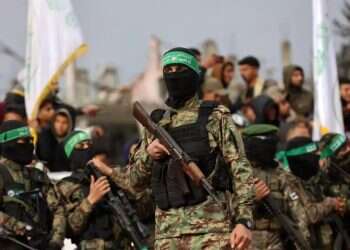
Amid the storm surrounding the establishment of the "peace board," Israel has killed a senior Hamas terrorist named Mohammed al-Houli, also known as Abu Fouad, who served as chief of central camp operations and participated in preparations for the October 7 massacre.
Abu Fouad joins a series of terrorists eliminated during the ceasefire against the backdrop of Hamas violations. Still, many senior figures remain in the organization's Gaza leadership, with accounts still to be settled. These individuals are responsible for attempted force buildup, ongoing violations, refusal to disarm, and a three-month delay in returning all deceased hostages.
The most senior figure eliminated in the past three months was Raad Saad. The founder of Hamas' Nukhba units and naval force, who served for decades as one of the military wing's senior commanders, had climbed to the No. 2 position in the wing after two years of war. Saad, who was killed on December 13 while traveling in his vehicle with bodyguards, oversaw weapons production and was responsible for assembling explosive devices deployed against IDF forces.
In early December, East Rafah Battalion commander Abu Ahmed al-Bawab and his deputy Ismail Abu Labda were killed. Both had spent extended time in an underground tunnel after the ceasefire took effect in October. On November 22, Alaa al-Hadidi was eliminated – a senior figure responsible for supply and equipment in the military wing's production apparatus. Two days earlier, Abdullah Abu Shamala, who served as head of Hamas' naval apparatus, was killed.
New power structure
At the top of the Gaza pyramid, associates of Yahya Sinwar have reemerged, taking the places of other senior figures who were eliminated.
The Saudi newspaper Asharq Al-Awsat reported earlier this month that Ali al-Amodi, one of the prisoners released in the 2011 Shalit deal who headed the "propaganda" apparatus in Gaza and used to accompany Sinwar, has become the de facto head of the Gaza Bureau. The report also stated he is considered the central figure in the Strip.

Sources indicated that no elections were held for the Gaza Bureau, but a "consultation" took place. In that process, Tawfiq Abu Naim was reportedly appointed as a bureau member. As we reported in October in the "Israel This Week" supplement, the prevailing assessment was that Abu Naim, like other senior figures, was called to serve in key Hamas positions amid the growing gap in the leadership's top ranks. Previously, Abu Naim commanded the terror organization's policing mechanisms. Like al-Amodi, he is a Shalit deal release and among Sinwar's associates.
Speaks Hebrew, dyed his hair, and got a haircut to escape
At the top of the military wing still stands Izz al-Din al-Haddad. A former Fatah member who became Hamas' only brigade commander in the wing not eliminated in the war.
According to foreign reports, al-Haddad, as Gaza City brigade commander, was among the few who knew the date of the October 7 attack. Like others, he was involved in planning and executing the mass massacre. After Mohammed Deif, Marwan Issa, and Mohammed Sinwar were killed, he was appointed head of the wing. Following the manhunt for him, he even dyed his hair and got a haircut to obscure his identity. Returned hostages reported that al-Haddad speaks Hebrew.
Intelligence Staff head Mohammed Odeh has also survived in the military wing. According to Arab reports, he was appointed commander of the northern Strip brigade in place of Ahmed Ghandour, who was killed. A terrorist named Mohanad Rajab was appointed Gaza City brigade commander. Besides him, three "veteran" battalion commanders survived the war: Imad Aslim and Haitham Hawajari from the Gaza brigade, and Hussein Fayyad from Beit Hanoun.

Alongside the surviving senior figures, Hamas still controls policing mechanisms and a military wing. According to data published, the three policing mechanisms have at least 20,000 members. However, most of the rocket array has been destroyed, and most trained terrorists in the military wing have been killed. Additionally, Israel estimates Hamas has been forced to appoint field commanders at lower levels after dozens of battalion commanders and company commanders were killed in the war.
The organization's leadership abroad
Simultaneously, there is, of course, Hamas' "political bureau" abroad, the one attacked in Doha on September 9. Most of its members reside in Qatar and Turkey, with the rest in other countries such as Iran and Algeria. In total, this involves several dozen senior and junior bureau members living there.

At the top of this bureau serves a five-member leadership council: Khalil al-Hayya, Khaled Mashaal, Mohammed Darwish, Zaher Jabarin, and Nizar Awadallah. Al-Hayya serves as Gaza regional head, and Zaher Jabarin serves as West Bank regional head. Mashaal is responsible for the diaspora abroad, and Mohammed Darwish is responsible for the organization's Shura Council. Awadallah also serves on the Gaza bureau.
For the position of bureau head, which remained vacant after Sinwar and Ismail Haniyeh were killed, al-Hayya and Mashaal are now competing primarily. As part of the election process, a deputy is also expected to be appointed following Saleh Arouri's killing in 2024.