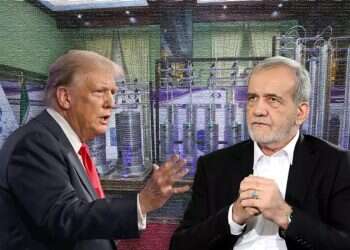
The US, in coordination with Britain, France and other countries, including Israel, has prepared a bank of targets for potential strikes on Iran, following the receipt and analysis of intelligence from multiple sources.
The ntelligence collection by the Americans and their allies has accelerated significantly over the past two weeks. In addition to Maj. Gen. Shlomi Binder, head of IDF Military Intelligence, who visited the US in recent days, representatives from other countries also arrived, including three Gulf states and another Arab country from the region.
A source familiar with the situation told Israel Hayom that this cooperation took place even though some regional states have publicly opposed a strike and have barred US fighter jets from transiting their airspace en route to Iran.

According to the source, senior intelligence officials held brainstorming sessions with their American counterparts aimed at maximizing the impact of a strike and, no less important, determining follow-on steps to ensure Iran would be unable to cause harm and that the regime would be weakened to the greatest extent possible, potentially to the point of collapse.
Alongside the military effort, the US Treasury Department has been concentrating extensive information on Iranian assets abroad. An American source said monitoring revealed that billions of dollars have been transferred in recent weeks from Iran to accounts and financial institutions outside the country. The funds include private money belonging to senior regime figures and Islamic Revolutionary Guard Corps officials, as well as assets of companies and organizations linked to them.
The aim is to freeze, seize and confiscate these funds wherever they are identified. The European Union's decision to designate the Islamic Revolutionary Guard Corps as a terrorist organization has greatly assisted this effort.

An Israeli political source told Israel Hayom that the designation grants European enforcement authorities the ability and legal authority to carry out asset freezes and seizures, make arrests and restrict the activity of any body or individual connected to the Revolutionary Guard. He assessed that most European countries would not settle for a declarative step alone and would enforce policy measures against the Guard.
It was noted that companies and financial and commercial entities controlled by the Islamic Revolutionary Guard Corps account for roughly one-third or more of Iran's struggling economy.
The American source said the economic move supports the military effort by reducing Iran's ability to procure military equipment and by limiting its capacity to pay salaries to Revolutionary Guard and military personnel. According to him, the president's policy of maximum enforcement and sanctions against Tehran is a particularly effective tool and would, at a minimum, shorten any military confrontation.

The Wall Street Journal reported that President Trump had been briefed on strike options against Iran developed jointly by the White House and the Pentagon, citing American officials. According to the report, the options presented included a plan described as "the big one," a large-scale bombing campaign against regime facilities and Islamic Revolutionary Guard Corps targets. More limited options include strikes on symbolic regime targets that would allow for escalation if Iran refused to abandon its nuclear program, as well as alternatives such as cyberattacks on Iranian banks and tougher sanctions.
The Guardian reported that Britain is not expected to take part in a US attack on Iran. Twelve British Typhoon fighter jets deployed to Qatar are intended for defensive missions in the event Iran attacks Qatar or other regional allies. The aircraft were transferred to Qatar following an explicit request from Doha.