

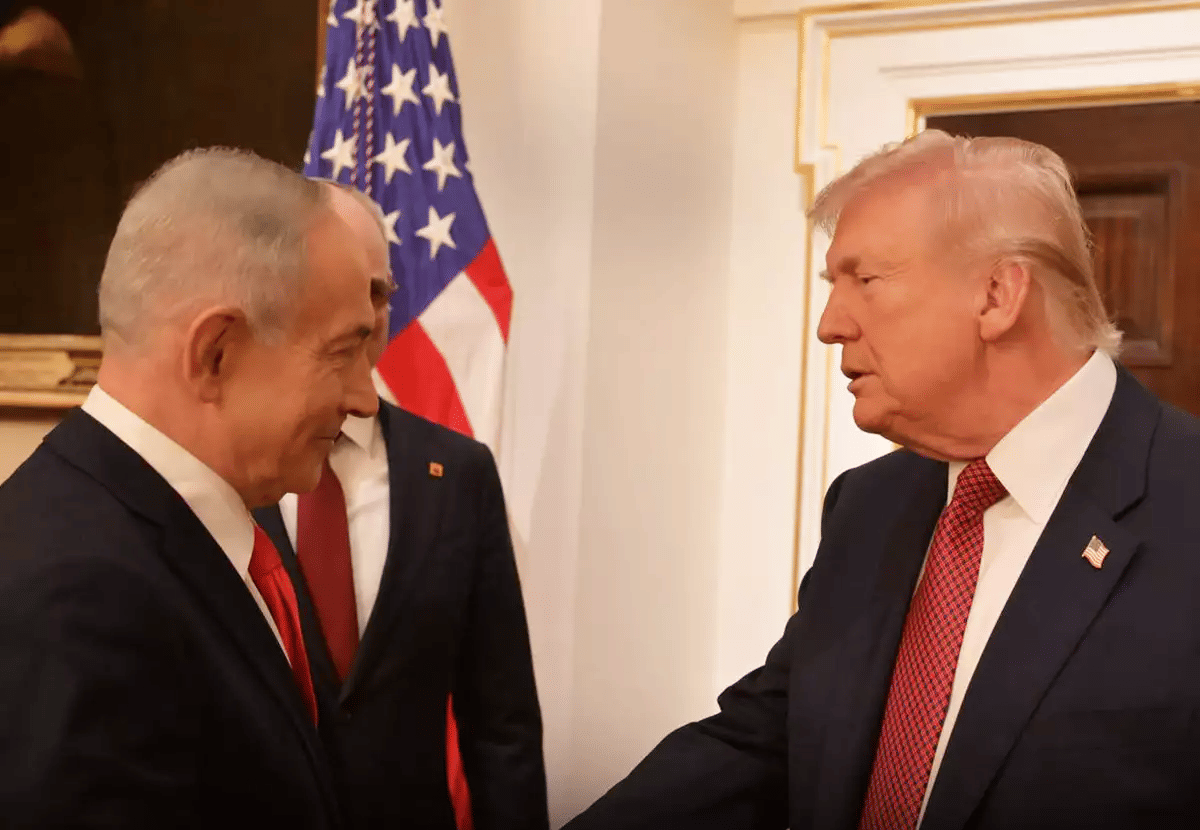
Operation Roaring Lion may prove to be a defining moment in US-Israel relations. If completed successfully, it could reshape not only the regional reality but also the nature of the alliance between the two countries for many years to come.
This operation is the most integrated bilateral combined strike in the modern era in terms of intelligence and operational cooperation. It represents an unprecedented level of integration between the allies – deep intelligence fusion, joint planning, and real-time operational synchronization. The sheer force of this combination was evident from the operation's very outset: especially tight intelligence coordination enabled the dramatic elimination of more than 40 senior figures in under a minute.
But this is not only a matter of intelligence. The cooperation also manifests in unprecedented technological and operational means: American F-22 fighter jets have been deployed at an Israeli Air Force base, and American refueling aircraft are operating from Israeli airfields, serving both American and Israeli planes.
Alongside this, breakthrough cooperation in electronic warfare and in the collection and sharing of data has been reported – cooperation that aided the deep penetration of drone swarms into Iranian territory. The implications of all this extend far beyond the current operation. In effect, we are witnessing a gradual shift away from a model of American "assistance" to Israel toward a new model of integrated capabilities.
This is an important conceptual shift: Israel is not merely a country that receives support – it is also an ally with capabilities, initiative, and strategic value. As US Defense Secretary Pete Hegseth recently put it, Israel is "a real ally with real capabilities – unlike some of our traditional allies, who only complain and call for the war to end."
This shift must drive two parallel processes. On the one hand, Israel must pursue a gradual and agreed reduction of American military assistance to zero over roughly a decade. On the other hand, and precisely in parallel, the "assistance" must be transformed into a deep strategic partnership that highlights Israel's contribution and establishes long-term infrastructure for cooperation: joint defense R&D, advanced intelligence sharing, combined exercises and training, joint production, and broader access to the most advanced American systems.
In other words, a transition from a "patron-client" model to an alliance between two capable partners. The diplomatic capital and trust built with the US government and military can and must be leveraged to expand regional cooperation with CENTCOM members and to cement a regional architecture of security, air defense, intelligence, and innovation.

As part of this unprecedented cooperation, it is important to persuade our American friends that the campaign's true goal must be regime change. The Iranian regime cannot make peace, ideologically or religiously, with the existence of Israel or with an American presence in the region. Exporting the revolution, pursuing nuclear weapons, and supporting terrorism are not "policies" that can be recalibrated – they are an integral part of the regime's worldview. As long as the ayatollah regime remains in power, every military achievement will be at most a temporary respite.
Only the Iranian people can do it
That said, we must not repeat the mistakes of the past. The lessons of Iraq and Afghanistan must be learned: regime change cannot be imposed from the outside through ground occupation or attempts to rebuild a state by foreign forces. Great caution is required regarding entanglement in a broad ground operation.
Ultimately, only the Iranian people can build a new government. Regime change must come from within. But it is equally important to emphasize this: Iran in 2026 is not Iraq in 2003. This is an educated, relatively modern society, with broad segments that aspire to a stable, prosperous, and even democratic future – not to sectarian or jihadist wars.
The role of Israel and the US is to create the best possible conditions for the Iranian people to replace the regime. This means systematically degrading the mechanisms of control and repression, severing the regime's leadership from the public, and striking at its command-and-control infrastructure. Not only in Tehran but also in the provinces.
In parallel, efforts must continue to neutralize emerging leadership figures who seek to fill the void left by eliminated senior figures, and to provide assistance to Iranian opposition forces – both political and armed – to improve coordination among them and exploit the window of opportunity. If the regime loses its capacity to control and suppress, the Iranian people may do what they have already attempted in the past, in the great waves of protest in recent years – but this time, under far better conditions.
The bottom line is clear: the campaign in Iran may prove to be not only a turning point in the struggle against the ayatollah regime, but also the moment when the US-Israel alliance moves to a new phase – a genuine, force-multiplying partnership based on integrated capabilities and shared interests. If we act correctly, we will not only strike the most dangerous enemy of both countries but also set a new strategic reality for years to come.
The author is a former minister and ambassador of Israel to the United States and the United Nations, and currently serves as head of the diplomacy center at the Misgav Institute for National Security.


