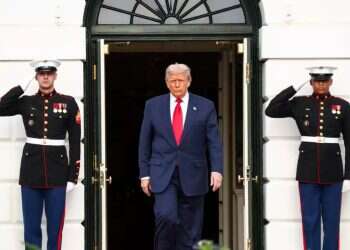
King Charles III and Queen Camilla arrived Monday in Washington for a four-day state visit to the United States, in an attempt to repair the persistently fraying relationship between the two governments, at one of the most complex moments in US-British ties in recent decades.
The visit was shadowed by the shooting Saturday at the White House Correspondents' dinner, after which Secret Service agents removed President Donald Trump from the venue.
"Looking forward to the start of the visit"
Following the shooting, Buckingham Palace confirmed Sunday that the visit would proceed, after consultations on both sides of the Atlantic and reports that its details were under review in light of developments. A palace spokesperson said the king and queen were "looking forward to the start of the visit." Acting Attorney General Todd Blanche said Sunday that authorities believed the shooting had most likely targeted President Trump and senior administration officials, and added that he was confident the king would be safe throughout the visit.
During the four-day visit, the royal couple is expected to meet with Trump at the White House and attend a state dinner. On Tuesday, the king will address a joint session of Congress to mark the 250th anniversary of American independence. Also planned are a symbolic visit to the September 11 memorial site, a reception in New York, and a visit to a national park in Virginia.
This will be the first time a British monarch has addressed Congress since Charles's mother, Queen Elizabeth II, did so in 1991. Elizabeth also visited the United States in 1976 to mark the American bicentennial, and on several other occasions, the last of which was in 2007. His father, King George VI, visited the US in 1939.
Seven months ago, President Trump visited Britain and was received with full royal honors – and it was clear the American president relished the monarchical atmosphere. Trump has never hidden his affection for the institution of the monarchy. At the time, it seemed that Britain and the Labor government led by Prime Minister Keir Starmer were succeeding in positioning themselves as Trump's "favorite child" in Europe, while the rest of the continent absorbed heavy tariffs and verbal insults.

"Not our war"
Since then, the waters of the Atlantic have grown murkier. The Iran war and Starmer's public and explicit refusal to initially allow the US to use British bases in the Indian Ocean and on the British island territory for strikes against Iran – citing fears of violating international law – complicated matters significantly. That decision was later softened, but Starmer reiterated his position, saying, "This is not our war, and we will not be dragged into it."
Trump responded to that refusal, predictably and without diplomatic restraint. He made clear on several occasions that Starmer was "no Winston Churchill," repeatedly declared he was "disappointed" in him, and, in a post, called the British aircraft carriers "toys" after Britain announced it was sending a carrier to the region. Trump added, "We don't need them – but we'll remember. We don't need people who join wars after we've already won."
In an interview with the British Telegraph, he also threatened to withdraw from NATO after allies declined to support him in the war.
But even before Trump grew disillusioned with Britain's lack of support in the Iran war, it was the British side that felt bruised by the president's actions. In a January interview, as part of his ostentatious contempt for the value of his European allies, Trump claimed that NATO soldiers had "stayed a little off" the front lines in Afghanistan.
"Among the greatest of warriors"
The remark caused an acute public storm in Britain, which lost 457 soldiers in the fighting there. The British press launched an attack, Prince Harry – who himself served in Afghanistan – condemned the comments, and Starmer called the remark "insulting and shocking" and demanded an apology. Following the uproar, Trump walked back the comment and praised British soldiers as "among the greatest of warriors." The bitter taste lingered, and calls already began on the British side for the king to cancel the visit.
Somewhat earlier, the Greenland affair rattled the relationship. Trump's ambition to annex the northern island, which is under Danish sovereignty, led him to threaten 25% tariffs on Britain and eight other European allies, and to refuse to rule out military force or withdrawal from NATO.
Starmer called the threats "completely wrong" and said that "Greenland's future belongs to its people and the Kingdom of Denmark alone." Trump ultimately backed down, but for the first time in NATO's history, the United States had appeared to be a genuine military threat to Europe.
Against that backdrop, King Charles III is considered the right person to try to salvage relations between what had been regarded as the closest allies in the Western world. "I know him well, I've known him for years. He's a courageous and distinguished man," Trump said of the king in a recent interview. During the president's visit to the palace in September, according to reports, the king managed to persuade him to increase American support for Ukraine.
Video: Pro-Iranian protesters outside the US Embassy in London. Credit: Reuters
"Playing the right card"
In a BBC review published ahead of the visit, Shannon Felton Spence, a researcher at Harvard University, said the monarchy was "Britain's number-one soft power tool, and there is no place where that is more apparent than in the United States." She added, regarding the momentous timing of the meeting, "It could not have come at a better moment for Britain. They are playing exactly the right card, at a time when they didn't even realize they would need to play it."
The British government hopes the king will leverage the personal capital he has accumulated with Trump to advance sensitive issues: support for Ukraine, strengthening NATO, and protecting an existing trade agreement. But the values gap between the two men complicates the mission. The king and the monarchy – who seek to be seen as bearers of the banner of liberal democracy, the world order, and a politics of moderation and responsibility (not always successfully) – represent the polar opposite of Trump's persona.
"Trump's show"
Charles will need to find the delicate balance between the need to secure his country's interests, which often pass through public flattery of the American president and attempts to ingratiate himself with him, and the preservation of his royal image. Max Bergman, a former senior adviser at the US State Department, told the BBC, "I don't know how disciplined he'll be. 'Trump's show' doesn't turn off just because the king is in town."
On the margins of the visit stand two challenges that could overshadow it. The first is how the 77-year-old king will manage the packed schedule, given his health condition and the fact that he has been undergoing cancer treatment for more than two years. The second is the elephant in the room: the scandal surrounding the king's brother, Prince Andrew Mountbatten-Windsor, and his ties to convicted sex offender Jeffrey Epstein.
That affair is back in the British headlines, with revelations related to the appointment of Peter Mandelson as ambassador to Washington – despite his ties to Epstein – potentially triggering a knife fight within the Labor government and ending Starmer's tenure.