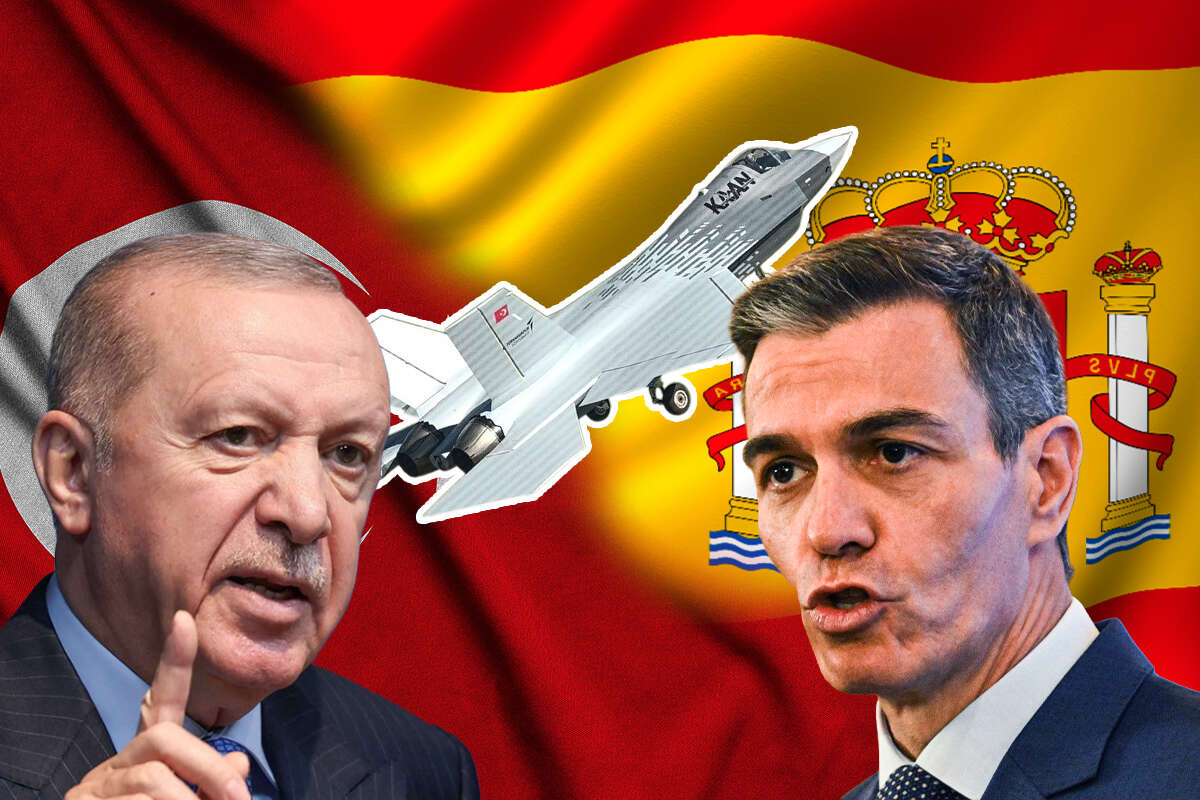
Spain is in preliminary talks with Turkey over the possibility of acquiring the Turkish-made fifth-generation KAAN fighter jet, Spanish media reported Thursday.
According to the local news site El Español, a source at Turkish Aerospace Industries said Spain had "a strategic intention and a requirement to acquire a fifth-generation fighter jet and accompanying unmanned aerial vehicles."
The report comes after Spain dropped plans to buy F-35 jets. El País, which first reported the decision to withdraw from the deal, said the reasons included US restrictions on access to the aircraft's critical technologies, concern over a possible US veto on its use, its price, and a desire to support European industries.

Another important context is the diplomatic clash between Prime Minister Pedro Sánchez and US President Donald Trump, which peaked around Sánchez's criticism of the war in Iran and Trump's threats to sever trade relations. Relations between Madrid and Washington had already been strained over Spain's refusal to commit to raising defense spending to 5% of GDP, in line with other NATO members.
Spain's fighter fleet is based on Eurofighter jets, produced jointly by companies from the UK, Germany, Italy and Spain, as well as F-18s. Spain had been expected to buy the F-35A variant for its air force and the F-35B variant for its navy, with the latter capable of vertical landing.
In the long term, Madrid had placed its hopes in the FCAS project, a joint initiative with Germany and France to produce a sixth-generation fighter jet. However, the project appears to have run aground in recent months.
The KAAN, whose name means "ruler" in Turkish, is a stealth, twin-engine, fifth-generation fighter jet being developed by Turkish Aerospace Industries. Its maiden flight took place in February 2024, and it is expected to enter service with the Turkish Air Force by the end of the decade, although so far only one prototype has conducted test flights.
According to Turkish officials, the aircraft also has the ability to operate drones in a "wingman" configuration, generally seen as a capability expected to be part of sixth-generation fighter jets. Development of the aircraft was accelerated after Turkey was removed from the F-35 program following its purchase of S-400 air defense systems from Russia.
Indonesia last year signed an agreement to purchase 48 of the aircraft for about $10 billion.

Spain has already announced that it will buy 45 Hurjet aircraft made by Turkish Aerospace Industries, which will be used by its air force to train fighter pilots. The deal, worth around €3.1 billion, was approved last October, and the aircraft will be converted to the Spanish configuration at Airbus facilities in Spain. Deliveries are expected to begin in 2028, and according to reports in Spain, they could also be used in the future to train pilots for KAAN aircraft.
According to reports in the Spanish press, one of the reasons for Madrid's interest is the possibility that the deal would include technology transfers, with Spanish systems integrated into the aircraft and part of its production carried out in Spain. Turkish Aerospace Industries officials were quoted as saying that "the Hurjet is only the first step, and it will be the training aircraft for the KAAN in Spain."