Doha poses as a mediator in the October 7 hostage talks, but the arsonist cannot be a firefighter. True mediation demands Cairo's credibility. Qatar hosted Hamas' leadership, funded and legitimized it, violating UN Security Council Resolutions 1373 and 2462, obligating states to deny sanctuary and funds. The UN Charter bars the use of force (Art. 2(4)) but preserves the right to self-defense (Art. 51). By abdicating its duty, Doha forfeited protection and became an accomplice.
Britain and France struck ISIS in Syria (2015); the US struck bin Laden's infrastructure in Sudan (1998) and eliminated him in Pakistan (2011). NATO's bombing of government institutions in Belgrade (1999), when Serbia harbored war criminals, was a reminder that palaces sheltering them become legitimate military objectives.
International law recognizes the "unwilling or unable" doctrine when a host state fails to prevent a threat. The US invoked it in its Article 51 letter on ISIS (2014), endorsed by the UK Attorney General (2017), holding that states harboring terrorists forfeit protection. This reflects due diligence, as affirmed in the Corfu Channel judgment (ICJ, 1949), which held Albania liable for failing to warn of mines that struck British vessels, and codified in the UN Articles on State Responsibility (2001). Articles 4, 8, and 11 attribute organs, proxies, and ex post conduct to the state: aiding terrorists forfeits immunity.
But Qatar is not Hamas' only hub. In Turkey, it maintained a headquarters in Istanbul, with operations focused on cyber and fundraising, and expanded into occupied northern Cyprus. Networks tied to Hamas, the Houthis, and Iran's Quds Force, documented by allied intelligence, deepened this partnership. This HQ plotted the assassination of Minister Itamar Ben Gvir.
The Turkish National Intelligence Organization, MIT, boasting full-spectrum surveillance and claiming to track every foreign actor, cannot plead ignorance. Since 2017, under Erdogan's direct control, its silence means coordination with Hamas.
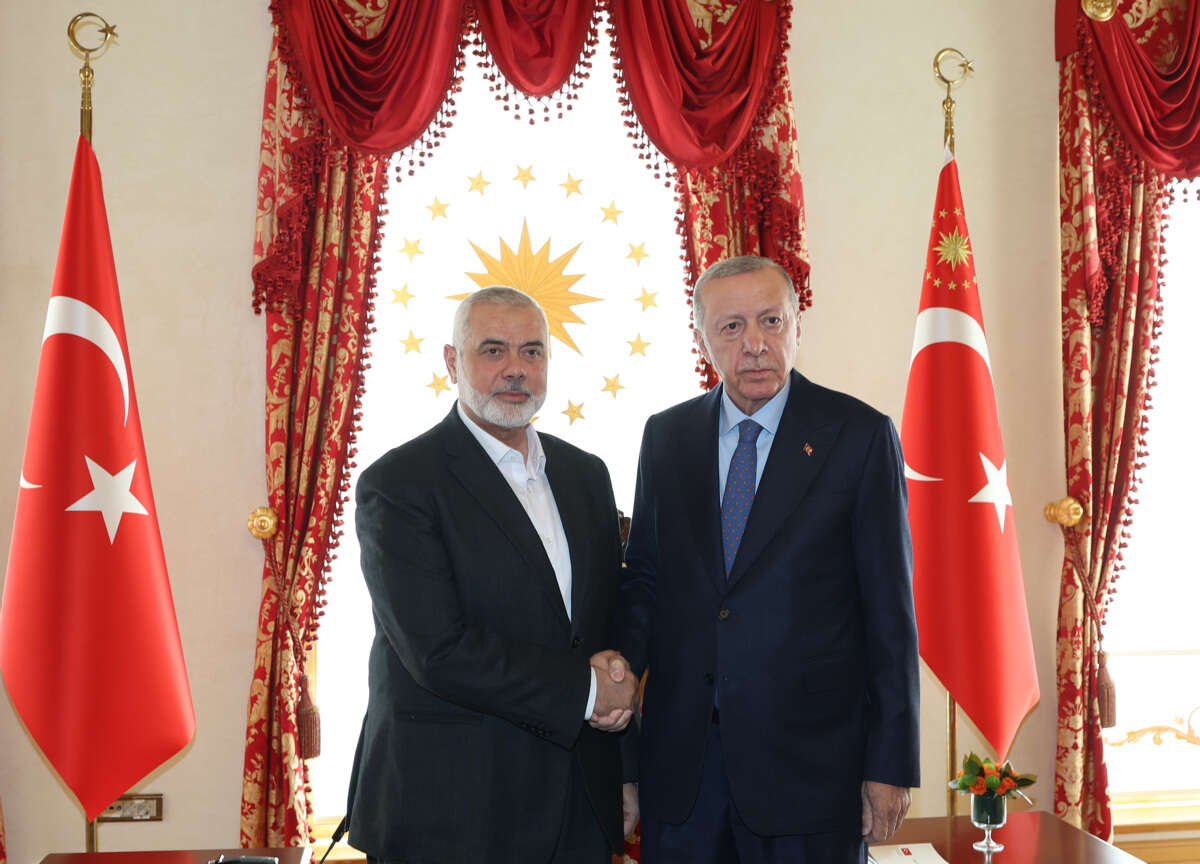
The embrace was overt: senior Hamas officials, including Ismail Haniyeh (eliminated in Tehran, 2024), were received at the presidential palace in Ankara. Erdogan personally handed Turkish passports to operatives on camera. Turkey has long invoked self-defense for incursions into Iraq and Syria against the PKK; the same logic entitles Israel to act against Hamas on Turkish soil.
Both Qatar and Turkey claimed immunity. Doha relied on its "mediator" role and hosting Al Udeid, the largest US base in the region, yet in 2024, Congress moved to review cooperation given Doha's ties to Hamas. Ankara relied on NATO membership and the Incirlik airbase. But reliance on US bases proved fragile when Erdogan accused Washington of backing the 2016 coup attempt. US operations at Incirlik were halted, exposing its vulnerability. By 2019, US debates had begun on relocating or splitting Incirlik, notably to Souda Bay (Crete), with Ovda (Israel) and Amman also being mentioned. In 2020, the US Navy homeported a major expeditionary sea base at Souda Bay, demonstrating the option's viability.
Israel informed Washington, but the Begin Doctrine – applied in Iraq (1981), Syria (2007), and Iran (2025) – anchors its freedom to act alone; allies may be consulted, but never bind Israel's hand. This posture reflects strategic autonomy: partnership without dependency. The Doha strike reaffirmed that principle: never outsourcing security; acting when vital interests are challenged, even if its partners are uneasy.
Turkey's Akkuyu nuclear project and northern Cyprus military activities could trigger Israeli responses if security thresholds are exceeded. In the maritime domain, Turkish enforcement of its Libya agreement threatens Israeli shipping lanes. Should Turkey block these routes, Israel may break the blockade by force, as it did against Egypt in 1956 and 1967 — this time with Egyptian support against their shared Turkish threat.
Israel let Hamas leaders cycle between Turkey and Doha, then struck within necessity and proportionality, demonstrating that sovereign immunity cannot shield complicit hosts.
Qatar and Turkey have operated coordinated influence campaigns across multiple regions, primarily through funding Muslim Brotherhood networks that destabilized Arab governments. This strategy reached Europe through the 2022 QatarGate scandal, which exposed Qatar's cash-for-influence scheme targeting European officials and resulted in millions seized during police raids. Meanwhile, Turkey deployed similar tactics through Diyanet mosques serving as political outposts and diaspora networks advancing Erdogan's interests abroad. These operations prompted Gulf allies to sever ties with Qatar from 2017 to 2021 over its funding of terrorist groups, while Qatar's Al Jazeera simultaneously provided media training to the Houthis, Hamas, and Polisario Front.
Doha bankrolled Polisario camps in Tindouf, Algeria, masked as aid, building Sahel's Tora Bora: a jihad outpost on Morocco's doorstep, backed by the Axis of Subversion – Qatar, Algeria, and Iran – linking it to Sahelian terror groups. Not charity but conspiracy: petrodollars fueling chaos at Europe's gate. Erdogan's Turkey de facto reversed its recognition of Morocco's integrity: since 2019, Polisario figures have been guests at AKP forums. MIT then used them as proxy drills, rehearsing spoofing, concealment, and stress-testing Morocco's defenses, targeting the country's external intelligence service (DGED).
The Israeli strike reinforced these lessons.
Not just justice, a wake-up call: states that host terrorists and open their gates to Hamas forfeit sovereignty and protection. Responsibility lies with the hand that fires and the state that arms. When Emir Tamim welcomes them in Amiri Diwan, when Sheikha Moza lends her prestige, and when Erdogan offers them his palace, their highest halls become staging grounds. Doha has demonstrated this principle. Beştepe, having crossed the same line, can no longer expect immunity.
Shay Gal is an expert in international politics, crisis management, and strategic communications. He operates globally, focusing on power relations, geopolitical strategy, and public diplomacy, as well as their impact on policy and decision-making.