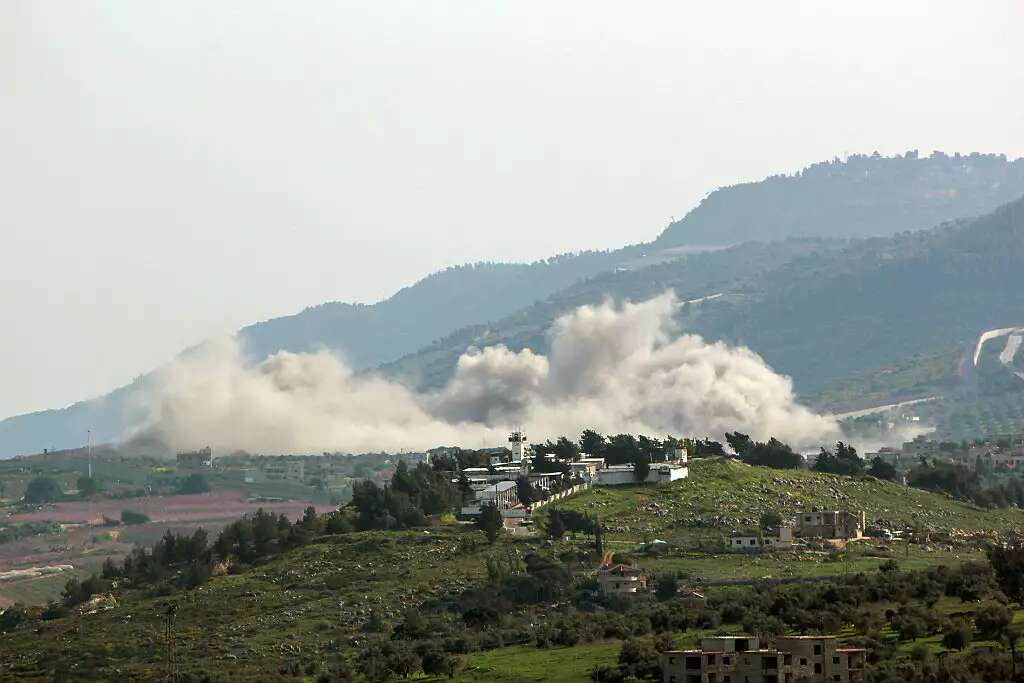
A year has passed since the war in Lebanon ended. Hezbollah had been knocked to the mat after Israel eliminated its political leadership and much of its senior military command, inflicting heavy damage on its military capabilities. Yet precisely at the moment when the terrorist organization faced an unprecedented crisis, Israel threw it a lifeline. By agreeing to a ceasefire, Israel enabled Hezbollah not only to preserve its remaining power but to rebuild it.
On that very same day, rebels in Syria led by Ahmad al-Sharaa, then still known as Abu Mohammad al-Julani, launched a surprise offensive against the regime of Bashar Assad. Within 12 days they toppled the regime and seized control of most of the country. Assad's fall dealt a serious blow to Iran, which lost its strategic foothold in Syria and its ability to transfer support and weapons to Hezbollah through Syrian territory.
This new reality along Israel's northern border created a dual challenge. On the one hand, Israel needed to maintain constant pressure on Hezbollah and continue striking it to prevent its recovery. On the other hand, Israel had a rare opportunity to capitalize on the dramatic shift in Syria and advance essential Israeli interests with the new regime in Damascus. That regime was prepared to guarantee calm along the Golan Heights border and possibly even beyond that.
Predictably, Israel did the opposite of what the new circumstances required. In Lebanon, Israel allowed Hezbollah to recover and rebuild. Apart from impressive precision strikes attributed to Israel as part of the ongoing campaign between wars, their strategic value is questionable. Similar operations in the previous decade also failed to prevent the October 7 disaster.
In Syria, Israel acted with arrogance, overconfidence and a dismissive attitude toward the new leadership in Damascus, despite its willingness to enter far-reaching agreements. Instead, Israel turned that leadership into an enemy and sank into unnecessary involvement in the Syrian quagmire, which does nothing to enhance Israel's security. Even worse, as in other matters, Israel allowed President Donald Trump to become the arbiter and final decision maker on issues central to Israel's national security.

Al-Sharaa is a jihadist by background, and Israel has every reason to treat him with suspicion. But he should be judged by his actions, not by his past statements. For now, he poses no threat to Israel. He is dependent on the United States, governs a shattered state and, more importantly, lacks any military capability that could endanger Israel.
In the aftermath of the October 7 massacre, Israel was unwilling to place trust in al-Sharaa. Instead, it seized control of the border strip with Syria and barred Syrian forces from deploying in the area. This has created unnecessary friction between the Israel Defense Forces and the local civilian population. More significantly, it has created a vacuum that terrorist groups, some backed by Iran and Hezbollah, rushed to fill. A reminder of this came last week in the incident in the village of Beit Jann, where six IDF soldiers were wounded during operations in an area that has effectively become ungoverned territory.
Israel's needless hyperactivity in Syria stands in stark contradiction to its inaction in Lebanon. None of the IDF's operations there amount to a strategic blueprint designed to neutralize Hezbollah's military capabilities.
Overshadowing all of this is President Trump, whose involvement repeatedly reminds Israel who is currently making the decisions for it, whether in Gaza, Lebanon or Syria. For now, Trump is angry at the Lebanese government, which has refused to meet his demands, disarm Hezbollah or institute reforms. As a result, he has given Israel a green light to act in Lebanon, and Israel must take advantage of that window before Trump changes course.
As for Syria, Trump has already decided that Ahmad al-Sharaa is someone he trusts, a ruler who is "doing a good job in Syria." Here too Israel finds itself compelled to fall in line with the American position, to try to deescalate and possibly even to reach understandings with al-Sharaa under Trump's sponsorship. That path would be far preferable to Israel than an unnecessary entanglement inside Syria.