

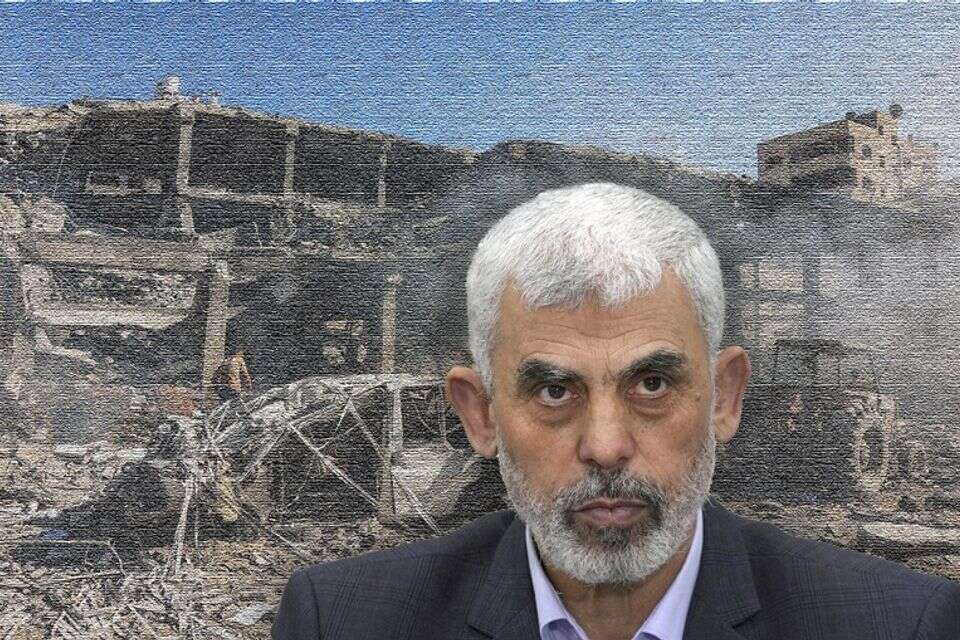
On the horrific morning of October 7, 2023, when Yahya Sinwar gave the order to "break through" to his terrorists, he imagined himself writing the most glorious chapter in the history of Palestinian resistance and Islamic activism. In his vision, the massacre in the communities surrounding Gaza was supposed to be the decisive blow that would collapse the "Zionist entity," spark a regional shockwave of pan-Arab uprising, and crown him as a historic commander, the modern Saladin of the Middle East.
History, however, is by nature an ironic and merciless scriptwriter. Viewed through the lens of historical perspective, as the dust eventually settles over the ruins of Gaza, southern Lebanon and Tehran, it may become clear that Sinwar not only failed to bring about Israel's destruction. Instead, he was the decisive trigger, the deadly "butterfly wingbeat," that led to the total collapse of the entire "axis of resistance" and the elimination of his greatest patrons: Hassan Nasrallah and Ali Khamenei.
To understand the magnitude of this strategic turning point, one must adopt a broader perspective that goes beyond the immediate pain of the massacre. Until October 7, Iran's "ring of fire," the strategic concept devised by Qassem Soleimani, functioned with chilling effectiveness. Hamas in the south, Hezbollah in the north, and the Houthis in Yemen all revolved around the Iranian sun, tying Israel's hands and creating a frustrating deterrence equation of constant attrition. Iran sat safely behind the scenes pulling the strings, while Hezbollah leader Hassan Nasrallah remained entrenched in his bunker, boasting of his vast missile arsenal and cultivating his image as the "defender of Lebanon" and the Israel Defense Forces' ultimate nightmare.
Then Sinwar arrived and, driven by messianic arrogance, pulled the trigger too early.
The brutal assault, the rapes and the mass murder did not break Israel's spirit. The opposite happened. They awakened a dormant military, social and national force. Shock and grief were replaced by righteous fury, leading to an unprecedented mobilization of a powerful reserve army, backed by internal legitimacy and, for a time, international support to act without restraints and without mercy. Sinwar, like Nasrallah, believed Israel was "as weak as a spider's web" because of its internal crises, but instead discovered a nation rallying around a burning instinct for survival.

What began as a campaign to clear the Gaza border communities quickly evolved into the complete destruction of the military and governing infrastructure of Hamas. But the butterfly effect did not stop there. Israel's defensive war in Gaza exposed the weakness of the axis of evil. Nasrallah, out of forced solidarity, provoked Israel in the north, trapped in the same flawed concept that the Israel Defense Forces were exhausted and bogged down in Gaza. He failed to understand that October 7 had changed Israel's security DNA. Containment was over. Passivity had turned into lethal offensiveness.
Thus, step by step, Sinwar's massacre led Israel's security establishment to launch unprecedented proactive attacks: targeted killings in the heart of the Dahiyeh district in Beirut, the destruction of precision missile arrays, and ultimately the dramatic killing of Hassan Nasrallah himself, the crown jewel of Iran's regional project. The blow inflicted on Hezbollah, the Lebanese Shiite terrorist organization, was so severe that it forced Tehran, contrary to its longstanding preference to remain behind the scenes, to enter into a direct and open confrontation with Israel and the US. Iran's decision to respond directly, a move that exposed its vulnerability and triggered counterstrikes, could ultimately bring about the end of the ayatollahs' rule and led to the elimination of Supreme Leader Ali Khamenei at its head.
When historians write the history books of the Middle East fifty years from now, October 7 will not be remembered only as the most devastating national disaster for the Jewish people since the Holocaust. Paradoxically, and almost cynically, it may also be recorded as the turning point: the moment when the architect of the massacre, Yahya Sinwar, ignited with his own hands the geopolitical chain reaction that burned the dream of Iranian hegemony to the ground, shattered Hezbollah, and brought about the historic collapse of the most dangerous axis in the region. A butterfly's wingbeat in Gaza that created a hurricane which erased its own patrons from the world.


