

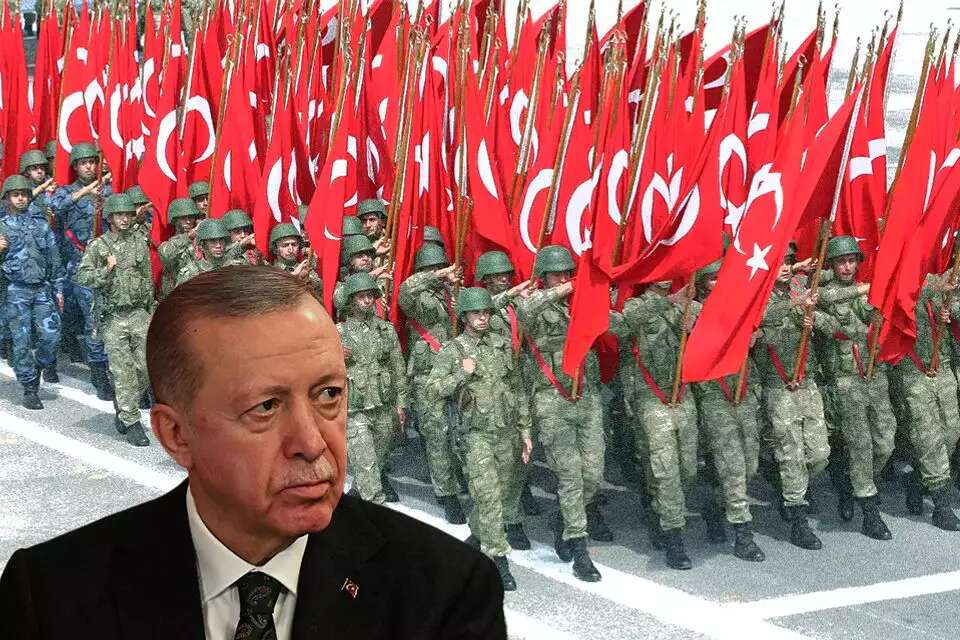
Turkey's foreign minister Hakan Fidan announced a trade cutoff with Israel, shutting ports and restricting airspace - the latest move in a strategy rooted in President Erdogan's 2019 maritime deal with Tripoli, which granted Ankara a direct line a thousand kilometers across Egyptian and Greek waters. The agreement, filed with the UN, drew immediate rejection as a fictitious border conceded for military aid.
About 98% of Israel's trade depends on Mediterranean routes, with seabed cables linking it to Europe and beyond.
Desperate for Turkish weapons, Tripoli handed him this gift - a tool to threaten Israel's sea lanes. Libya is fractured: the Tripoli government, dependent on Erdogan's military aid and aligned with the Muslim Brotherhood, Qatar, and global jihad networks. Opposing it stood the eastern camp of General Haftar, supported by Russia, and by Saudi Arabia, the UAE, and Egypt - whose security interests often converge with Israel's. Haftar rejected the 2019 deal as an illegitimate surrender of Libya's sovereignty - an invented border conceded to Ankara for military aid. Today the east is shifting: after Haftar met Turkey's intelligence chief, the Tobruk House of Representatives, once opposed, is preparing to approve. What began as a one-sided deal with Tripoli is now a lever spanning both camps.
The agreement was challenged in courts on both sides. In 2021, al-Bayda's Court of Appeals annulled the maritime MoU, ruling Tripoli lacked authority without parliamentary approval. In 2024, the Tripoli Court of Appeals (west) struck down a Turkey-Libya gas deal, ruling it rested on the same imaginary border.
Turkey argues that Greek islands are entitled only to narrow territorial waters, without an EEZ. International law says otherwise: the Law of the Sea, though unsigned by Turkey, remains binding. Small islands may have reduced weight, but major islands like Crete and Rhodes cannot be erased. In the eastern Mediterranean, virtually no open waters; every mile is claimed or disputed. Any new Turkish line cancels neighbors' sovereign rights.
Turkey acts as if the deal is valid, sending ships, signing contracts, and a nine-month, 10,000-km seabed survey to deepen its "facts on the ground".
The European Union declared the Turkish-Libyan deal legally void. Its 2019 sanctions against "unauthorized drilling" failed; NATO patrols off Libya have not stopped Turkish ships.
EU divisions were starkest in Paris's stance: France shielded Haftar in EU councils - blocking a 2019 draft condemning his Tripoli offensive - backing him diplomatically without rallying Europe, while pursuing its own Libya policy with Haftar and Gulf allies - leaving the EU fragmented, Ankara unchecked.
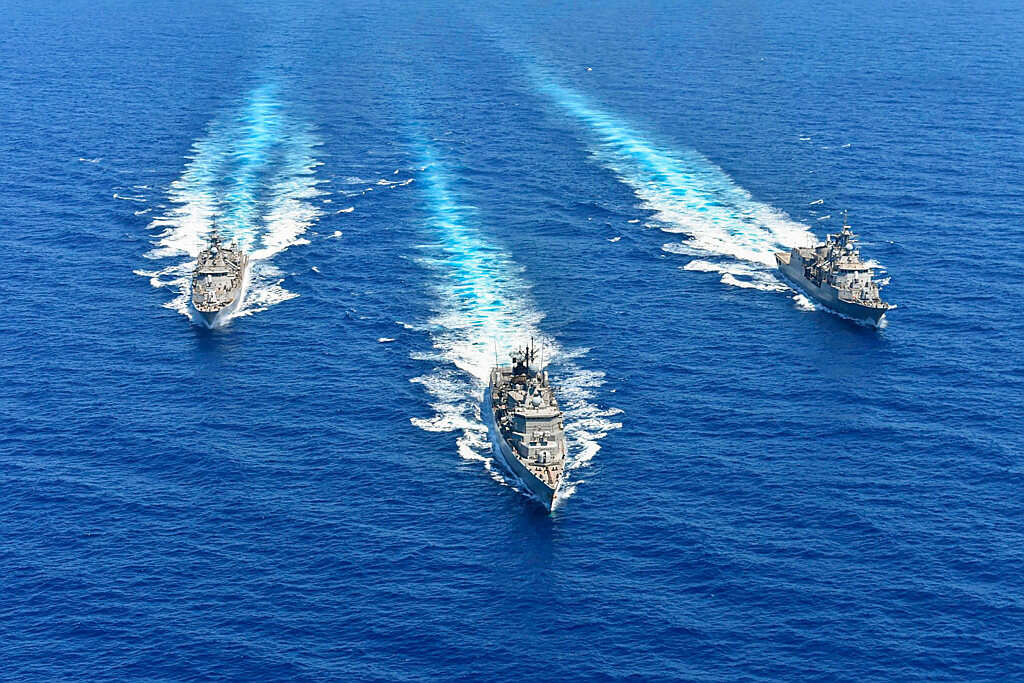
Europe has seen the cost of such vulnerability before. In 2022, the Nord Stream explosion - the flagship pipeline carrying Russian gas to Germany - exposed Europe's vulnerability to undersea attacks. Yet in the eastern Mediterranean no dedicated force has been deployed. Ankara is exploiting the vacuum.
And this challenge is not unique to the Mediterranean. Australia faces a parallel threat: over 95% of its global connectivity depends on undersea cables, a grey zone where 'accidents' conceal sabotage. Chinese ships mapped cable routes under the guise of science - lawful in form, strategic in effect - the same pattern Ankara applies in the Mediterranean. What Canberra calls a "fragile center of gravity" beneath the Southern Ocean is, in the Mediterranean, the very domain Turkey seeks to control.
Israel's trade artery runs through this contested zone, and any Turkish claim could mean harassment of Israeli vessels. The EuroAsia Interconnector - linking Israel's power grid via Cyprus to Crete and Greece - depends on stability in the area. Intercontinental cables like Blue-Raman also cross these same waters.
This border, which has collapsed legally and defies geographic logic, is not just a fictitious map. It is a strategic instrument - aimed at erasing Greece, squeezing Egypt, blocking Israel. Through it, Turkey seeks to control the critical infrastructure on which Israel and the region's security and economy rely.
Without Turkey's control of Northern Cyprus - occupied since 1974 and transformed into the forward base of the "Mavi Vatan" (Blue Homeland) doctrine of expanded Turkish dominance in the Eastern Mediterranean - the maritime deal with Libya would have remained a fiction. Northern Cyprus gives Ankara a launchpad to extend a direct line to Libya, binding the fictitious maritime line into its wider Mavi Vatan design. For Israel, this occupation is not abstract: from drone and missile bases there, Turkey can swiftly target Israeli gas rigs, naval assets, and communications, while enabling covert Hamas and Iranian operations — a playbook familiar from Tehran's own proxy warfare. This is the front that the "Poseidon's Wrath" contingency is meant to address - and the Libyan extension of Mavi Vatan may one day test the region in a similar way.
In the Red Sea, Ankara operates through the Houthis as an unofficial navy, disrupting Suez shipping and diverting Asia-Europe trade onto overland routes Ankara controls - mirroring Iran's reliance on proxies to disrupt maritime routes. This strategy is not only aimed at global trade but also at Egypt itself: by undermining the Canal, Erdogan seeks to undermine al-Sisi's regime, erode Egypt's economic lifeline, and empower the Muslim Brotherhood, his long-standing ideological allies. In this way, Ankara sketches a continuous grip - from the Mediterranean to Bab al-Mandeb - designed to control trade routes and reshape regional strategy.
The Suez Crisis (second Arab-Israeli war) of 1956 and the Six-Day War of 1967 both erupted by Israel to break Egypt's naval blockade of Eilat. Today, Egypt stands with Israel against a similar enduring maritime threat from Turkey - and could be a partner in removing it.
Shay Gal is an expert in international politics, crisis management, and strategic communications. He operates globally, focusing on power relations, geopolitical strategy, and public diplomacy, and their impact on policy and decision-making.


