Israel Hayom is a media organization founded on the belief that the Israeli public deserves better journalism—more balanced, more accurate, and more reliable. Journalism that speaks rather than shouts. Journalism that is trustworthy, objective, and matter-of-fact. A different kind of journalism, offered free of charge. The first print edition was published on July 30, 2007, and in 2010 Israel Hayom became the Israeli newspaper with the highest weekday readership. The newspaper’s publisher is Dr. Miriam Adelson. Its Editor-in-Chief is Omar Lachmanovitch, and its founding editor is Amos Regev. Israel Hayom’s Hebrew and English websites, as well as its Android and iOS applications, provide around-the-clock news coverage, exclusive content, breaking news and updates, analysis and commentary, video, podcasts, and live broadcasts. The digital platforms of Israel Hayom include news and opinion channels covering culture and entertainment, lifestyle, technology, sports, business and consumer affairs, health, military affairs, food, Judaism, tourism, and automobiles. In 2021, a new Hebrew-language website and mobile application were launched to provide users with a fast, up-to-date, secure, and convenient experience. The content of the newspaper’s print edition is also available online through a daily digital edition and can be received via newsletter. “The Israel Hayom Clique,” the publication’s exclusive benefits club, offers website users discounts and special promotions on products and services. Israel Hayom welcomes feedback, criticism, and suggestions for improvement from its readers. You can contact the organization by email at hayom@israelhayom.co.il

Tuesday Jul 21, 2026
NEWSLETTER
www.israelhayom.com
  • Home
  • News
    • Israel
    • Israel at War
    • Middle East
    • United States
  • Opinions
  • Jewish World
    • Archaeology
    • Antisemitism
  • Lifestyle
    • Food
    • Travel
    • Fashion
    • Culture
  • Magazine
    • Feature
    • Analysis
    • Explainer
  • In Memoriam
www.israelhayom.com
  • Home
  • News
    • Israel
    • Israel at War
    • Middle East
    • United States
  • Opinions
  • Jewish World
    • Archaeology
    • Antisemitism
  • Lifestyle
    • Food
    • Travel
    • Fashion
    • Culture
  • Magazine
    • Feature
    • Analysis
    • Explainer
  • In Memoriam
www.israelhayom.com
Home News World News

US-Iran tensions rise over oil route as EU tries to save nuclear deal

by  Reuters and Israel Hayom Staff
Published on  07-06-2018 00:00
Last modified: 12-22-2019 11:59
US-Iran tensions rise over oil route as EU tries to save nuclear deal

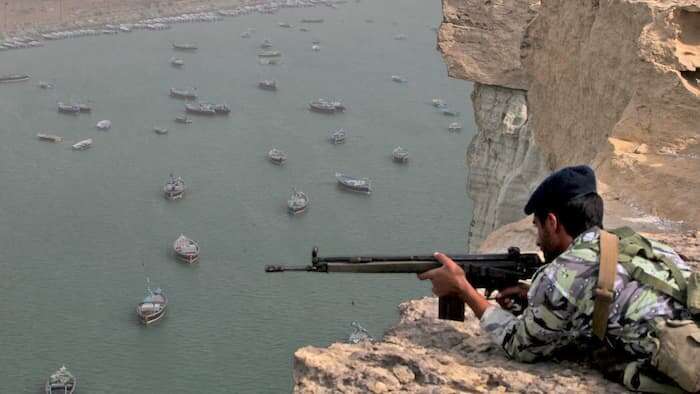
An Iranian solider positioned over the Strait of Hormuz

Share on FacebookShare on Twitter

Tensions between Iran and the United States over oil shipments through the Strait of Hormuz rose Thursday, with Iran saying that if it is blocked from shipping oil through the strait it will block all others from doing so too, and the U.S. responding that the U.S. Navy stands ready to ensure free navigation and the flow of commerce through the strategic waterway.

The European Union has proposed a plan for salvaging the 2015 international nuclear deal with Iran in the wake of the U.S. pullout in May and the reimposition of U.S. sanctions on Iran.

But Iranian President Hassan Rouhani said on Thursday that the package does not go far enough.

Rouhani and some senior military commanders have threatened in recent days to disrupt oil shipments from Persian Gulf countries if the U.S. tries to strangle Iranian exports.

Foreign ministers from the U.K., China, France, Germany and Russia met with the Iranian foreign minister in Vienna this week for the first time since the U.S. left the pact, but diplomats see limited scope for salvaging it.

"The objective is to save the deal," a senior European diplomat said. "We've made some progress, including on safeguarding some crude sales, but it's unlikely to meet Iranian expectations. It's also not just about what the Europeans can do, but also how the Chinese, Russians, Indians, others can contribute."

The pillars of the EU strategy are European Investment Bank lending, a special measure to shield EU companies from U.S. secondary sanctions, and a European Commission proposal that EU governments make direct money transfers to Iran's central bank to avoid U.S. penalties.

"The Iranians expect the others to say what we are going to do to keep the deal alive. We will have to see if it is going to be good enough for them," an EU source said.

According to Iranian state media and his own website, Rouhani spoke with French President Emmanuel Macron and German Chancellor Angela Merkel by phone, and told them he was disappointed with their package, which did not go far enough.

Rouhani has warned that Iran could reduce its cooperation with the U.N. nuclear watchdog, the International Atomic Energy Agency, and has threatened U.S. President Donald Trump of the "consequences" of fresh sanctions against Iranian oil sales.

The parties were expected to meet again on Friday for what Iranian officials described as an "important" meeting. The officials said that the key for them is to ensure measures that guarantee that oil exports can continue and that Iran will still have access to the SWIFT international bank payments messaging system.

"SWIFT is the key, but Iran has to stay in [the nuclear deal] at least until the end of the year to maintain divisions between the EU and U.S., keep some credibility and try and survive amidst forthcoming sanctions," said Sanam Vakil, an associate fellow at the London-based think tank Chatham House.

While talks are expected to focus on the nuclear deal, they come amid increasing rhetoric from the Trump administration, which says Iran poses a serious security threat.

An Iranian diplomat based in Austria was among four people arrested on suspicion of plotting an attack on an Iranian opposition group in France last week.

The issue could be a distraction in the Vienna talks.

Iran has said it had nothing to do with the plot and has demanded the official be released without delay.

But any confirmation that Iranian authorities were behind the plot could make it politically difficult for European leaders to continue to back the nuclear deal.

Maj. Gen. Mohammad Ali Jafari, commander of the Revolutionary Guard Corps, said Thursday that if Iran cannot sell its oil due to U.S. pressure, then no other Gulf country will be allowed to do so either.

"We are hopeful that this plan expressed by our president will be implemented if needed," he said. "We will make the enemy understand that either all can use the Strait of Hormuz or no one."

In response, U.S. Central Command spokesman Navy Captain Bill Urban said, "The U.S. and its partners provide and promote security and stability in the region."

Asked what would be the U.S. naval reaction if Iran blocks the strait, he said, "Together, we stand ready to ensure the freedom of navigation and the free flow of commerce wherever international law allows."

The Revolutionary Guards' naval arm lacks a strong conventional fleet. However, it has many speedboats and portable anti-ship missile launchers and can lay mines.

A senior U.S. military leader said in 2012 that the Guards have the ability to block the strait "for a period of time," but the U.S. would take action to reopen it in such an event.

Related Posts

Transition at Downing Street: Starmer bows out, Andy Burnham to become PMAaron Chown /AFP

Transition at Downing Street: Starmer bows out, Andy Burnham to become PM

by Adi Nirman and Dudi Kogan

Former Manchester mayor takes helm of British government after his meeting with King Charles.

Andy Burnham declared Labor Party leader following Starmer collapseAP Photo/Jon Super

Andy Burnham declared Labor Party leader following Starmer collapse

by Bar Shaffer

The transition comes after outgoing Prime Minister Keir Starmer resigned under intense party pressure following just two years in office.

White House denies rift between Trump, Vance over Iran policyAFP

White House denies rift between Trump, Vance over Iran policy

by Or Shaked and Adi Nirman

Press Secretary Karoline Leavitt stated that differing remarks on negotiations occurred at different times, emphasizing that the administration remains unified.

Menu

Analysis 

Archaeology

Blogpost

Business & Finance

Culture

Exclusive

Explainer

Environment


Features

Health

In Brief

Jewish World

Judea and Samaria

Lifestyle

Cyber & Internet

Sports


Diplomacy 

Iran & The Gulf

Gaza Strip

Politics

Shopping

Terms of use

Privacy Policy

Submissions

Contact Us

About Us

The first issue of Israel Hayom appeared on July 30, 2007. Israel Hayom was founded on the belief that the Israeli public deserves better, more balanced and more accurate journalism. Journalism that speaks, not shouts. Journalism of a different kind. And free of charge.

All rights reserved to Israel Hayom

Hosted by sPD.co.il

  • Home
  • News
    • Israel at War
    • Israel
    • United States
    • Middle East
    • Sports
  • Opinions
  • Jewish World
    • Archaeology
    • Antisemitism
  • Lifestyle
    • Food
    • Travel
    • Fashion
    • Culture
  • Magazine
    • Feature
    • Analysis
    • Explainer
    • Environment & Wildlife
    • Health & Wellness
  • In Memoriam
  • Subscribe to Newsletter
  • Submit your opinion
  • Terms and conditions

All rights reserved to Israel Hayom

Hosted by sPD.co.il

Newsletter

[contact-form-7 id=”508379″ html_id=”isrh_form_Newsletter_en” title=”newsletter_subscribe”]

  • Home
  • News
    • Israel at War
    • Israel
    • United States
    • Middle East
    • Sports
  • Opinions
  • Jewish World
    • Archaeology
    • Antisemitism
  • Lifestyle
    • Food
    • Travel
    • Fashion
    • Culture
  • Magazine
    • Feature
    • Analysis
    • Explainer
    • Environment & Wildlife
    • Health & Wellness
  • In Memoriam
  • Subscribe to Newsletter
  • Submit your opinion
  • Terms and conditions

All rights reserved to Israel Hayom

Hosted by sPD.co.il