

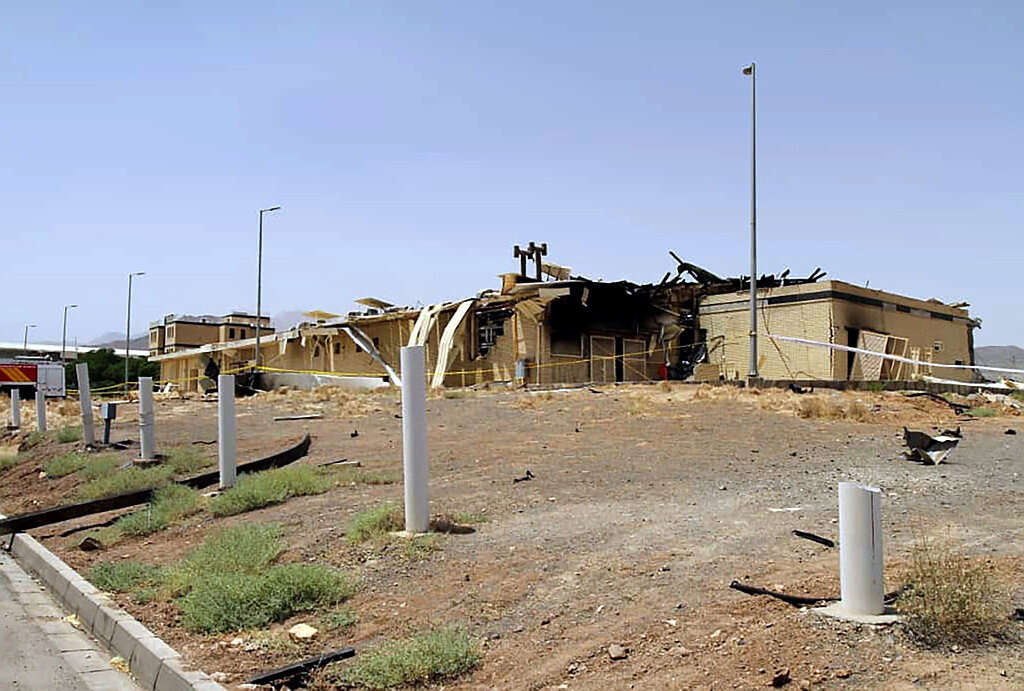
A mysterious string of fires and explosions at military and industrial sites across Iran in recent weeks has led to wide speculation over whether these incidents are mere coincidence or purposeful sabotage by a foreign entity. And if it is indeed the latter, the question is who and why, and will Iran attempt to retaliate?
Follow Israel Hayom on Facebook and Twitter
Farzin Nadimi, an associate fellow at the Washington Institute for Near East Policy, told JNS the recent series of strange accidents in Iran "were a mixture of industrial mishaps" and "suspected cyberattacks." The Natanz explosion, for example, was "apparently concluded as a bomb blast caused by an infiltrator or infiltrators."
Nadimi said Iranian officials are not willing to talk about it just yet "because they're still looking for the culprit(s) and figuring out how to respond."
"What is almost sure, however," he said, "is that they want their response to be proportional with similar magnitudes."
In June, explosions occurred at the military complex of Parchin and in the Sina At'har health center in Tehran.
In July, a series of explosions occurred, including at Iran's largest nuclear enrichment facility in the city of Natanz; at the Shahid Medhaj Zargan power plant in the city of Ahvaz; in the oxygen factory in the town of Baqershahr; at a missile facility belonging to the Iran Revolutionary Guard Corps; at the Tondgooyan petrochemical plant; in an industrial complex near Mashad; on an oil pipeline in Ahvaz, and at a power plant in Isfahan Province.
Also in July, a large fire broke out at a shipyard in the southern Iranian port city of Bushehr, and 70 people were injured following a chlorine gas leak at the Karoon Petrochemical Plant in the city of Mahshahr. An aluminum factory in the industrial city of Lamard caught fire, and another fire broke out at a petrochemical plant in Khuzestan Province.
Nadimi said that if Iran believes that Israel was behind the Natanz attack – considered more serious since it targeted Iran's nuclear program – Iran "will try to target Israel's nuclear infrastructure or something as important because they might not be able to get to an Israeli nuclear site 'on foot' for a sabotage attack."
"This time they will definitely do something after they figure things out," he said of Iran.
Reacting to these mysterious events taking place in Iran, Raz Zimmt, a research fellow specializing in Iran at the Institute for National Security Studies, wrote on Facebook that "even if the latest incidents cannot be connected and even if most of them are not the result of a sabotage campaign, the heightened sense of stress it foments inside Iran piles additional pressure on the government to take drastic measures."
"Eventually," Zimmt wrote, "Tehran may cave to those pressures, despite the leadership's desire to avoid severe steps before it can recalibrate its strategy to reflect the results of the November US presidential election."
Iran has plenty to deal with at the moment, including coronavirus, crippling US sanctions, a deep economic crisis and domestic issues. There are also the upcoming US presidential elections, which could see the election of Joe Biden and the Democrats in power—a party that would be interested in appeasing Iran by removing the current sanctions.
'Iran most certainly gets the hint'
The Islamic Republic began violating the 2015 nuclear deal last year, using advanced centrifuges and stockpiling more heavy water and enriched uranium.
The Trump administration has applied broad economic, trade, scientific and military sanctions against Iran for its regional belligerency and non-compliance with international norms.
Behnam Ben Taleblu, a senior fellow at the Foundation for Defense of Democracies, where he focuses on Iranian security and political issues, said he had "originally taken an Occam's Razor approach to these reported fires and explosions – meaning that the simplest explanation was likely to be the truest.
"As of late June," he said, "that meant seriously considering the thesis that some of these explosions were merely the result of regime incompetence, too much secrecy and poor security protocols. But stringing the series of attacks together, the theory of foreign sabotage makes the most sense."
Subscribe to Israel Hayom's daily newsletter and never miss our top stories!
The fact that so many important and strategic sites have exploded or gone up in flames in just a matter of weeks demonstrates to the leadership that its sensitive sites "are not as secure as the regime may have thought," he said.
Ben Taleblu said that the regime is too embarrassed by these incidents to admit its vulnerability publicly or to overtly engage in some form of retaliation abroad since it will "force the regime to admit this deficiency at home, which can also cause problems."
"In short," he said, "Iran's escalation options are limited, but not non-existent."
Reprinted with permission from JNS.org.


