Israel Hayom is a media organization founded on the belief that the Israeli public deserves better journalism—more balanced, more accurate, and more reliable. Journalism that speaks rather than shouts. Journalism that is trustworthy, objective, and matter-of-fact. A different kind of journalism, offered free of charge. The first print edition was published on July 30, 2007, and in 2010 Israel Hayom became the Israeli newspaper with the highest weekday readership. The newspaper’s publisher is Dr. Miriam Adelson. Its Editor-in-Chief is Omar Lachmanovitch, and its founding editor is Amos Regev. Israel Hayom’s Hebrew and English websites, as well as its Android and iOS applications, provide around-the-clock news coverage, exclusive content, breaking news and updates, analysis and commentary, video, podcasts, and live broadcasts. The digital platforms of Israel Hayom include news and opinion channels covering culture and entertainment, lifestyle, technology, sports, business and consumer affairs, health, military affairs, food, Judaism, tourism, and automobiles. In 2021, a new Hebrew-language website and mobile application were launched to provide users with a fast, up-to-date, secure, and convenient experience. The content of the newspaper’s print edition is also available online through a daily digital edition and can be received via newsletter. “The Israel Hayom Clique,” the publication’s exclusive benefits club, offers website users discounts and special promotions on products and services. Israel Hayom welcomes feedback, criticism, and suggestions for improvement from its readers. You can contact the organization by email at hayom@israelhayom.co.il

Friday Oct 16, 2026
NEWSLETTER
www.israelhayom.com
  • Home
  • News
    • Israel
    • Israel at War
    • Middle East
    • United States
  • Opinions
  • Jewish World
    • Archaeology
    • Antisemitism
  • Lifestyle
    • Food
    • Travel
    • Fashion
    • Culture
  • Magazine
    • Feature
    • Analysis
    • Explainer
  • In Memoriam
www.israelhayom.com
Home Lifestyle Food

East meets West: Jerusalem exhibit displays coffee culture through the ages

The Museum for Islamic Art features ornately decorated cups without handles used for Turkish coffee on display next to larger china cups used by the French elite. One features a mustache-shaped bar in the cup opening designed to protect the facial hair of the drinker.

by  Judy Lash Balint , JNS and ILH Staff
Published on  07-25-2021 12:03
Last modified: 07-25-2021 12:18
East meets West: Jerusalem exhibit displays coffee culture through the agesGetty Images

Not your average cup of Joe | Illustration: Getty Images

Share on FacebookShare on Twitter

Coffee culture in Israel is as varied as the population. Bedouin hospitality dictates finely ground dark coffee served in tiny cups; Arabs will serve strong Turkish coffee often spiked with a dash of cardamom and brewed in a raliya, or finjan as it's known in Israel; Israelis with a European or American background favor espresso drinks; and many Jews with Ethiopian roots still revere and practice the traditional Buna coffee ceremony.

Follow Israel Hayom on Facebook and Twitter 

In a new temporary exhibit, "Coffee: East and West" that just opened, the Museum for Islamic Art in Jerusalem pulls all those strands together to tell a compelling story of economic, social, religious and cultural significance.

The exhibit, spread over three of the museum's halls, includes items from more than 30 countries that illustrate how rich and poor prepared and served coffee over the ages. Many items are on loan from Turkish collections since the Ottoman Empire was at the center of the economic and cultural coffee enterprise.

Tiny, delicate, ornately decorated cups without handles that were used for Turkish coffee are on display next to larger china cups used by the French elite. One features a mustache-shaped bar in the cup opening designed to protect the facial hair of the coffee drinker.
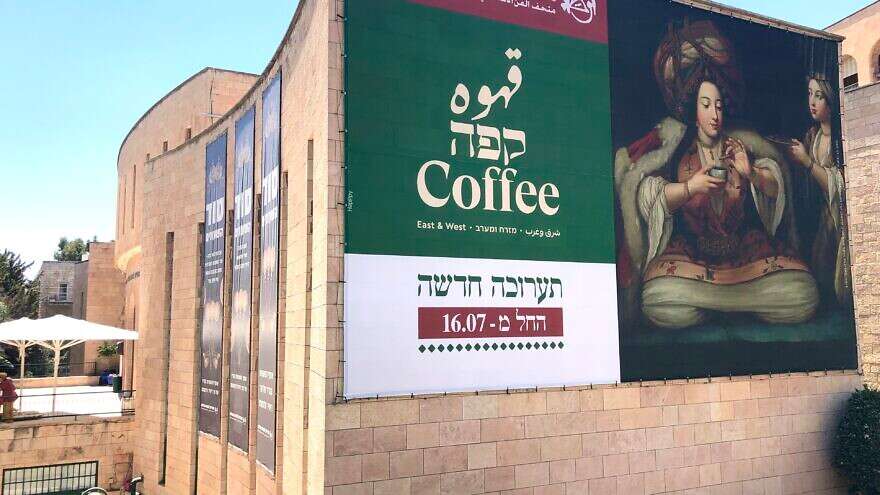
"Coffee: East and West," at the Museum for Islamic Art in Jerusalem tells a compelling story of economic, social, religious and cultural significance (Courtesy via JNS)

In a preview visit, a senior guide told visitors that until the 16th century, tea was the traditional beverage of the Middle East, introduced by those who plied the Silk Road trade route. Coffee originally developed in Ethiopia and spread to Yemen. With the spread of the Ottoman Empire over large swaths of the Arabian Peninsula, coffee and coffeehouses became popular in places where alcohol was prohibited, despite the unsuccessful efforts of Muslim religious authorities to outlaw the gatherings they felt were taking people away from the mosques. "Coffee replaced wine in Islam," stated exhibit curator Yahel Shefer.

Jews have also engaged in religious disputations over where and how coffee should be served. One section of the exhibit displays a Hebrew text that deals with various opinions on whether coffee could be consumed on Shabbat and whether Jews could visit a coffee house owned by Christians. The arguments spanned continents but, according to the museum guide, actually led to cooperation between rabbis from the West and their peers from the East, who had encountered coffee at an earlier stage.

The exhibit also illustrates how coffee was sometimes used as a means of separation between women and men, but also as a means of creating female solidarity and empowerment. The illustration used as the banner for the exhibit is a portrayal of a French woman drinking coffee dressed in traditional male Turkish dress. The mingling of men and women in coffeehouses was frowned upon in most places in the world during the 16th and 17th centuries, so some women who desperately wanted to be part of the coffee culture, dressed in men's clothing. A petition from women in 17th-century London who protested their exclusion from coffee houses hangs in another part of the exhibit. Generally, women of 17th- and 18th-century Europe gathered to drink coffee together at home—the origin of the kaffeeklatsch.

Fast-forward a few centuries to pre-state Palestine of the 1930s under the British Mandate. European Jews who fled their turbulent continent when Hitler came to power brought a sophisticated cafe culture with them.

Several ceramics factories were founded during this period that produced a distinctive "Eretz Israel" style of coffee pots and cups. Many of these are on display and form the premiere of the "Israeliana" collection at the Museum. Among the items are founding father and first Israel Prime Minister David Ben-Gurion's coffee cup, the "President" coffee set created for the President's House and Israeli embassies abroad during the term of office of the longest-serving Israeli President Yitzhak Ben-Zvi.

Also on view is an impressive array of vintage Italian espresso machines that used to grace the best Israeli cafes. One is a model of the world's first espresso machine manufactured in 1884.

Subscribe to Israel Hayom's daily newsletter and never miss our top stories!

Simpler coffee-making gear in use by Bedouin today, as well as the utensils used in the Ethiopian Buna coffee ceremony, make a significant appearance at the exhibit. Jews of Ethiopian origin brought the tradition with them to Israel, with the home preparation for the ceremony, roasting and grinding the beans, three stages of preparing the builder, blessings and more are the antithesis of the instant coffee that some Israelis still enjoy.

While there's little inherently Jewish about the ritual, those curious to gain insight into Ethiopian culture can take part in a Buna ceremony and enjoy a performance of Ethiopian music and traditional Ethiopian refreshments on several evenings during August at the museum.

Reprinted with permission from JNS.org.

 

Related Posts

An Israeli chef cooked for the British royal family; here's what she servedLior Berman

An Israeli chef cooked for the British royal family; here's what she served

by Ofir Rabinovich

How Lior Berman found herself cooking for princes and lords in one of the city’s most exclusive homes.

No flour, no butter, rich chocolate cake from just 4 ingredientsGemini

No flour, no butter, rich chocolate cake from just 4 ingredients

by Asaf Golan

With just four ingredients and a few minutes in the blender, this dense, fudgy cake proves less really is more.

Nationwide Ben & Jerry's recall for milk-and-honey flavorOhad Davidi

Nationwide Ben & Jerry's recall for milk-and-honey flavor

by Hili Yacobi-Handelsman

Manufacturer pulls milk-and-honey pints off shelves as safety regulators warn public against consumption after a plastic-like object complaint. Ben &...

Menu

Analysis 

Archaeology

Blogpost

Business & Finance

Culture

Exclusive

Explainer

Environment


Features

Health

In Brief

Jewish World

Judea and Samaria

Lifestyle

Cyber & Internet

Sports


Diplomacy 

Iran & The Gulf

Gaza Strip

Politics

Shopping

Terms of use

Privacy Policy

Submissions

Contact Us

About Us

The first issue of Israel Hayom appeared on July 30, 2007. Israel Hayom was founded on the belief that the Israeli public deserves better, more balanced and more accurate journalism. Journalism that speaks, not shouts. Journalism of a different kind. And free of charge.

All rights reserved to Israel Hayom

Hosted by sPD.co.il

  • Home
  • News
    • Israel at War
    • Israel
    • United States
    • Middle East
    • Sports
  • Opinions
  • Jewish World
    • Archaeology
    • Antisemitism
  • Lifestyle
    • Food
    • Travel
    • Fashion
    • Culture
  • Magazine
    • Feature
    • Analysis
    • Explainer
    • Environment & Wildlife
    • Health & Wellness
  • In Memoriam
  • Subscribe to Newsletter
  • Submit your opinion
  • Terms and conditions

All rights reserved to Israel Hayom

Hosted by sPD.co.il

Newsletter

[contact-form-7 id=”508379″ html_id=”isrh_form_Newsletter_en” title=”newsletter_subscribe”]

  • Home
  • News
    • Israel at War
    • Israel
    • United States
    • Middle East
    • Sports
  • Opinions
  • Jewish World
    • Archaeology
    • Antisemitism
  • Lifestyle
    • Food
    • Travel
    • Fashion
    • Culture
  • Magazine
    • Feature
    • Analysis
    • Explainer
    • Environment & Wildlife
    • Health & Wellness
  • In Memoriam
  • Subscribe to Newsletter
  • Submit your opinion
  • Terms and conditions

All rights reserved to Israel Hayom

Hosted by sPD.co.il