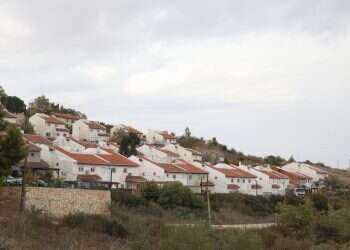
Increased violence between Israelis and Palestinians in Jerusalem as well as Judea and Samaria could spark another Gaza war, UN Special Coordinator for the Peace Process Tor Wennesland said on Tuesday.
Follow Israel Hayom on Facebook and Twitter
"If left unchecked, I am concerned that not only may the situation in the West Bank further deteriorate, but these dynamics could also impact the security situation in Gaza and undermine the cessation of hostilities that has held since May 2021," Wennesland told the UN Security Council's monthly meeting on the "Situation in the Middle East, including the Palestinian Question?" in comments made virtually from Jerusalem.
In Wennesland's estimation, Israelis and Palestinians could be facing "another destructive and bloody round of violence. We must act now to prevent that from happening." While the Israeli government attempted to calm tensions with the White House by deciding earlier this month to halt advancement of a building project in its own capital, citing the need for an environmental study on the matter, the Kenyan and French representatives at Tuesday's meeting complained about the lack of containment of settlement activity.
The Security Council meeting is part of a monthly routine at the United Nations where member states routinely point the finger squarely at Israel for the lack of progress on the peace process. At the meeting in October, US Ambassador to the UN Linda Thomas-Greenfield rebuked the Council for its disproportionate focus on the Israeli-Palestinian conflict.
"This council spends a great deal of time on the Israeli-Palestinian conflict, which is both understandable and consistent with the agenda. But far too often, the substance of these discussions is centered almost entirely around criticism of Israel and counterattacks," she said in her remarks.
Nevertheless, Council members took Israel to task for policies towards the Palestinians.
The Irish representative warned of a possible Israeli-forced transfer of Palestinians from Judea and Samaria. This comes at the same time that record numbers of building permits have been issued to Palestinians, including in Israeli-controlled Area C of Judea and Samaria. Israel's government is also issuing increased work permits to Palestinians, including to Gazans, and the Israeli Palestinian Joint Economic Committee is set to meet for the first time in years in order to prop up the Palestinian Authority.
Outside of that, Russia used its platform at Tuesday's session to call for Fatah and Hamas – the Palestinian factions that run the Palestinian Authority and Gaza, respectively – to reunite, with Moscow offering to broker that process. Russia, which has essentially told the international community to stay out of its standoff with Ukraine, also said it supports P.A. President Mahmoud Abbas's call for an international conference to resolve the Israeli-Palestinian conflict.
Elsewhere on Tuesday, and with little fanfare, the Security Council unanimously renewed the expiring mandate of the United Nations Disengagement Observer Force (UNDOF) for six months. UNDOF is the longstanding UN peacekeeping force that patrols the Israeli-Syrian border in the Golan Heights. The renewal came without controversy or substantive disagreement, and is a technical rollover of the previous mandate.
The UN Secretary-General's most recent report on UNDOF's activities, issued in September, noted that while the ceasefire between Israel and Syria was generally being maintained, ongoing violations of the 1974 Disengagement of Forces Agreement persist – including firing by Israeli forces over the ceasefire line, the presence of Syrian forces in the area of separation and the existence of unauthorized weapons in the limitation area, creating a potential volatile security situation.
Speaking at the Golan Heights Conference on Economics and Regional Development in October, Israeli Prime Minister Naftali Bennett told participants that "the Golan Heights is Israeli, full stop" and that "the horrors taking place in Syria make it seem as if it would be preferable for the Golan to prosper under Israeli hands."
Bennett argued that would be the case even if the situation in Syria changed or if other countries' diplomatic relations with the current government in Damascus improved. Bennett's statement came in the context of false reports in June that the US – a co-penholder on the UNDOF file – intended to rescind its recognition of Israeli sovereignty over the Golan Heights. In March 2019, then-US President Donald Trump signed a presidential proclamation recognizing Israeli sovereignty over the Golan Heights, making the US the only UN member state to do so. The State Department affirmed this policy under questioning in June, though Secretary of State Antony Blinken has intimated in the past that Israeli control over the Golan Heights is a necessity in light of the current security and geopolitical situation, leaving open for interpretation whether changes on those fronts might alter the policy of the Biden administration.
Subscribe to Israel Hayom's daily newsletter and never miss our top stories!
Bennett also announced that Israel intended to build new settlements in the area, with the aim of doubling or even quadrupling the size of the Israeli population in the Golan Heights. He added that a plan that will "change the face of the Golan Heights" would be put forward in November or December, though no such plan has emerged yet.
Perhaps most dramatically, Medhat al-Saleh, the director of the Golan Affairs department at the Syrian prime minister's office and a former Syrian parliamentarian representing the Druze minority in the Golan Heights, was assassinated by sniper fire in mid-October in the town of Ein el-Tinneh, a village inside Syria near the line of separation. Though no actors have claimed responsibility, the Syrian government maintains that Israel was behind the assassination. Israeli defense officials have said that al-Saleh had been working with Iran to enhance Iran's presence along the Syrian-Israeli border.
Reprinted with permission from JNS.org.