


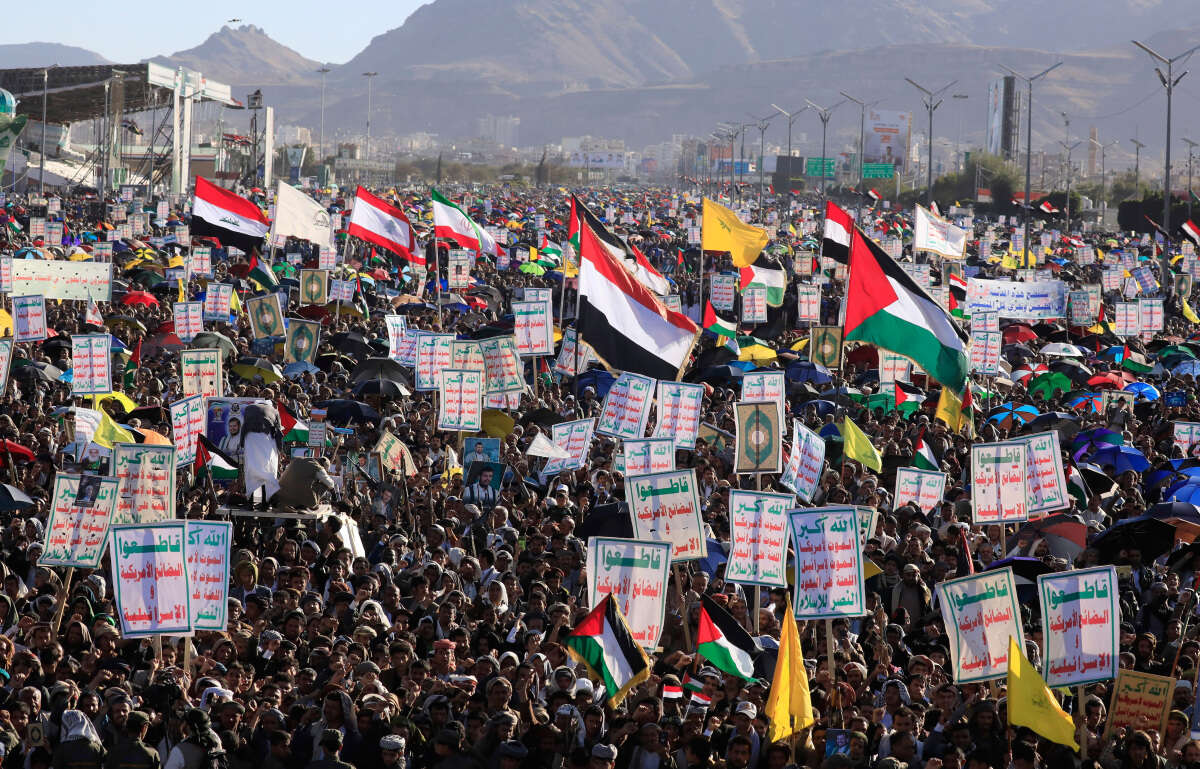
A significant portion of the latest speech by the Houthi leader in Yemen was dedicated to Israel's operation in Syria. Abdul-Malik al-Houthi spoke about the strategic importance of controlling Mount Hermon's peak. From that point, he claimed, the IDF could observe all of Syria. More importantly, he accused Israel of planning to create a corridor from the Golan Heights to the Euphrates River, where it would join Kurdish forces supported by the US. The conspiracy theory woven by Abdul-Malik appears designed to justify the Houthis' continued aggression, even in the case of a Gaza ceasefire.
This sentiment was echoed in statements by Yahya Saree, the terrorist organization's official spokesman. The pretext of "supporting Gaza" becomes just another item on a long list. Saree speaks about the need to protect Yemen from Israeli attacks, as if his organization hadn't done everything possible to initiate conflict. The organization blocked a major maritime route to Israel in the Red Sea, launched hundreds of missiles and drones at vessels, and Abdul-Malik himself declared open warfare. Mohammed Ali al-Houthi, a senior organization leader, reached peak absurdity when he accused Israel of "war crimes" in its strike. A classic case of attacking while playing victim.
It's important to understand that precisely at a moment of weakness in the pro-Iranian axis, with Hezbollah's defeat and the end of the Assad regime era in Syria, the Houthis see an opportunity to become Iran's favorite proxy.
After all, their geographical distance from Israel actually helps them while limiting Israel's response capabilities to aerial strikes. As a source in southern Yemen explained to me last week, even if senior Houthi military leadership is eliminated, without a massive ground operation, they will ultimately replenish their ranks.
That same distance transforms Yemen into Iran's testing laboratory for long-range ballistic missiles. True to form, Tehran prefers letting the local proxy bear the consequences of launching heavy missiles toward Israel, which test Israel's air defense systems. The Houthis claim these are hypersonic missiles breaking the sound barrier, but it's doubtful they possess capabilities matching those of a superpower like the US.
For now, the Iranians observe from the sidelines, evaluating performance without risking exposure. The experiment serves them in two ways. First, they see how Yemen too can become a fortress threatening Israel indirectly, should Israel want to destroy Iran's nuclear project. Second, they identify vulnerabilities in defense systems that they could exploit within that same project to destroy Israel.
The Houthis, for their part, expect financial support and military aid. The terrorist organization aims to leverage this to continue conquering Yemeni territory. The main entity among their opponents is the Presidential Council, an alliance between separatists aspiring to re-establish South Yemen and pro-Saudi elements from the old regime. These people are willing to cooperate with Israel, and we should seriously consider this opportunity.
Eventually, someone needs to fight the Houthis on the ground. If a significant portion of Iranian "foreign investments" shifts to Yemen in the near future, Israel risks losing an important potential ally. It will also have to deal in the future with "Houthis on steroids" controlling the important port city of Aden.
Another Houthi interest is gaining sympathy among anti-Israel elements in Saudi society. Abdul-Malik never misses an opportunity to criticize conservative Arab regimes. In his view, they collaborate with the US and Israel, abandoning the Palestinians. This sentiment exists among many citizens in Arab countries, and Abdul-Malik exploits it to undermine the authorities' stability. This is one reason Saudi Arabia cooled its normalization enthusiasm with rigid demands for a Palestinian state. And who better than Crown Prince Mohammed bin Salman understands the feelings of young Saudis? These youth are exposed through social media to images of the war against Hamas in Gaza and are radicalizing their positions toward Israel. That's why he took a step back in negotiations. He's not concerned about Ramallah, but rather about stability being undermined in his own kingdom.
From Israel's perspective, a strategic move against the Houthis could be another foundation in developing relations with Riyadh. The more secure bin Salman feels in his rule, the more open he'll be to a peace agreement that would transform the Middle East.


