

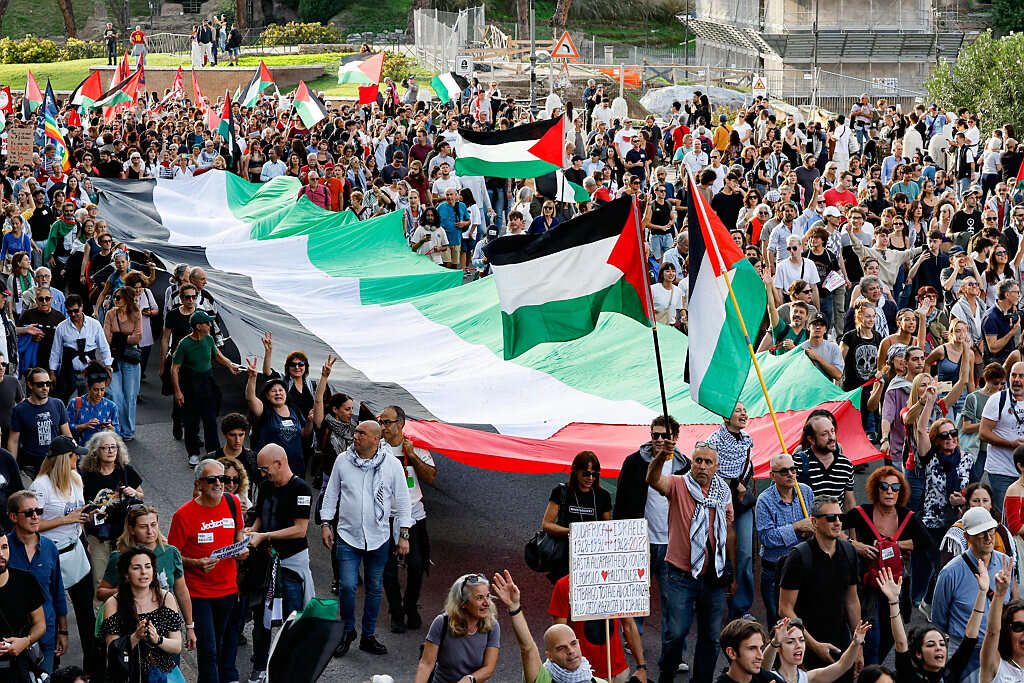
In Italy, talking about Palestinian terrorism has always been a slippery slope, a topic that divides, polarizes, and is often removed from public debate. While the violence perpetrated by Hamas, Islamic Jihad, and other groups fully meets the international definition of terrorism – indiscriminate attacks against civilians, suicide bombings, kidnappings – in Italian political and media discourse, this phenomenon is rarely referred to by its name. The reasons for this are rooted in a complex history marked by political compromises, ideological taboos, and a narrative that has preferred to emphasize the humanitarian and political dimensions of the Palestinian cause at the expense of its violent component.
The first element to consider is historical in nature. Beginning in the 1960s and 1970s, the Palestinian struggle was viewed in Italy as part of the anti-colonial and anti-imperialist liberation struggles. Many sectors of the left, from political parties to trade unions, identified Palestine as a cause akin to those in Latin America or Africa, transforming PLO terrorists and other factions into symbols of resistance rather than terrorists. In that context, an informal agreement was also reached that was to have a long-lasting impact: the so-called Lodo Moro, according to which Palestinian groups were granted tolerance and freedom of movement in Italy in exchange for a promise not to attack targets on Italian territory.
This choice allowed the state to gain security in the short term, but it created a gray area in relations with organizations responsible for attacks in Europe and the Middle East. This legacy has profoundly influenced the Italian narrative, making it difficult to clearly denounce Palestinian terrorism. Added to this was strong political polarization: for decades, the Israeli-Palestinian question has been an ideological symbol. Defending Israel meant placing oneself in the Atlanticist and conservative camp, while supporting the Palestinians represented a progressive and anti-imperialist choice. This binary pattern made a balanced debate impossible: those who denounced Hamas risked being accused of pro-Israeli propaganda, while those who downplayed Palestinian violence presented themselves as sympathetic to an oppressed people. Journalistic language reflected this impasse. The Italian media prefers terms such as "militants," "resistance fighters," or "armed activists," while the word "terrorist" appears much less frequently than when referring to al-Qaida or the Islamic State. This semantic choice is not neutral: it contributes to constructing an imaginary world where Palestinian terrorism appears as a secondary, almost marginal issue.
But the most controversial point concerns the massacres that took place in Italy between the 1970s and 1980s. On more than one occasion, investigations have revealed clues about the possible involvement of Palestinian groups or the role played by the relations established by our country with those organizations. However, these leads have been systematically shelved. The case of Ustica remains one of the most discussed examples: several reconstructions have suggested that behind the downing of the Itavia DC-9 there was an episode linked to arms trafficking to the Palestinians, or to a missile launched in the context of related military operations. Yet that lead has never been fully pursued. The same applies to the Bologna massacre of August 2, 1980: alongside the neo-fascist hypothesis, some investigators and subsequent documents have hinted at a possible link with Palestinian terrorism, linked to the balance of power in the Moro Agreement. Despite the evidence, the judicial process chose another direction, leaving the Palestinian trail in a gray area.
An explicit precedent had already been set with the 1973 Fiumicino massacre, when a Black September commando opened fire at the airport, killing 34 people. In that case, Palestinian responsibility was immediately recognized, but over the years, the episode has been almost removed from the collective memory, as if it were an isolated incident and not a sign of a constant risk. This removal is not accidental. Pursuing the Palestinian lead to its conclusion would have meant admitting that the Italian state had, for years, made compromises with terrorist organizations. It would also have meant undermining the myth of international solidarity with Palestine, which is deeply rooted in politics and the media. So it was decided not to address the issue, leaving Palestinian terrorism a marginal topic, if not censored altogether.
Completing the picture is the humanitarian approach that still dominates the news coverage of Gaza and the West Bank today. Images of bombings, innocent victims, and desperate conditions have rightly drawn attention to civilian suffering, but they often obscure the direct responsibilities of Hamas and other organizations, which use the population as human shields and hinder any prospect of peaceful development. In Italy, criticizing Hamas risks being perceived as attacking the victims, and this contributes to reinforcing self-censorship.
Finally, there is pressure from associative and activist networks in the country. Pro-Palestinian committees, NGOs, and movements have occupied an important space in public discourse, constructing a narrative that minimizes the terrorist dimension and foregrounds the rhetoric of resistance. In this context, those who speak openly about Palestinian terrorism risk being labeled Islamophobic or partisan. The result is a great silence: in Italy, Palestinian terrorism remains taboo, an uncomfortable topic that few address clearly. Yet distinguishing between the legitimate aspirations of the Palestinian people for a state and the terrorist actions of those who target civilians should be a necessary step for anyone who wants to seriously address the Middle East issue. Ignoring or removing this aspect helps neither the Palestinian cause nor the prospect of a just peace.
Stefano Piazza is an Italian journalist and essayist who writes on terrorism and transnational crime.


