"When will there be an attack?" That is the question many in Israel have been asking since the protests broke out in Iran and reports emerged of a shocking massacre of civilians. A new blue-and-white development, created by Yonatan Back, seeks to address that uncertainty.
Back recently launched a website called StrikeRadar. In an interview with Israel Hayom, he said his goal was to build a tool for people who constantly ask about the timing of a strike, one that would be dynamic, update at a high frequency and track a range of developments. According to Back, the entire project, which has already been exposed to hundreds of thousands of Israelis, was built in a single night.
The new development, built using AI-based systems including the Claude artificial intelligence tool, carries out complex strategic analysis that until now had been reserved almost exclusively for elite intelligence units, taking into account a wide range of variables.
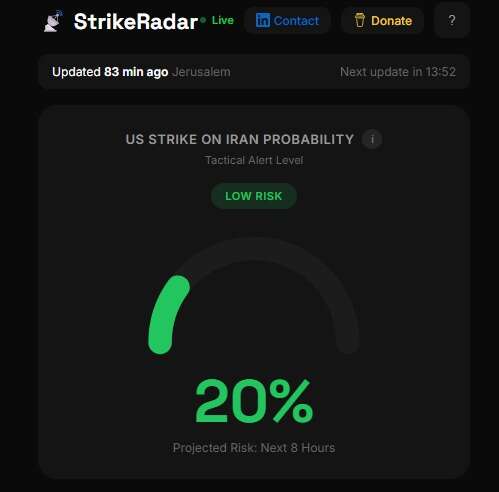
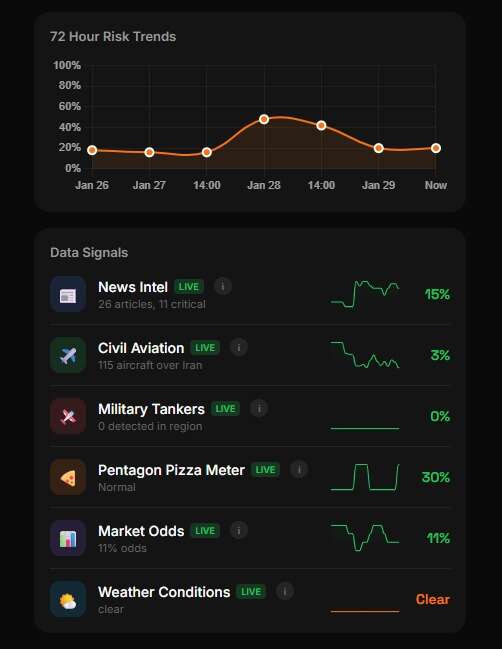
The software is connected to public sources, including major news websites, the Pentagon's well-known "pizza index," and the Polymarket forecasting platform. It then rewrites all the data into a formula, the results of which are displayed on a dynamically updated dashboard.
On a practical level, Back explained that he defined two points he called "extreme values." One was the night of January 15, when many were convinced an attack was imminent, along with the days preceding Operation Like a Lion as one end of the spectrum. On the other end were periods of routine calm. Between these points, he said, AI helped him reach "the correct scale and appropriate weighting in the calculation" for each refined variable, in order to arrive at a final probability.
One such variable is "News Intel," intelligence derived from news reports. The software analyzes dozens of items from leading news outlets such as the New York Times and the BBC, searching for words like "strike," "missile," "military," and similar terms. The more frequently such words appear, the higher the assessed likelihood of a strike. News reports account for 25 percent of the final weighting.
Prediction markets do not contradict the tool's purpose
At first glance, a forecasting system based on gut feeling, such as Polymarket, might appear to contradict the information-based system Back developed and therefore should not have been factored into his calculations. Back disagreed, arguing there is no contradiction, and pointed to recent incidents in which an anonymous bettor dramatically increased his wagers shortly before a strike in Venezuela.
"I looked for the best possible sources, and unfortunately I believe the reports about inside information among bettors are accurate, and I assume this will continue," he said. "If there are large-scale drills, a weapons operator will try to cash in." In practice, if someone with inside information enters the market, as has apparently happened in the past, Polymarket cannot necessarily be defined solely as a platform driven by gut instinct.