


Reinstating officials who were previously pushed aside is a classic hallmark of weakness in authoritarian regimes. That pattern now seems visible in Tehran. Khamenei, who has held ultimate authority for 37 years, has long balanced rival political factions without allowing any genuine independence. Over time, however, his tight grip and refusal to inject new blood into the system have contributed to deep public resentment, evident in repeated waves of nationwide protests against his rule and the regime's harsh repression.
According to recent reports, Khamenei has appointed Ali Larijani as secretary of the National Security Council, reviving a body that operated during the 1980-1988 Iran-Iraq War and oversaw the war effort. At the time, the council was headed by Akbar Hashemi Rafsanjani, then considered Iran's No. 2 under Supreme Leader Ayatollah Ruhollah Khomeini. By restoring the council and placing Larijani at its helm, Khamenei has effectively elevated him to a similar rank beneath the supreme leader.
After Khomeini's death in 1989, Khamenei gradually sidelined the founder's close associates and replaced them with his own loyalists, many drawn from the Islamic Revolutionary Guard Corps. The Guards, tasked with safeguarding the regime, have shown little hesitation in using force to maintain stability, whether through violent crackdowns at home or terrorist attacks against Jewish and Western targets abroad.

From religious aristocracy to the leader's inner circle
Ali Larijani hails from a powerful clerical family long embedded in the Islamic Republic's elite. His father was close to Khamenei, helping pave the way for his sons' ascent.
One brother, Mohammad Javad Larijani, is regarded as one of the architects of Iran's nuclear program and is known for extreme views, including calls for Israel's destruction and the elimination of regime opponents.
Another brother, Sadeq Amoli Larijani, served as head of the judiciary and was once floated as a potential successor to Khamenei. His political fortunes declined, however, after allegations of financial corruption and a lavish lifestyle embarrassed the leadership. Although removed from key centers of power, he still chairs another largely symbolic council.
Like his brothers, Ali Larijani served in the early years of the revolution in the Islamic Revolutionary Guard Corps, bringing him into close proximity with the leadership. At the time, Khamenei was serving as president and cultivating the Guards as a loyal power base.
Larijani later oversaw propaganda and public diplomacy for the Guards before becoming head of Iran's state broadcasting authority, which to this day provides a platform and support for the media arms of terrorist organizations such as Hamas and Hezbollah. Under his watch, the network helped amplify Islamist ideology far beyond the Middle East, including through foreign-language channels designed to spread the revolution's message worldwide. In that sense, he can be seen as one of the architects of the mass anti-Israel and antisemitic demonstrations now seen in Western capitals.
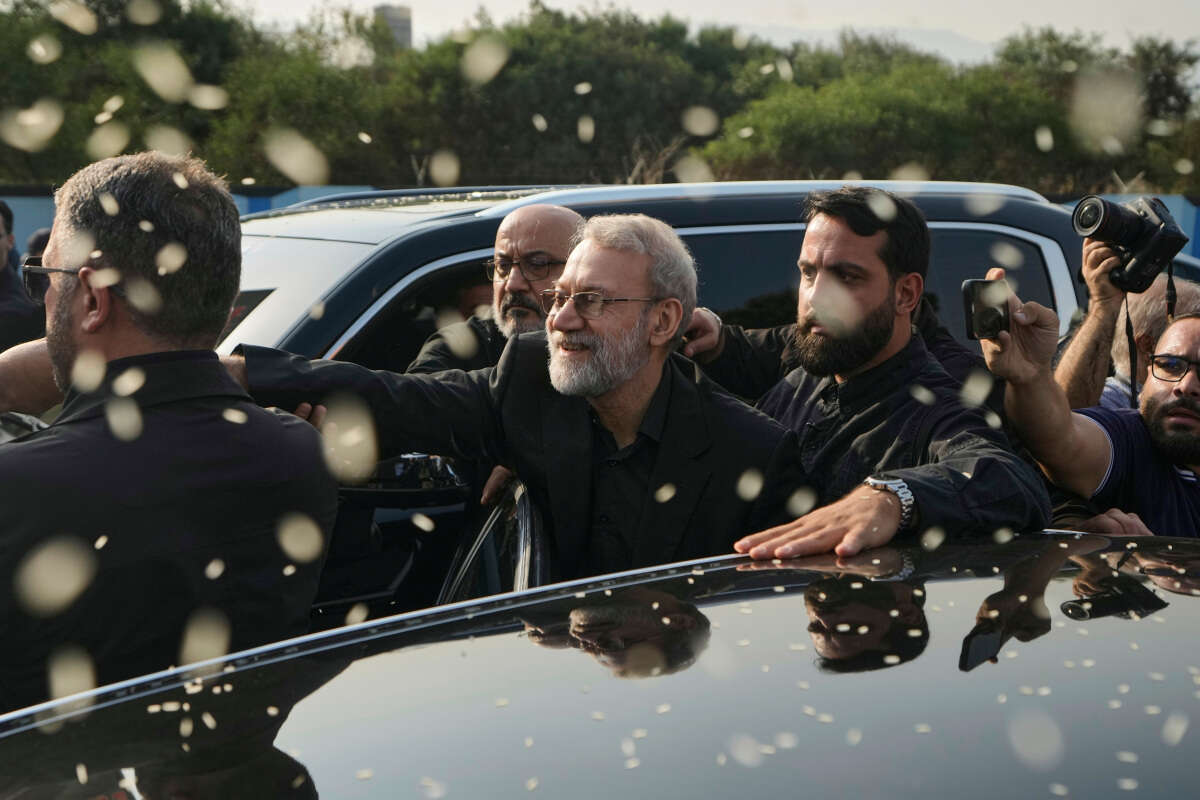
Forgiveness or desperation?
Domestically, Larijani used his positions to fortify the supreme leader's standing. Through both propaganda and direct action, he confronted reformists in the 1990s and 2000s. He later became secretary of the Supreme National Security Council under President Mahmoud Ahmadinejad but was dismissed amid deep policy disagreements. He subsequently moved into roles that answer directly to the supreme leader, including speaker of parliament and membership in key councils appointed by Khamenei that function as the real centers of power in Iran, in contrast to the president and his cabinet.
Despite his long record of loyalty, the Larijani brothers' names became entangled in major corruption scandals in recent years. They were gradually pushed aside and relegated to ceremonial positions. It also emerged that their children live in Western countries and hold American or Canadian citizenship, even as the family presided over a regime that leads crowds in chanting "Death to America."
In doing so, the aging Khamenei, now 87, may be prioritizing his grip on power over the long-term stability of the Islamic Republic itself. By bringing back seasoned enforcers and propagandists, he may secure short-term continuity. But it remains far from certain that such corrupt figures will uphold his legacy once he is gone.


