


In 1955, the Baghdad Pact was established under British initiative, with the participation of Turkey, Iraq, Iran, and Pakistan, and later with significant American involvement. The alliance was designed to integrate into the Western containment architecture against the Soviet Union during the Cold War. In the Middle Eastern context it was perceived as an effort to curb radical Arab nationalism under the leadership of Gamal Abdel Nasser.
In the current geopolitical reality, a similar structural framework appears necessary. In this context, the deepening relationship between Israel and India may serve as the foundation for a new strategic core within a trilateral framework that includes the United States.
Over the past decade, relations between Israel and India have undergone a significant qualitative leap. Nevertheless, it appears that Prime Minister Netanyahu, in his address to the Knesset, sought to "upgrade" Israel's relations with India to the level of an "alliance." Prime Minister Modi, by contrast—leading a state that for many years carried the banner of the Non-Aligned Movement—preferred to maintain a degree of strategic distance and defined the relationship as a "strategic partnership."
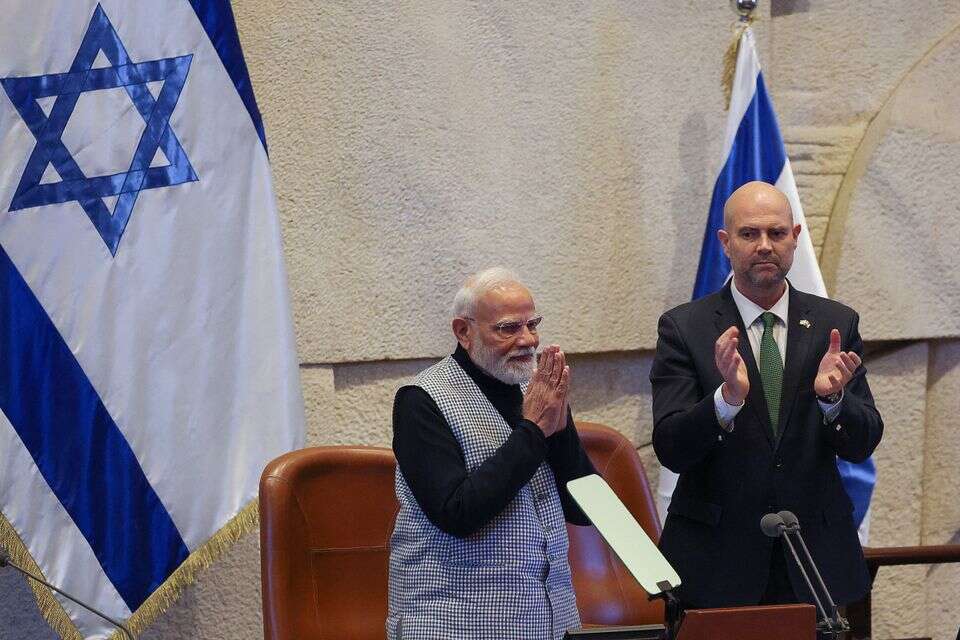
The central strategic challenge currently facing Israel and India is the expansion of the strategic partnership into a trilateral framework that includes the United States as a senior and shaping actor. Over the longer term, such a framework could serve as the nucleus of a broader pro-Western coalition.
The Indian prime minister's visit to Israel is therefore not merely a milestone in bilateral relations; it also conveys an implicit strategic message to Washington. The message reflects a profound appreciation of American power and of the strategic closeness both countries share with the United States. At the same time, it embodies a sober recognition: Israel and India cannot afford to rely exclusively on the American security umbrella.
In other words, both states are signaling to the United States that it faces a choice: to deepen its commitment and enter a clearly defined alliance framework, or alternatively to accept the emergence of strategic coordination mechanisms that are not wholly dependent upon it.
This posture stems from American conduct in recent years, perceived as a form of "strategic fence-sitting." On the one hand, Washington maintains very close relations with both Israel and India; on the other, it supports or cooperates with actors viewed in Jerusalem and New Delhi as destabilizing forces—such as Turkey and Qatar, and in certain respects Pakistan as well.
An American policy perceived as balanced between India and Pakistan raises doubts in New Delhi. The "royal reception" accorded to Pakistan's Chief of Army Staff, Asim Munir, during his most recent visit to the United States—including an intimate luncheon with the President—has been interpreted in India as a troubling signal, particularly in light of the persistent threat of Islamist terrorism and the ongoing tensions in Kashmir.
From India's perspective, a trilateral coalition with Israel and the United States is intended to generate a clear strategic advantage on Pakistan and the China–Pakistan axis. Should the United States refrain from making an unambiguous strategic choice, it risks eroding the confidence placed in it by its Asian allies.
Modi's visit to Israel thus contains a strategic appeal to the United States to abandon ambivalence and position itself unequivocally within the camp of the "responsible states." Such a decision could reshape the global balance of power, strengthen deterrence against the Iran–China axis, and consolidate an international order grounded in a coalition of democratic and free nations.
If the United States chooses to enter such a framework "with both feet and boots on the ground," it would not only reinforce its allies but also solidify its own standing as a leading power in the international system particularly against the backdrop of intensifying strategic competition and possible confrontation with China.


