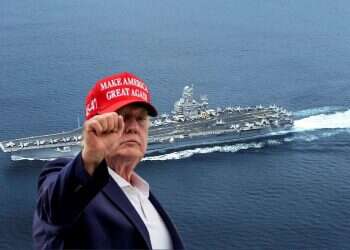
President Donald Trump announced Sunday a naval blockade of the Strait of Hormuz, following the collapse of talks with Iran in Pakistan the day before, in an attempt to strangle Iran's oil exports and ramp up pressure on the regime. "Iran is not prepared to give up its nuclear ambitions," he wrote in a post. "The US Navy, the best in the world, will begin the process of imposing a blockade on any vessel attempting to enter or exit the Strait of Hormuz."
Trump announced that he had ordered the Navy "to seek and interdict every vessel in International Waters that has paid a toll to Iran. No one who pays an illegal toll will have safe passage on the high seas.
"Iran will not be allowed to profit off this Illegal act of extortion," he wrote and added, "Other countries will be involved with this blockade." Shortly after the president's announcement, an account on X attributed to the IRGC Navy wrote that "any wrong move will trap the enemy in the strait's deadly currents."
In two posts, Trump wrote that during the talks, which lasted nearly 20 hours, his representatives "were, not surprisingly, very friendly and very respectful toward Iran's representatives.

"Most of the points were agreed upon, but the one point that truly mattered, nuclear, was not," he wrote, adding, "As I have always said, from day one and for many years: Iran will never have nuclear weapons." He added that the US was "fully prepared and ready, and our military will finish what remains of Iran."
Since the start of the war, Iran had operated a controlled transit corridor within its territorial waters, with the IRGC supervising movement and granting passage only to countries with which Tehran maintained relations – such as India, Pakistan, and China – in exchange for a "transit fee." At the same time, Iran had blocked other vessels from transiting the strait, effectively paralyzing the critical trade route.
While other Gulf states lost billions of dollars due to the Strait's closure, Iran profited from the situation. According to a Reuters analysis, Iran's oil revenues rose 37% since the start of the fighting, as it remained the only country exporting oil through the strait. Bloomberg reported that Tehran earned approximately $139 million per day in March, compared with $115 million in February – a rise driven by both stable export volumes and the surge in global oil prices since the outbreak of hostilities.
The blockade declaration marks a reversal of the strategy Trump had pursued until now, which aimed to expand oil supply in the market in hopes of easing price rises – partly by lifting sanctions on Iranian oil already "at sea."
Trump adopted a similar strategy against Venezuela, which ended with the capture of dictator Nicolás Maduro. On the one hand, the move could certainly help bring about the economic collapse of the ayatollah regime; on the other hand, it may drive up energy prices worldwide – something Trump decidedly does not want. In practice, if implemented similarly, the US Navy would move to seize oil tankers transiting the strait and confiscate them.
.@POTUS: "They haven't left the bargaining table. I predict they come back, and they give us everything we want—and I told my people, I want everything. I don't want 90%, I don't want 95%. I told them, I want everything. They have no cards." pic.twitter.com/LeGu9z6weO
— Rapid Response 47 (@RapidResponse47) April 12, 2026
Although the ceasefire declared on April 8 included an Iranian commitment to reopen the strait, Tehran had not done so in practice. According to the Russian news agency TASS, a senior Iranian official acknowledged that Iran would not permit more than 15 vessels per day to pass, compared with approximately 130 before the war. As part of the negotiations, Iran demanded recognition of its sovereignty over the strait and the right to collect transit fees from vessels – a demand that the US and Gulf states rejected entirely, and one that is effectively illegal under the strait's international status.
Trump announced that he had ordered the Navy "to locate and detain any vessel in international waters paying a fee to Iran," and that "anyone paying an illegal toll will not receive safe passage on the open sea." "Iran will not be permitted to profit from this illegal extortion operation," he wrote. "Additional countries will participate in the blockade."
"Britain will assist"
In an interview on Fox News shortly after the post in which he declared the naval blockade, Trump said the blockade "will begin very soon," and explained that while there had been "good meetings" with the Iranian representatives, "we didn't get there on the important issues – they want nuclear weapons, they won't have them." He added, "Toward the end of the negotiations, the Iranians became very friendly, and we got every point we wanted, except for the nuclear weapons." On the talks in Pakistan, he said, "They came in as if they had cards to play, but they have no cards. The whole place has been destroyed. There's one thing they can do, and that's lay mines – and if you have a billion-dollar tanker, you're not going to take that risk. This is extortion; they're extorting the world." On the blockade, he said, "We're imposing a full blockade and we will not allow Iran to let in only the ships they want – it will be like Venezuela, but at a much higher level." Trump expressed disappointment with NATO, which "didn't show up," but promised, "It won't take long before we clean this up."
Trump added that the US had "mine-sweepers, using new technologies as well as traditional minesweepers," and noted that "Britain will assist in this." On the destroyers that transited the strait the day before, he said, "We don't know if they laid mines or not – my instinct is they laid a few."
Mine-clearing in the strait
US Central Command (CENTCOM) announced Saturday that two US destroyers had transited the Strait of Hormuz and were operating in the Arabian Gulf as part of the operation to clear mines planted by the IRGC. CENTCOM commander Vice Admiral Brad Cooper said in a statement, "Today, we began the process of establishing a new passage, and we will make it available for use by the shipping industry shortly to allow the free movement of goods." He added that additional forces – including underwater drones – would join the mission in the coming days. Iran denied that the vessels had crossed the strait, claiming they had been turned back to the Indian Ocean after a warning. Iranian media published Sunday what it claimed was the transcript and documentation of the US Navy vessels' transit through the Strait of Hormuz, including a radio recording in which the IRGC Navy was heard demanding that the destroyer "change course and return to the Indian Ocean immediately," threatening that it would "become a target." The American side responded that the vessel was "transiting in free passage in accordance with international law."