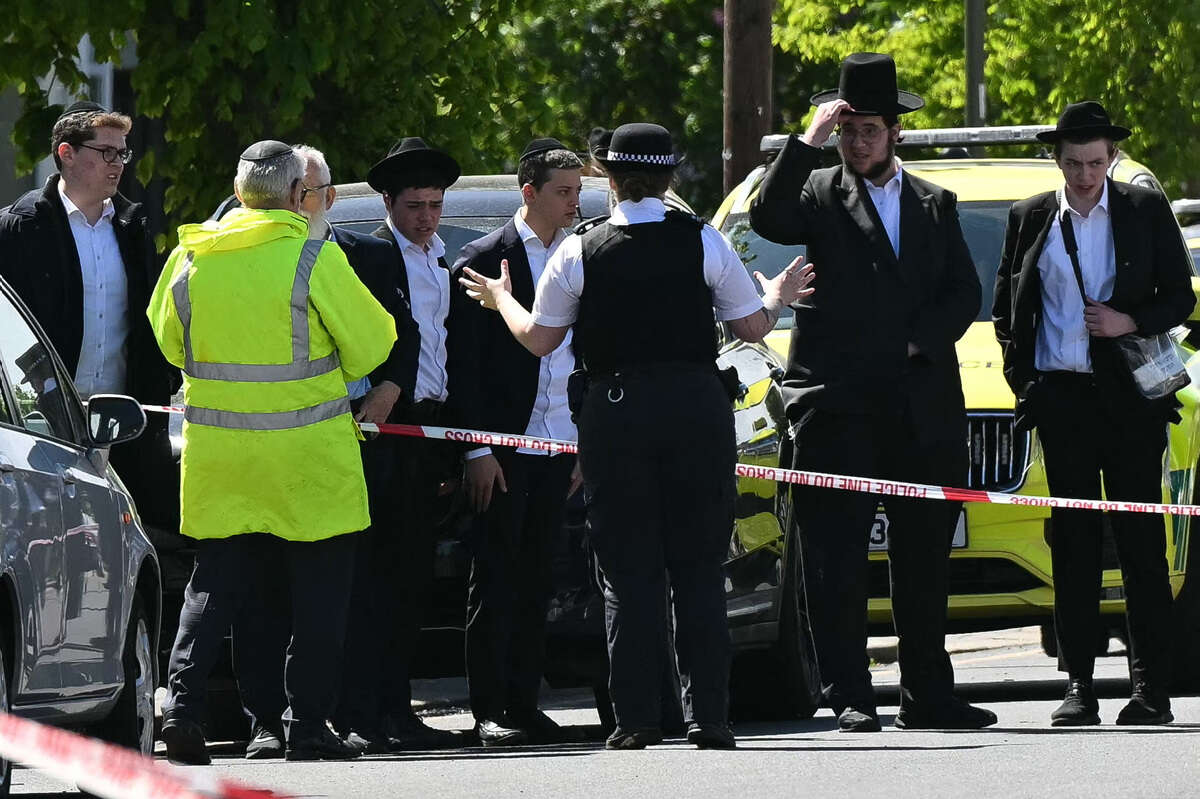
The past month has been a rolling series of low points for England. Three terror attacks on the local Jewish community – the fifth-largest in the world – culminating in a stabbing attack in Golders Green, and a terror threat level raised to "severe," all point to a deteriorating state of domestic security. A long-simmering debate on the subject reached a head with these incidents. But one viral moment on a local television program – one that, on the surface, should not have caused a stir – exposed an even more disturbing trend among the British public: complete blindness to the problem.
View this post on Instagram
A discussion about Jews
In a video that drew more than one million views from Jeremy Vine's program on Britain's Channel 5, Jewish-British journalist and presenter Jonathan Sacerdoti, who appeared to speak about the rising antisemitism in the country and the Jewish community's sense of insecurity, pushed back against the claims that surface every time an attack on Jews makes headlines in Britain. "Every time you try to talk about antisemitism in this country, this is what happens," Sacerdoti said on the program, pointing to his fellow panelist, political commentator Marina Purkiss, who responded, "So no one is starving in Gaza?"
"For me, it was very predictable going on Channel 5," Sacerdoti told Israel Hayom. "It falls in line with basically all British media on these topics. It's anti-Israel, it's anti-Jewish, even when it thinks it isn't being, it basically behaves in a way that is, because it's become so default, so automatic in Britain that you treat this topic in a certain way."
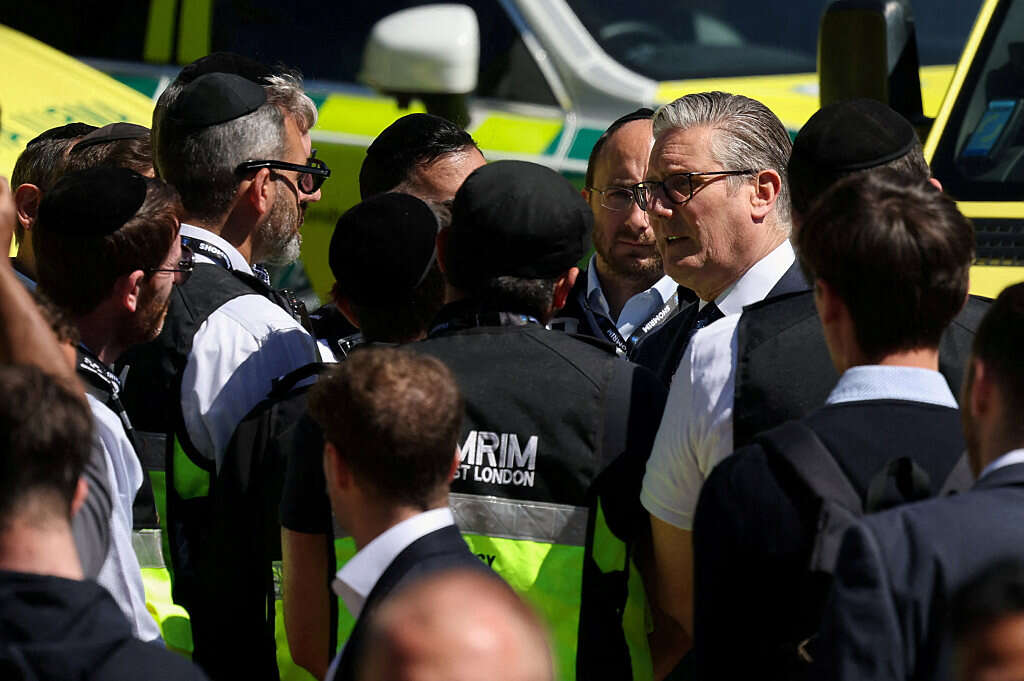
Jonathan was invited the day after the attack in the Jewish neighborhood, in which two Jewish men, Shloime Rand (34) and Moshe Shine (76) were stabbed, to discuss, among other things, Prime Minister Keir Starmer's responsibility for the country's antisemitism problem. Despite this being a critically important subject – particularly given the criticism Starmer has been drawing lately – the discussion did not go in that direction.
"There I was on this panel, and immediately everything was switched to talking about Israel," he said, adding, "I was interrupted constantly. Words like genocide were thrown at me. Snipers targeting babies, starvation, all of these things were thrown at me in a discussion about Jews being attacked in the UK. In a month or two, when several Jewish locations had been targeted for firebombing or arson, Jewish ambulances from Hatzalah had been exploded, completely burnt out, Jews had been stabbed, last Yom Kippur in Manchester, Jews had been killed by a terrorist called Jihad al-Shami. And yet, what we were talking about were fake lies about Israel and Israel's conduct during the last three years."
"Don't blame us for Israel"
According to Sacerdoti, the conflation of violence against Jews with the war in Gaza was embodied in the commentator's conduct on the program, but the incident describes a far broader phenomenon across England.
"If we want to talk about pretty much anything from a Jewish perspective, it is always immediately diverted to talking about Israel. And then the problem I have personally, actually, and I have this problem with quite a few people in the Jewish community here in the UK, is when we talk about Israel, what's always been their default position is to say, 'don't blame us for Israel.'
"'These ghastly Israelis are murdering babies for fun, but don't blame us for it.' That doesn't work on either front. Firstly, because most British Jews actually do want to defend Israel. And so our enemies would be right to say, well, if you're defending that, then we have a right to be angry with you. Maybe not to stab you, but we have a right to be angry with you. But what I would say is, no, these are falsehoods. They're calumnies, they're lies about Israel, and they are perpetuated by the television coverage."
The world's most trusted English news source?
Sacerdoti attributes the phenomenon primarily to one of the world's most recognizable media networks – one that has faced relentless criticism over the past three years: the BBC. "Primarily, the worst culprit is the BBC, obviously, because the BBC is pumped into everyone's lives either directly or indirectly, even if, like me, you barely watch their junk, it still filters through into your life," he said bluntly.
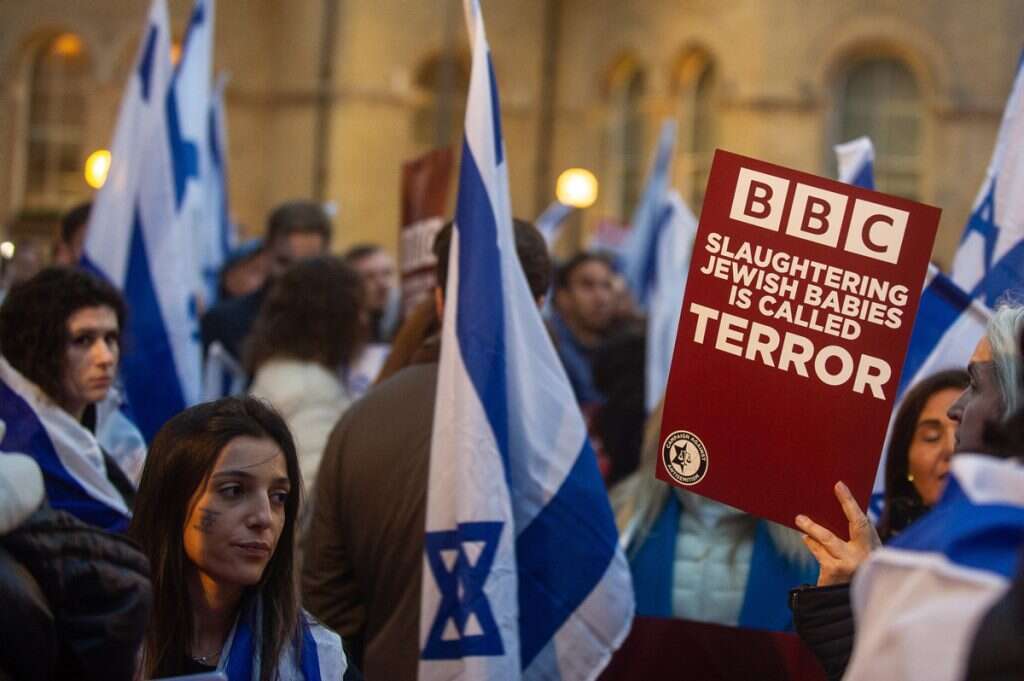
"It's, I think, the world's most trusted English language news source, which is ironic because it's also one of the worst as far as I can tell on Israel. They warp and twist everything, either deliberately or accidentally. It's become so commonplace that they don't even know they're doing it.
"Only a few months ago, when they put on this heart-rending documentary about children in Gaza, and they forgot to mention that the child who narrated the whole documentary was the son of a Hamas minister in Gaza. I mean, it's just insane that this is the kind of thing that doesn't even surprise us anymore," he said, describing the troubling pattern.
The core of the problem also stems from the lineup of commentators on the country's various television programs. According to Sacerdoti, anti-Israel commentators are often not experts in the field and offer perspectives unsupported by facts, which only sharpens the problem.
"Despite having this privileged position to be a regular guest on this news discussion program on Channel 5, produced by ITN, one of the lead news outlets' producers in this country, one of their regular guests appears to be there more for her blonde hair and orange skin than for her actual knowledge of the news. A woman who commentates frequently on Israel, Jews, and antisemitism and doesn't know anything about Israel, Jews, or antisemitism, or the Koran, or Islam, or extremism," he said of Purkiss.
"There are virtually no knowledgeable and good commentators on this in the UK. There are a handful of people who do it, one of them being me. I want people to know what's going on. I want people to know the actual facts that are in the Middle East and what's going on in the war, and I want them to have somewhere where they can read it that's in the mainstream."
View this post on Instagram
The emphasis, he noted, is not on criticism itself but on its source: "Anyone can criticize Israel. The issue is whether her [Purkiss'] criticism is well-informed, valid, whether she's open to discussion, and most importantly, whether it comes from a place of genuine curiosity and function for news or whether it's an obsession for some other reason."
Q: Do you feel that Jewish guests on TV are often expected to explain or defend Israel before they are allowed to speak about antisemitism?
"Absolutely, that is the case. Obviously, it's not right that Jews in the UK should first have to defend every prejudice or lie their interlocutor has about Israel before they're even allowed to talk about their own experience as British Jews."
No future in the UK
This phenomenon – which Sacerdoti said has already become normalized – has led the Jewish community to reckon with its future in Britain. "There is not a single event with a majority or only Jewish crowd that I go to, and I go to a few of them, where the main topic of conversation is when to leave, where to go, how to do it," he said.
"People are very bleak. They don't believe that we have a future here in the UK. And I'm inclined to agree with them, sadly. I'm not sure this is the best place to bring up Jewish children. When people ask me, I do say, yeah, I think you should very much work up a plan B and a plan C. How can you transfer your work? Where would you go? How would you do it? When would you do it? Is it better to do it now or later? Do you want to wait for the last moment? These are really weird considerations to have again as Jews, but they're not unfamiliar ones for the Jewish people, sadly."
At the very start of the interview, Scardoti shared that it seems we would be meeting in Israel in the near future.
"The big difference is that for every single Jew asking those questions now, compared to my father's generation – my father was a child Holocaust survivor – we have a very strong answer of one place where Jews can go. Won't be easy, but the state of Israel has a defined policy and law from the beginning that we have a refuge there if we need it. I suspect most of us really never thought that we, British Jews, would ever need it. So many of them do now."