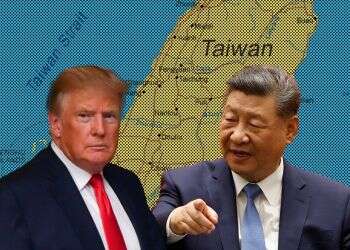
In Israel and the Gulf states, officials believe that the Americans will not resume strikes on Iran at least until after President Donald Trump's meeting with his Chinese counterpart, Xi Jinping.
According to two diplomatic sources, the Americans have made clear to their allies in the region that the high level of military readiness is ungoing, the US Navy is maintaining its blockade on Iranian ships, and the accumulation of additional equipment, including interceptors, is also continuing. But, Trump is giving the diplomatic channel a chance.
"The president will not come to China against the backdrop of a war, since he wants to enlist the Chinese president in moves that will bring the war to an end through a deal," one of the sources told Israel Hayom.
Not for free
According to the source, the Chinese are the most significant international actor capable of pressuring the Revolutionary Guards, and they are also the ones that have been badly harmed by the blockade of Hormuz. On the other hand, he added, they will not help Trump for free, and will try as much as possible to prevent an agreement that would lead to US involvement in Iran's oil sector. The compensation they demand may be connected to Taiwan.
In Israel Hayom, we reported that China had already intervened about a month ago by exerting pressure on the regime in an effort to bring about, at the very least, a ceasefire. That pressure, together with the military blows, did indeed lead to a halt in military actions, even though Iran withdrew from its agreement to open Hormuz unconditionally. Beijing warned Tehran at the time that if the blockade of the Strait of Hormuz continued, it would turn to alternative oil sources and consider suspending the strategic cooperation agreement between the two countries.
Israel Hayom has learned that, at the request of the Arab Gulf states, the Chinese demanded that Iran refrain from bombing them. Iran complied only partially, and in the latest flare-up over the weekend it attacked the United Arab Emirates, but did not expand the strikes to Saudi Arabia and the other Gulf states.
On the other hand, according to the Americans, China assisted Iran with intelligence information. As a result, the US Treasury Department announced that it was imposing sanctions on three Chinese companies accused of helping Iran's military carry out attacks on US forces during the war. According to the report from the US State Department, the Chinese companies provided satellite images that enabled Iranian military attacks against US forces in the region. The reference is apparently to attacks on US bases in Saudi Arabia, Bahrain and Qatar.

At the same time, against the backdrop of energy distress caused by the blockade of Hormuz, the European Union is beginning to show signs of involvement, even if only minimal. European Union foreign policy chief Kaja Kallas said the EU would expand its sanctions against Iran to include those responsible for disrupting freedom of navigation. She accused Iran of responsibility for the escalation in the strait, but clarified that the EU sought to help renew negotiations with Iran in order to end the conflict.
Kallas also said that EU foreign ministers had agreed to strengthen cooperation with the countries on the shores of the Persian Gulf after the Iran war and to accelerate work on strategic partnership agreements with all six countries of the Gulf Cooperation Council.