Egypt is playing yet another dangerous double game this time with numbers. For years, President Abdel Fattah el-Sisi and his top officials have repeatedly claimed that Egypt hosts "ten million refugees" on its soil, trotting out the figure at international summits whether the context fits or not. What began as a talking point has hardened into regime gospel: an unchallenged "fact" designed to portray Cairo as an overburdened humanitarian superpower deserving of endless Western backing and diplomatic leniency.
This is not an unintended exaggeration. It is a calculated fabrication, part of a broader pattern of narrative manipulation that President Sisi's government has perfected. By inflating refugee statistics and deliberately blurring the lines between genuine refugees, economic migrants, foreign residents, and even temporary visitors, Cairo manufactures a crisis it can weaponize both to extract billions in international aid and to justify its own authoritarian stranglehold at home.
The government's own recent statements expose the scheme.
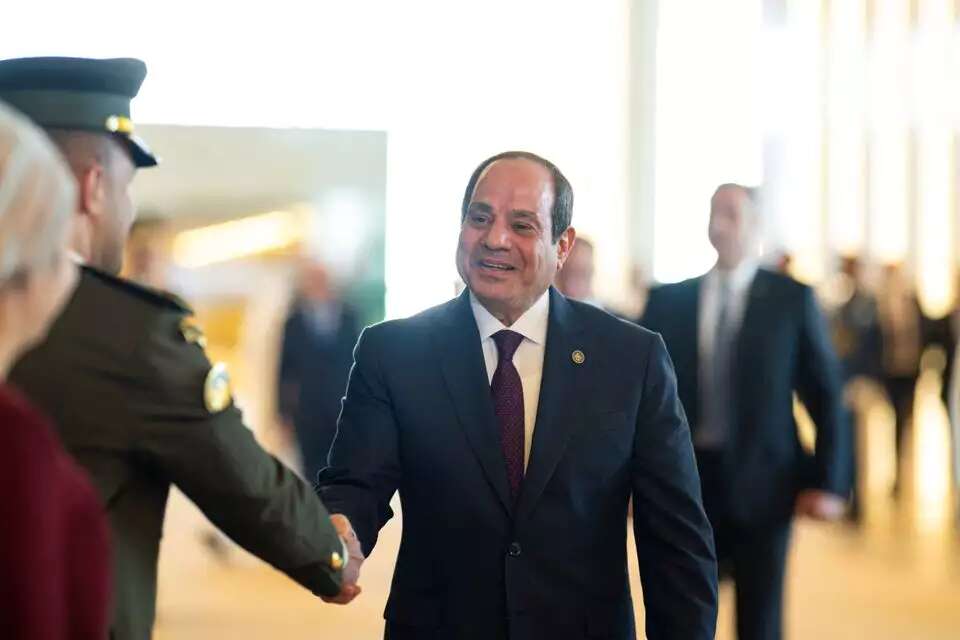
On April 1, 2026, Foreign Minister Badr Abdelatty told an African ministerial meeting that Egypt hosts "about ten million refugees and migrants" who enjoy full access to basic services without discrimination. He lamented the "limited international support" relative to the "increasing burdens" caused by regional conflicts and demanded "burden-sharing" and "international solidarity" per international conventions.
On the same day, Prime Minister Mostafa Madbouly met with the Director General of the International Organization for Migration, Amy Pope, in the New Administrative Capital. Madbouly insisted Egypt hosts "more than ten million migrants, refugees, and asylum seekers" and praised his government's "integrated approach" to migration management while again pressing for continued IOM support.
On May 4, during President Sisi's meeting with the OECD Secretary-General Mathias Cormann, the presidency's official spokesman, Mohamed El-Menshawy, reiterated that Egypt shelters "about ten million foreigners" who fled crises in their countries and receive the same services as Egyptians asserting that this is done "without exploiting the issue for political purposes".
The repetition is not accidental. It is state-orchestrated propaganda, delivered in diplomatic forums where Western officials rarely push back out of political courtesy or fear of embarrassment. Once repeated often enough, the "ten million" figure becomes an accepted media truth, shaping policy and explaining Cairo's failures.
Reality, however, is far more modest and documented. According to official UNHCR data, as of April 2026, the number of registered refugees and asylum seekers stands at approximately 1.1 million.
The breakdown is clear and nationality-specific:
Sudan: 847,571 (77.05%)
Syria: 101,866 (9.26%)
South Sudan: 55,822 (5.07%)
Eritrea: 45,198 (4.11%)
Ethiopia: 18,918 (1.72%)
Somalia: 13,787 (1.25%)
Yemen: 10,347 (0.94%)
Iraq: 4,327 (0.39%)
Others: 2,191 (0.20%)
These figures come from verified official records, not politically driven estimates. While unregistered individuals exist, the overwhelming majority of genuine refugees register with UNHCR for legal protection and resettlement opportunities. Cairo's inflated tally relies on lumping in economically integrated foreigners business owners, shopkeepers, restaurant workers who are not burdens but active participants in Egypt's economy. Even the most generous estimates place such non-refugee foreigners at no more than 20 percent of the Cairo's claimed total.
This deliberate conflation serves a dual purpose. Internationally, it transforms Egypt into the indispensable wall standing between Europe and waves of illegal migration, pressuring the West for more grants, loans, and relaxed scrutiny on human rights violations. Domestically, it reshapes public perception; the government is depicted as heroically shouldering an impossible load, thereby excusing harsh economic decisions and diverting attention from governance failures.
The subtext is unmistakable and coercive. As the regime's own rhetoric implies: "Support us, or watch the Mediterranean shores collapse under uncontrollable waves of illegal migration". It is classic blackmail dressed up as moral appeal, from a military-led system routinely ranked among the world's worst on multiple governance and rights indices.
Egypt's refugee numbers scheme is not an isolated distortion. It fits the same pattern of duplicity Cairo has displayed on Gaza, the Muslim Brotherhood, and US-led peace efforts: publicly posturing as a partner for stability while quietly undermining American interests and manufacturing crises to preserve its leverage and lifeline of aid.
The United States and its allies must stop accepting Cairo's narratives at face value. Policy cannot be built on unverified statistics. Washington should demand transparent, verifiable data from Egypt and tie continued assistance to genuine cooperation not manufactured victimhood.
Mohamed Saad Khiralla is a political analyst specializing in Middle Eastern affairs and Islamist movements, an opinion writer and member of PEN Sweden.
Khaled Hassan is an Egyptian British national security and foreign policy expert and council member of Israeli President Isaac Herzog's Voice of the People Initiative.