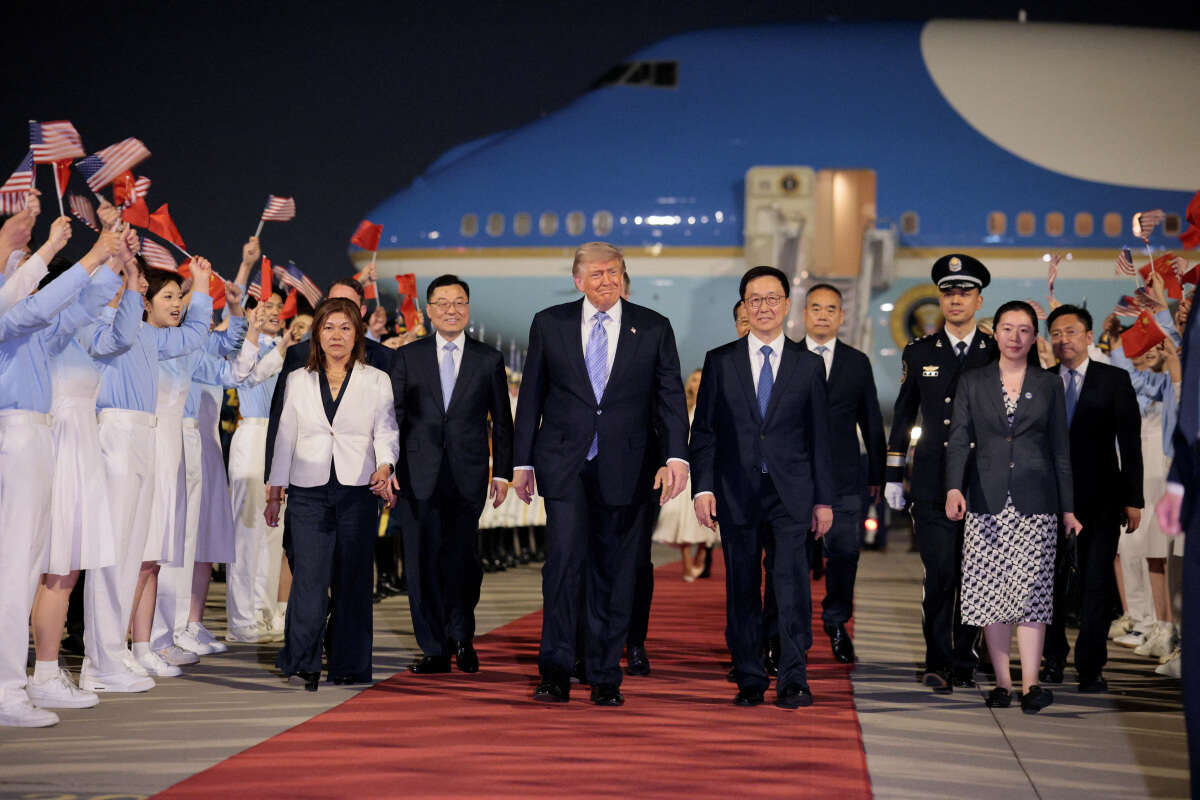
Some 300 young Chinese people lined both sides of the red carpet at Beijing Capital International Airport on Wednesday to welcome US President Donald Trump, alongside a military honor guard. Thus began the first official visit by a US president to China since 2017, when Trump himself also visited Beijing. This is the seventh face-to-face meeting between the two leaders, the previous one taking place last October in South Korea.
An official welcome ceremony with Chinese President Xi Jinping will be held Thursday morning at the Great Hall of the People. In the afternoon, the two leaders will visit the Temple of Heaven together, the religious center of the Chinese empire for centuries, and in the evening an official dinner will be held. A follow-up meeting is planned for Friday before Trump returns to Washington.
Nvidia at the last minute
Traveling with Trump were senior executives from the leading companies in the US economy, some of whom were given the honor of arriving aboard Air Force One. Among the prominent names were Elon Musk, Apple CEO Tim Cook, Nvidia CEO Jensen Huang, and senior executives from Boeing, BlackRock, Goldman Sachs, Meta and other companies. The composition of the delegation signals the priorities: trade, technology and business, alongside the war in Iran, are the issues expected to dominate the talks.
US-China relations in recent years have been defined by tariff wars that Trump launched during his first term. In his second term, he escalated that approach: mutual tariffs climbed to a peak of 145%, China responded with restrictions on rare mineral exports and other retaliatory measures, until the sides signed an economic "ceasefire" last October that cut tariffs by more than half. Trump now seeks to formulate deals for the purchase of US agricultural products and Boeing aircraft, and to establish a joint "trade council," while Beijing is pressing for the remaining tariffs to be lowered.
Nvidia CEO Jensen Huang was not on the White House's official guest list, but joined the delegation at the last minute when Air Force One stopped to refuel in Alaska. The importance of his arrival is clear: The chip giant, which stands at the forefront of the AI industry, is at the center of one of the most explosive disputes between the two powers, the struggle for control over progress in the decisive industry and access to advanced chip technology.
The US has restricted exports of advanced chips to China in recent years to curb Beijing's technological ambitions, but China has a weapon of its own: It controls about 90% of the world's rare mineral processing, which is essential for manufacturing chips, electric cars and fighter jets. Last October, China used this leverage for the first time when it imposed export restrictions on those materials. These two issues are likely to be at the heart of the talks.

China's pressure on Iran
At the center of the summit, of course, will be the war in Iran, with reports saying Trump is expected to ask China for help in reaching an agreed framework to end the war. During the war, Trump emphasized the importance of the Strait of Hormuz to the Chinese economy, but assessments suggest China has strategic reserves that would last it many months even if the current situation in the strait continues.
China, however, does appear to hold the strongest leverage over Iran: It buys about 90% of Iranian oil exports, and the besieged regime in Tehran cannot afford to lose its almost sole customer and a key diplomatic backer. Israel Hayom previously reported that China had warned Tehran that if the blockade of the Strait of Hormuz continued, it would consider turning to alternative oil sources and suspending the strategic cooperation agreement between the two countries. In addition, there is the issue of arms sales to Iran and restrictions on the export of dual-use materials essential to Iran's missile industry.
The US has already tried to pressure China in another way: This month, it imposed sanctions on private Chinese refineries that bought Iranian oil while ignoring Western restrictions, as well as on companies that supplied Tehran with satellite imagery used to attack US forces. China responded relatively harshly: It called the sanctions "illegal and unilateral" and, for the first time, activated a blocking law enacted in 2021 ordering Chinese companies to ignore them.

A small statement, a big gift
"If Trump brings a statement, small but significant from the Chinese perspective, in which he says he opposes Taiwanese independence, even that would be a very major achievement for the Chinese, and for that they would be prepared to pay and exert diplomatic power and everything they can. But I don't think Trump will necessarily agree to do that," Yuval Weinreb, head of the technology program at MIND Israel and host of the podcast "Understanding China," told Israel Hayom.
Taiwan, the island that has functioned as a de facto state since 1949 and over which China claims sovereignty, could be the currency Beijing demands in exchange for its help on Iran. A senior Taiwanese official told Bloomberg he feared the island "would be on the menu" in the talks between the powers.

Beijing may try to use the meeting to extract from Washington an official declaration that it "opposes Taiwanese independence" and a renewed, explicit reaffirmation of the "One China" principle, a step it would view as a diplomatic achievement. This would come alongside a demand to reduce US arms sales to the island, after a massive deal last December angered Beijing.