The scorching, liquid noon pours into the waterways of Yas Island in Abu Dhabi. Outside, every step is a challenge against the sun. Inside, the hall is wonderfully air-conditioned. At the center of the hall is a screen, which, like everything in the Emirates, has to be huge.
At the edge of the screen are the words "Dialogue of Civilizations," and that is exactly what is happening in the large hall. Religious, scientific and spiritual figures have gathered from every corner of the globe, mainly from the Eastern and Arab worlds, regions not always remembered as part of the globe too. They are all here to create dialogue among representatives of Earth's different civilizations, as part of the International Dialogue of Civilizations and Tolerance Conference.
The screen lights up the speakers on stage. It highlights the whiteness of the kanduras, the traditional clothing of the many Emiratis in the hall. Amid all this, Rabbi Yaakov Nagen, president of the Interfaith Field, sits in a suit and prepares to address hundreds of scientists and religious leaders who have gathered from around the world. They are all here to discuss the conference's theme: how to protect family and tradition from the great destroyer of our time, AI and new media.
When his turn comes to speak, Rabbi Nagen seems lit from within. He opens his mouth and says: "People think the light of the Emiratis comes from the fire of their oil. It is not the oil, it is the people and the values that shine." Then, in a loud voice, he continues. "According to the Quran," he says, quoting from the scriptures in an American accent, "Allah calls on us, the different communities of believers, not to give up, to hold fast together to the rope of faith in times of crisis and war. Not to fall. Not to let the forces of evil in the world separate us."
From the well-groomed Bahais in silk knits to the last of the orange-clad Hindus, the hall falls silent in astonishment. "I couldn't believe what I was hearing," a Syrian man will say afterward. "A Jewish rabbi with a kippah on his head stands and quotes from the Quran, and you feel he knows what he is talking about."
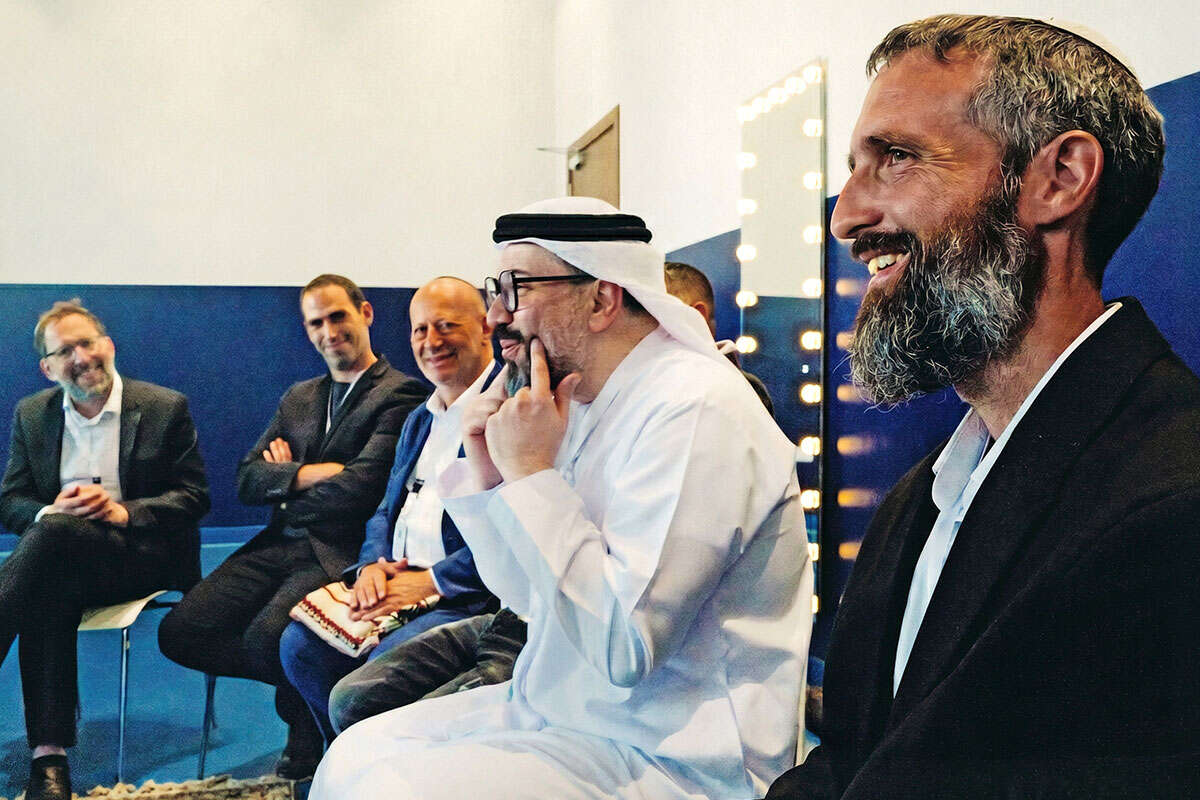
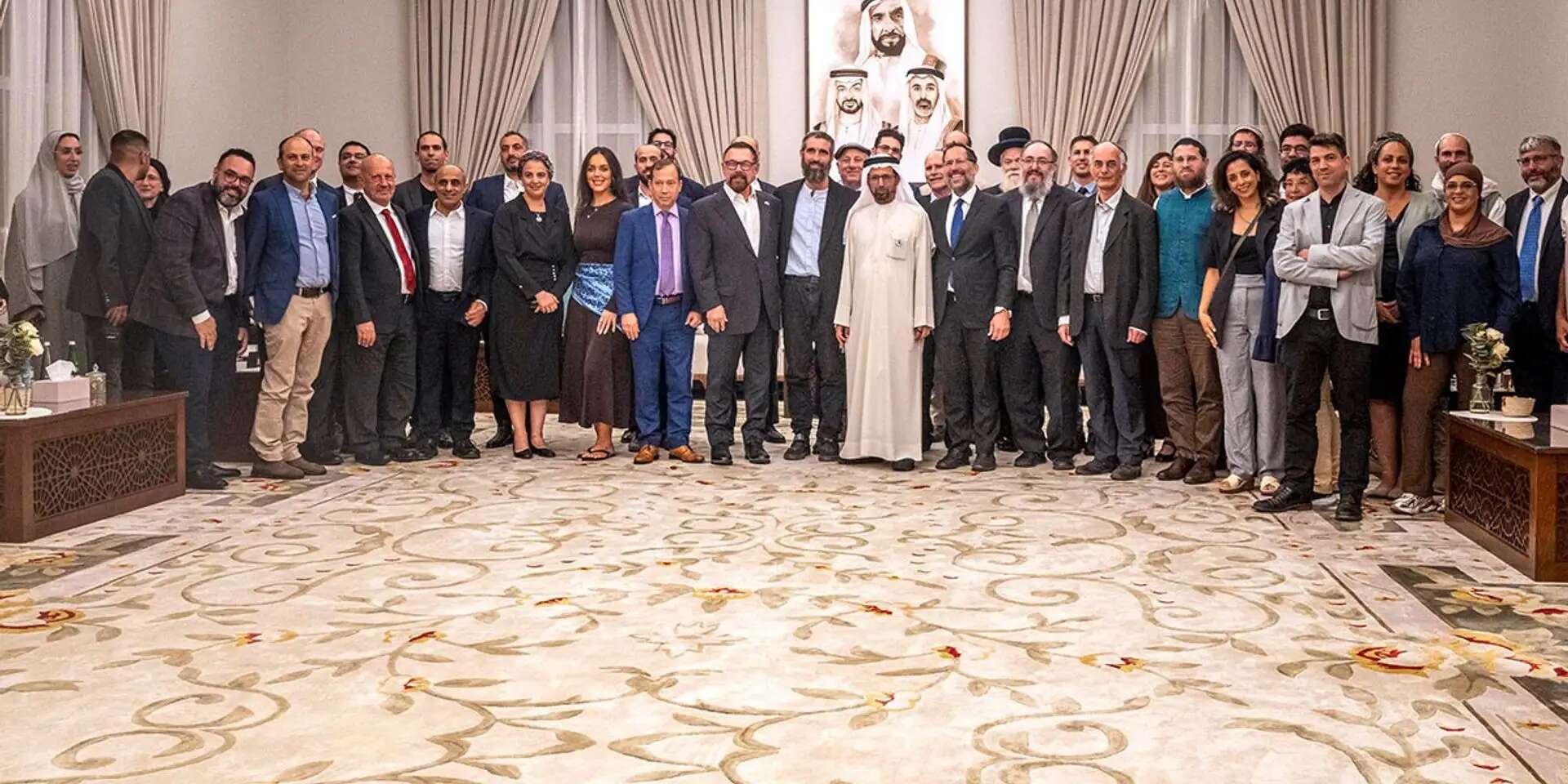
Among the Emirates' many attractions, the most surprising attraction over the past week was the Interfaith Field delegation from Israel. Dr. Roi Horn, head of the Abrahamic Beit Midrash and director of the delegation, takes a moment away from managing the carefully planned schedule.
"The Interfaith Field is a coalition of different organizations that deal with resolving the Jewish-Arab conflict from a somewhat different angle, that of religion and tradition. The goal is to increase understanding between the religious Muslim world and the Jewish world. The way to do this is through dialogue and by cultivating social and diplomatic ties with governments and organizations in the Muslim world that recognize Israel and want what is best for it."
Rabbi Dr. Aharon Ariel Lavi, director of the Jerusalem Interfaith Center, who founded and leads the field of interfaith diplomacy organizations in Israel, explains the delegation's purpose: "The delegation brings together almost all the major organizations in Israel active in the field, and it lays the groundwork for more coordinated, professional and effective engagement with the Emirates and other partners."
Rabbis, Middle East experts, settlers, Women Wage Peace activists, youth movement members, academic researchers and leaders of organizations that build ties and bridges between religious worlds. In Hebrew, describing the delegation is complex and complicated. In Abu Dhabi terms, they call it simply the Abrahamic way. And it is here everywhere you look.
An alternative museum
"This is our ninth time here, and the third time since the war with Iran," the man sitting next to me on the flight to Dubai tells me. "Do you like attractions?" he asks with a smile. "We're here for a poolside vacation at the hotel and the mall. We're not leaving the air conditioning."
The lofty souls warned me that the Emirates in general, and Dubai in particular, are nothing more than artificial attractions. That is a mistake. Already at the airport I discover that I have traveled into the future. Everything looks and feels like a utopian science-fiction film. Clean design, smooth lines and decorative edges. It is planned, practical and full of splendor. But that is only preparation for Dubai itself. Bold traditional architecture, stylish towers soaring upward in a blaze of lights, a curled skyline in which skyscrapers are sometimes yearnings for God.
Nothing prepares you for the experience of the Emirates, a land of futures and legacies. Anyone looking at the Emirates through tourist sunglasses will see only attractions, infinity pools that reflect everything in finite doubles. But there is also another side to the frame: the Emirates hidden from sight. Those tucked away in the alleys of Dubai's old city. There, among two-story brown houses and a cooling tower, we arrive at the first stop on the journey, the Museum of Civilizations.
Outside is a large picture. A wild-haired redhead who looks like the grown-up version of the Bamba baby represents Israel. Beside him, an Arab man in a keffiyeh rests a hand on his shoulder, both of them laughing and holding cups of excellent Emirati coffee. Like the local Arab "sada," but dressed up with saffron. In the Emirates, they do everything a little differently. On the side, it says "Cousins" in letters that combine languages, beginning in Arabic and ending in Hebrew. Beneath it is the hashtag "cousins meet," in small, thin, solitary English.
Ahmed Obaid AlMansoori greets us at the entrance. He is a member of the Federal National Council of the United Arab Emirates, and in the past held a range of senior official positions in the local government. AlMansoori established the Museum of Civilizations with his own money even before the Abraham Accords. Its rooms display Judaica items from across the Arab world: biblical manuscripts, a printed Gutenberg edition and even sheet music for religious hymns from a millennium ago.
For AlMansoori, the good thing is that the roots of our problems are not our own. They are an inheritance from the empires that ruled here. He mentions the Sykes-Picot agreements and explains that the Jewish people did not begin with Zionism and were not born in Europe. All the rooms here are meant to show that, in essence, the Jewish people belong to the Middle East.
AlMansoori's eloquent words echo against the prevailing view in the Muslim world that Jews are representatives of a domineering West, a vanguard force seeking to topple the Islamist space.
AlMansoori continues to challenge the core values of Israeliness and of the Israelis present in the audience, explaining that too many Israelis speak about the link between the Holocaust and the State of Israel, and see the Holocaust as the justification for Israel's existence. Most Arabs do not deny the Holocaust, but they also do not think it is the reason the state exists. That is why, he says, one must speak about the ancient roots of Judaism, which connect it to time and place. That is why the museum has photographs and documents of Jews from many Muslim countries, to show the ancient bond between Islam and Judaism.
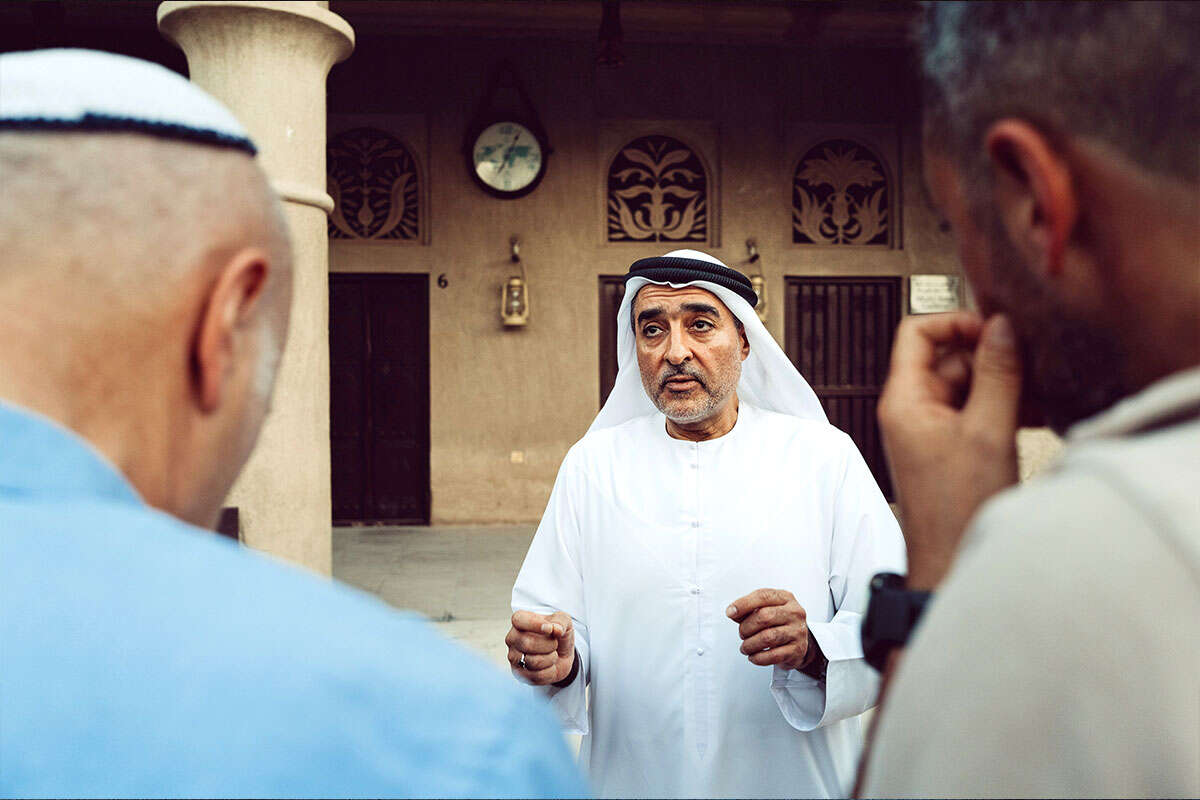
I look around. The delegation members are attentive, but it is clear that AlMansoori's perspective challenges the value paradigms of those present.
The final room in the museum is dedicated to the Holocaust. Yes, you read that correctly. Dubai, and the first Holocaust museum, and for now the only one, in the Muslim world. At the heart of the room is a visual display, perhaps too visual: a cardboard figure of the boy raising his hands in terror, surrounded by a circle of rifles hanging from the ceiling and aimed at his head from 360 degrees. AlMansoori invested great effort in collecting Nazi propaganda materials that were distributed in the Arab world. From the exhibits, an understanding emerges of just how significant prior consciousness is to implementing murderous ideologies. At the edge of the room, the different approach to presenting the Holocaust continues: a special area dedicated to Righteous Among the Nations, this time from Iran, Egypt and Japan, who saved Jews from the Nazis.
His words resonate in a silence melting in the heat. At the end of the tour, AlMansoori opens for us an entryway into the Emirati soul. From his remarks, it becomes clear that interests and money are only a platform for establishing relations, but they cannot connect peoples over time. Identity and faith make the difference. They connect us. They remain, and help overcome obstacles.
Forefathers blessing
During the visit, I learn that just as there is jet lag, when the body fails to adjust to the present time, there is also "soul lag." It happens when material life, progress and technology all race forward, but values and the soul are left behind. Yosef Mahfoud Levi, director of INSIJAM, an organization that works in intercultural mediation, explains that the United Arab Emirates demonstrates how the values Emiratis believe in can move forward with them, rather than being left behind. "Israeli businesspeople and government officials come with a 'dugri' approach, straight-talking and blunt. 'Come on, let's get down to business.' But in the Emirates, they first look for the value-based and personal connection."
The visit to the Museum of Civilizations ends with the Mincha afternoon prayer in the museum courtyard. Standing to the side is Sheikh bin Tamimi, a Shiite sheikh from Iraq who was educated to hate Israel and the Jews. When he grew up, bin Tamimi went from being a child to a leader of extremist Shiite militias that fought Sunnis. The twists of fate and a sobering up from the values of hatred on which he was raised drove him from his country and brought him to the Emirates, where he became a scholar, researcher and teacher who now works to promote reconciliation between Jews and Muslims.
The ancient words of the prayer leader echo: Blessed are You, Lord our God and God of our fathers, God of Abraham, God of Isaac and God of Jacob. In the present situation, they take on an entirely different meaning.
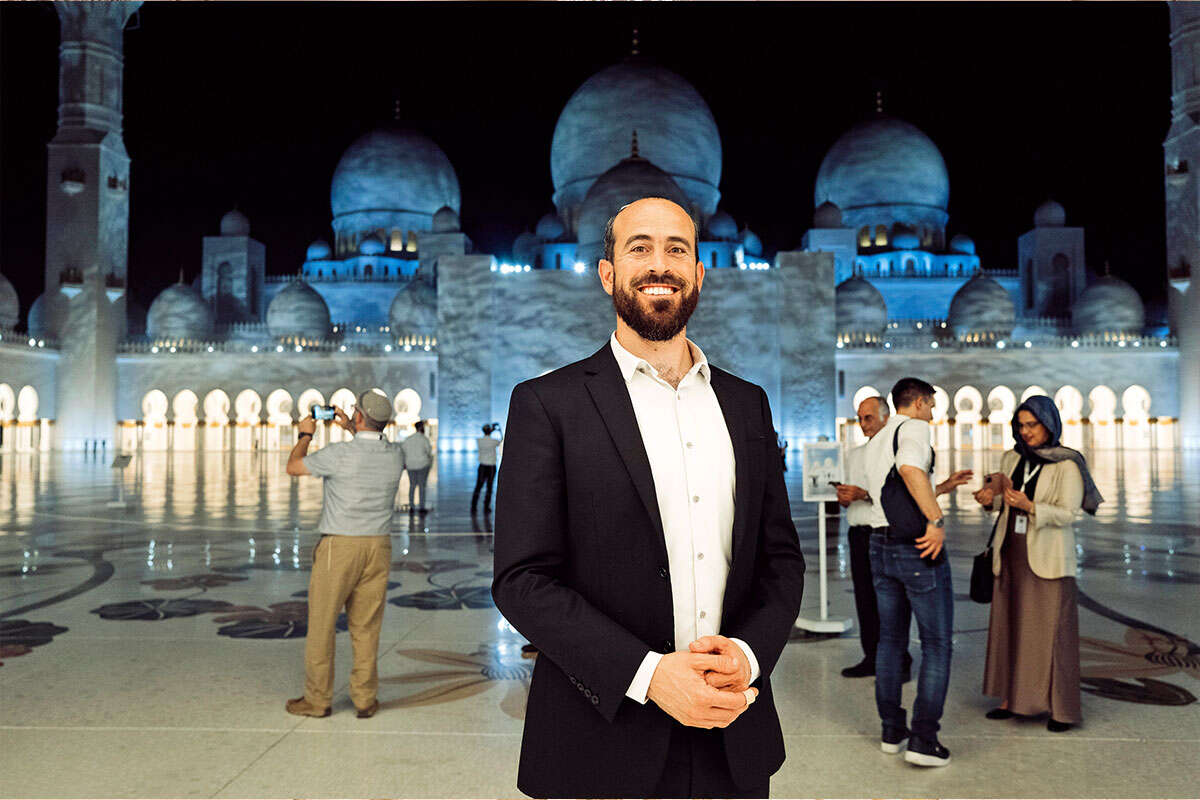
On the ride to the hotel, I understand that the Emirates, or at least the tip of the iceberg exposed in the setting sun, challenge the whole set of values instilled in me by the Jewish Agency, Hollywood and the West. Dubai and Abu Dhabi emerge as a mirror world, where the Arabs are Western and lead progress from within tradition, not by casting it off. It is like an answer to the question of what would have happened had the Mongol invaders not burned the House of Wisdom, the great library in Iraq, to ash and dust in 1258.
"People can criticize the Dubai show, the desire to be Western, to build the biggest mall in the world, the tallest tower in the world and the most beautiful museum in the world. Everything has to be the biggest, the best, the most. But behind all that are people who are proud of their identity, of their Bedouin heritage. A society of nomads who, even when they become bourgeois and build giant buildings, still find it important to remain nomads in their souls, to be flexible, to adapt to different situations, to set out on adventures but remember where you came from and where you are going. And even if you know how to play the Western economic game, you are not blinded by it, but play with it," reflects Rabbi Sarel Rosenblatt, head of the Ohr Torah Machanaim hesder yeshiva and a senior fellow at the Ohr Torah Interfaith Center. These are end-of-day insights, after a tour of Dubai's infinite mall, opposite the light and fountain show at the Burj Khalifa.
The path of peace
The next morning, we travel to Abu Dhabi, the neighboring emirate. The road is covered with green from end to end. It is artificial, the cynics will say, man-made. It is the conquest of the desert, the believers will say, making the wilderness bloom, Emirates style.
The home of Yosef Hamdi, "the last Yemeni," is in a compound of small houses that look like an extension of a kibbutz. Children's bicycles, gardening tools and a Ferrari gleaming in the sun. Long live the small difference. The distance from the bus is a few hundred meters, but in the blazing heat it is an exhausting journey. In the Emirates, they still believe in the two-state solution: the one with air conditioning and the one without.
Hanging in Hamdi's home is a calendar of Zion Golan, and beside it a picture of Sheikh Mohammed bin Zayed, the ruler of Abu Dhabi and president of the United Arab Emirates. "I brought Zion Golan to my son's bar mitzvah," Yosef recalls, moved.
To understand the picture of the sheikh, Yosef tells the story of his life as the last Jew in Houthi Yemen. He spent half a year in prison because of his origin before being smuggled out with his family. The person who helped make that happen was Sheikh bin Zayed.
The family arrived in Abu Dhabi in a complex operation. In the emirate, they can live a full Jewish life through the Abrahamic Family House, a unique complex where a synagogue, church and mosque stand side by side. There is a kosher mikvah for ritual immersion. But concrete and marble can be bought with money. Rainwater, less so. Yosef says that a year after the mikvah was established, a rare storm struck the area for the first time in seven decades. The water reservoirs filled with pure rainwater.
Yosef sees that coincidence as far more than climate statistics. Between the lahoh flatbread and his mother's wonderful Yemenite soup, we get a small glimpse of how this place really works.
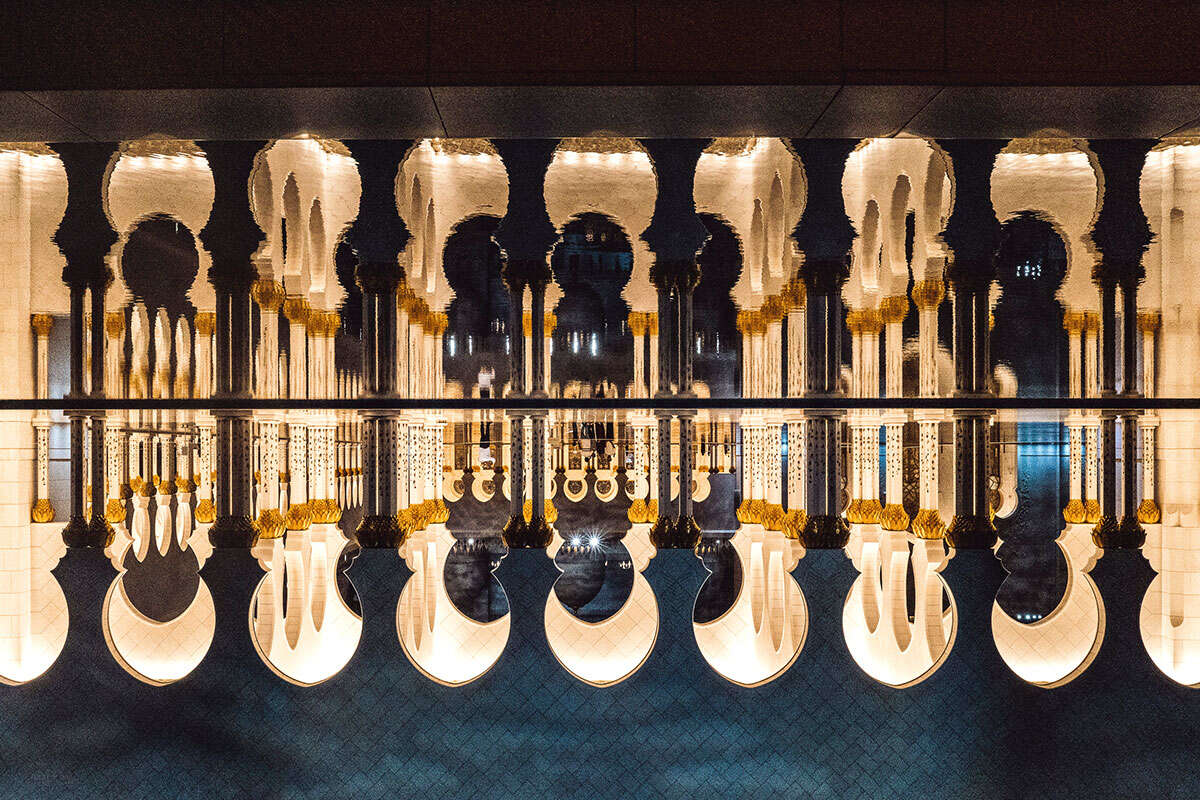
Qasr Al Watan is the enormous and breathtaking presidential palace. The Western eye searches constantly, looking for the exact attraction of the palace, until the desert understanding fills you: here, the absence is the great presence. The central space is designed so that all its lines curl upward toward infinity.
We put on our evening suits and drive deep into the night, turning off the main road with no sign or light to clarify where we are headed. At last, we arrive at a large and luxurious hospitality farm. Inside, we meet Dr. Ali Rashid al-Nuaimi, chairman of the Defense, Interior and Foreign Affairs Committee of the United Arab Emirates' Federal National Council. In the past, he served as the president of the main university, and in Abu Dhabi he is known as "the architect of the Abraham Accords."
Dr. Ali receives us in traditional dress: kandura, ghutra, agal and sirwal. Beside him, the European suits look foreign and strange to the time and place. "I built this place deliberately," he explains, "as a space large enough to host different kinds of people and delegations, governments and organizations, without losing the feeling of a home." From his seat at the head of the room, Dr. Ali steers the conversation with a smile, admiration and a nod.
At the heart of Dr. Ali's remarks is the Emiratis' credo and the message he sends to all Israelis. "The Abraham Accords are not merely a security or political agreement. They were designed to create connections among people, communities and nations. Sadly, parts of our region have been hijacked by forces promoting narratives of division, hatred and mistrust. That is why we need leaders of peace who will build bridges and speak publicly and clearly about the importance of these ties. The relationship between the Emirates and Israel is a strategic relationship, rooted not only in shared interests but also in a shared vision for a better future for our region. We must continue to strengthen this partnership for future generations."
In the Emirates, they take pride in making five-year plans for 50 years, seeing far, seeing clearly in the desert of the future. That is why Dr. Ali's words resonate far. The outstretched hand of the Emirates challenges the traditional peace concept of Shimon Peres' New Middle East, based solely on economics and lacking an understanding of the region, its people and their different values.
"Normalization between us is not peace. It is only a piece of paper between two governments," Dr. Ali says gravely, looking those present in the eye. "Peace is relations between people, person to person. That is the heart of the matter."
At the official dinner, I receive a practical demonstration of his words. The table is laden with the foods of the old Middle East: couscous, grape leaves, grilled meats and magnificent hummus in three colors, pale from tahini, purple from beets and fiery red from tomatoes.
Is hummus a thing here? I ask one of the women on the staff. "No," she says with a smile, "but we know it's a thing for you Israelis." AlMansoori's words echo in my ears. "In the Emirates we say, 'Diversity is beauty.' As long as you respect your own identity, it connects us. The idea that economics alone will bring peace is not true. In the Middle East, you cannot bypass culture on the way to peace."
Slowly, slowly, Tehran
The third International Conference on Dialogue of Civilizations and Tolerance is part of the Emirates' educational policy concept. "Iran spreads terror and weapons and is trying to drag the Middle East into religious conflict, while the Emirati project is to spread the message of education and tolerance," explains Dan Fefferman, a Middle East expert and founder of the MiddleEast24 media channel.
The arena hall is packed. Here you can meet a former CNN news presenter as artificial as the network; an Alawite Syrian from Latakia who promotes the idea of an Alawite state; or a German security guard who once served in Iraqi intelligence. From here, the world is broad and full of shades. Alongside Rabbi Nagen on the main stage is Qadi Dr. Iyad Zahalka, head of Israel's Sharia courts, who took part in the joint declaration on Jewish-Muslim reconciliation. A Sudanese conference attendee is surprised: "There is a Muslim qadi in the State of Israel?!? How do we not know this? This story must be told!"
A man in a thin orange sari takes the stage. Brahmavihari Swami, head of the Hindu temple in Abu Dhabi, looks right and left, then begins a mantra. The hall is magnetized to him. His voice instills calm, the poetic singing arouses the sublime. Brahmavihari finishes, lets the silence thunder, then speaks. "I want to bless the good energy in this room, which connects us all together. There is no proportion between the enormous amount of resources invested in developing the efficiency of artificial intelligence and the small amount invested in its ethics."
Brahmavihari describes with insight the influence of AI technology and social networks. "The atom is the first nuclear unit in the physical world. The family is the nuclear unit of the human and social world." And he concludes: "If we respond to the challenges before us out of fear, we will inevitably make the wrong decisions."
The Emiratis nod. No wonder they are preoccupied with the connection between artificial intelligence and family heritage. Here the past is bound by ancestral ties to the future. Here the future is family. The foundation stone of the space station set on the edge of the desert, 180 kilometers (112 miles) from Iran and 828.8 meters (2,718 feet) up and forward into the greatest unknown of all: the future.
The essence of the conference was summed up succinctly by Dr. Firas Habbal, president of the Emirates Scholar Center, which focuses on education as a tool to promote peace and tolerance: "We understand that the key to changing the Middle East lies in education, and therefore we decided to focus on this field strategically and in a knowledge-based way. We see this partnership as a significant bridge to reconciliation and long-term influence on the region, in a spirit of tolerance, coexistence and mutual understanding."
Israeli suspicion toward anything wearing a keffiyeh is challenged by his words, which make clear that the Emirates was a culture of peace long before the peace agreements with Israel. That is why the Abraham Accords are a result of who they are, not the other way around.
Gilad Shadmon, director general of the Regional Cooperation Ministry, which supported the delegation, reinforces the point from the other side: "The delegation to the Emirates sends a clear message at a critical moment: the Abraham Accords are here to stay. They are the key to stability and prosperity in the Middle East. That is why we attach supreme importance to building bridges of tolerance, trust and dialogue, and we are proud to support the Jerusalem Interfaith Center, which led this unique delegation."
The sun sets over Abu Dhabi. A week on the unfamiliar side of the Emirates gives rise to insights. "In the Emirates, a dream is not an escape from reality," Rabbi Sarel Rosenblatt writes in the delegation's WhatsApp group. "It is a work plan."