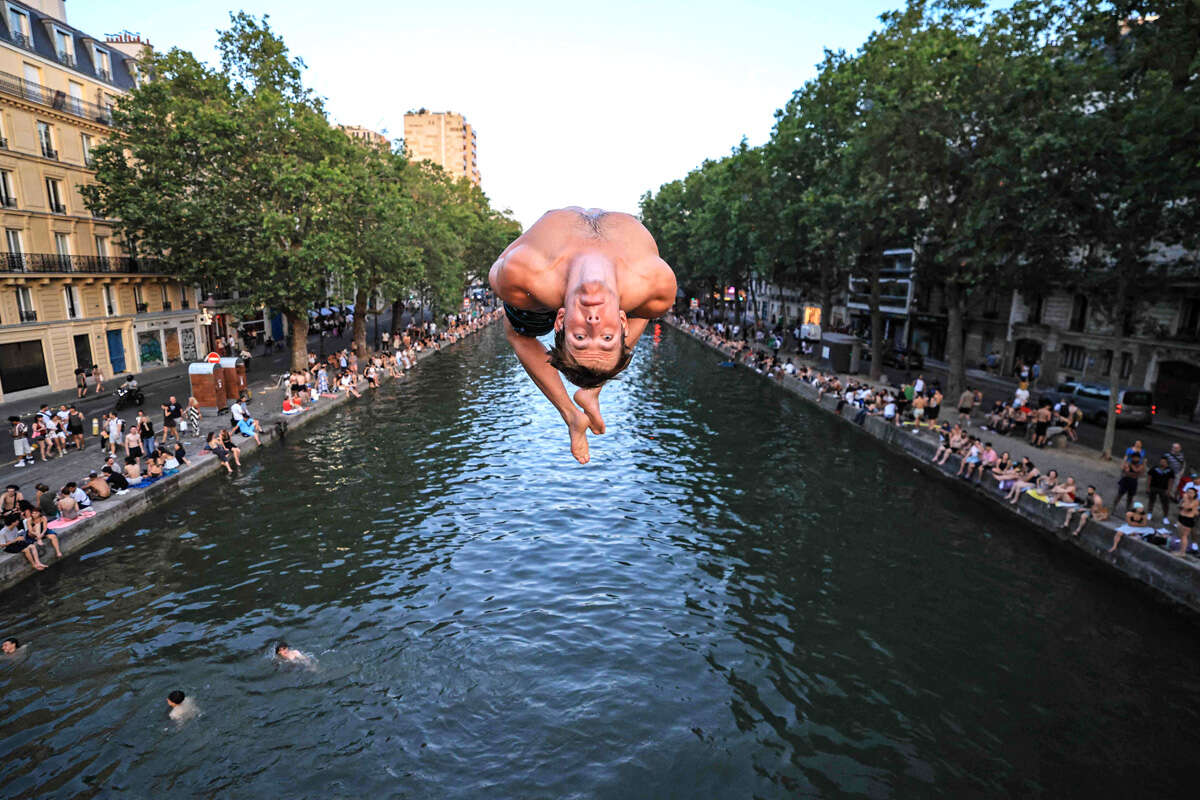
In the very heart of the 10th arrondissement, between Saint-Louis Hospital and the Gare de l'Est train station, lies Canal Saint-Martin, which for many decades has been a bohemian and trendy meeting place. It is where Parisians go on first dates, a place that has appeared in many films and Impressionist paintings. But over the past month, the area has become something else entirely: from the steeply arched bridges above the canal, teenage boys leap backward into the water in spectacular flips, trying to impress young women fainting under the scorching sun.
The banks of the canal are packed with people and trash, and along its long quays a wild gang of children aged 10 to 16 has been spreading fear. Some carry water guns, others have stolen public Vélib' bicycles, which they use to block pedestrian and vehicle traffic. Their undisputed leader is a 14-year-old boy of Algerian descent, fat as a barrel and Tarzan-like, named Hamza "Customs" (La Douane), a nickname he acquired because of his nasty habit of demanding a 2-euro coin from passersby. Those who refuse are subjected to a torrent of appalling curses, while dozens of children soak them to the bone with water guns.
After starting with cyclists and pedestrians, Hamza refined his prank techniques and moved on to cars, including police vehicles. At first, the frustrated officers tried to chase him, but despite his enormous bulk he is as quick as an eel, curses like a sailor and is a skilled swimmer. And so he slips from one bank of the not especially clean canal to the other. His other dubious activities include pushing women in bikinis into the water, throwing wicker chairs from nearby cafés, peeping at women on ground floors, locking female tourists in public toilets and, in general, creating a storm of constant chaos around him. Within a short time, the French TikTok sphere filled with videos starring him, like frogs after the rain.
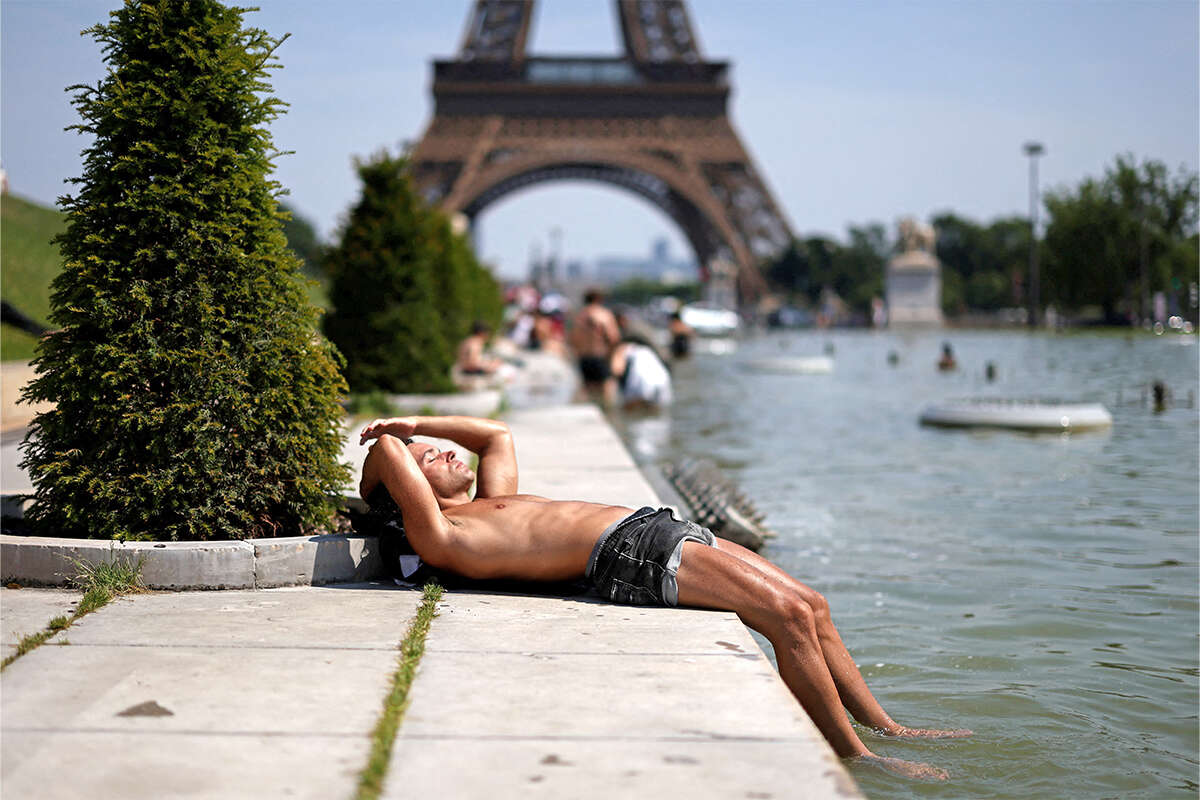
But there is no real rain. Europe is in the grip of a prolonged, sweltering heat wave. In its dense, heavy cities, built to retain as much heat as possible, life has become unbearable. That is why many Parisians, in their distress, have turned to every possible urban water source to cool off, from the dubious waters of the Seine to fountains, canals and the artificial lakes in public gardens. Unairconditioned schools released the little ones and teenagers earlier than usual into a boiling, sweltering summer vacation.
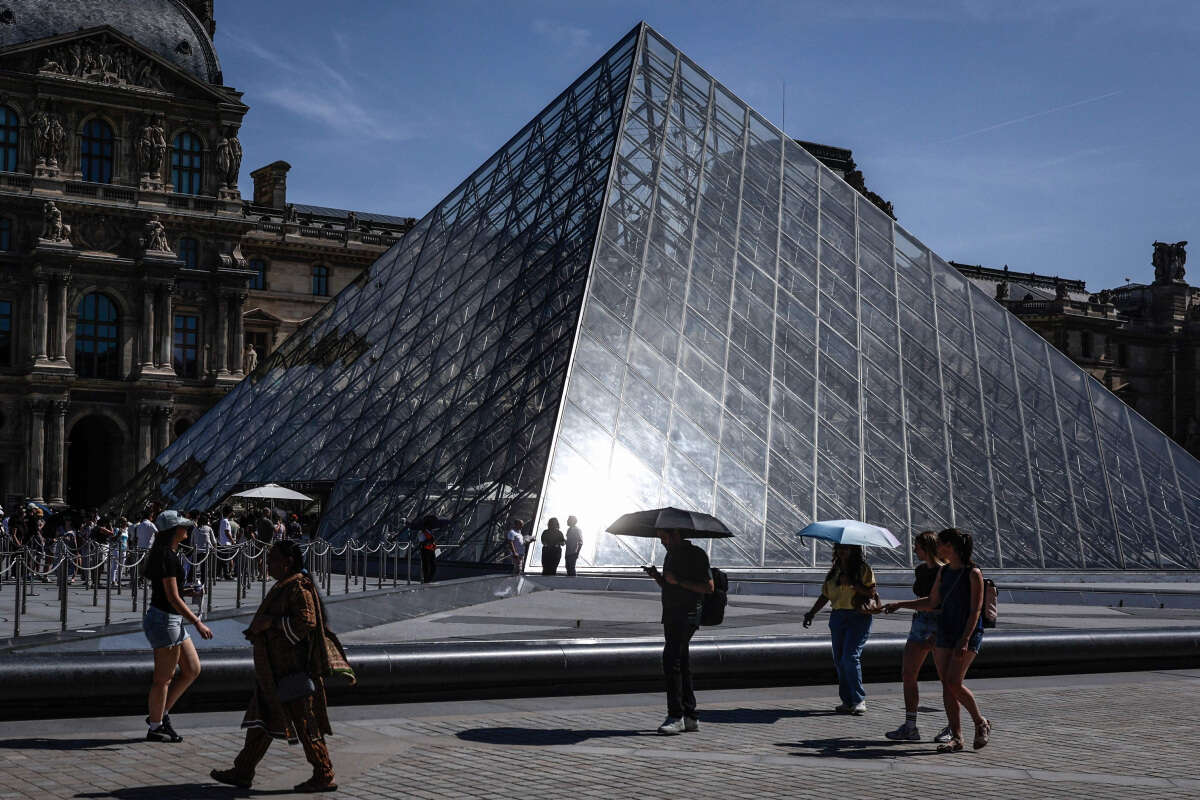
The political climate
We Israelis, at the first hint of heat, instinctively reach for the remote control. One "beep," and cold air flows through the adjustable plastic vents. At the end of every sweaty shuffle down a scorching street sits an air conditioner rich with breeze, whether in the heart of Kolkata or on the edge of a Manila suburb. What seems obvious to us, and to most of the sane world, is not at all obvious on the European continent. Here, a strange war is raging, and some would say an unnecessary one: the war over air conditioning.
A total of 14,802 French people died in the August 2003 heat wave, but in France the penny drops slowly, if it drops at all. That national trauma, mainly involving an entire layer of elderly people who slowly perished in the heavy heat 23 years ago, did not lead the French to embrace air conditioning en masse. Only about 25% of households in France are airconditioned, and the reasons for that are, well, very French.
The French Health Ministry is already mourning more than 1,000 people who died as a result of the current heat wave, but the question most of the world's peoples do not even ask themselves, "air conditioning, yes or no?" is in France, naturally, a political question. The conservative Right, bordering on the "extreme," supports air conditioning that would increase productivity and keep the elderly alive for at least one more vacances, while the Left, led by the Greens, is vehemently opposed to the satanic American invention of 1902. They see it as the root of all evil and have a variety of excuses and arguments at their disposal. Most of them, incidentally, are irrelevant and even demagogic.
For example, the previous "ecological transition" minister, yes, there is such a thing, Agnès Pannier-Runacher, served up a famous word salad during last July's heat wave that has since gone viral. From the bowels of a superbly airconditioned power station, she enlisted the laws of thermodynamics and explained that heat must move from one place to another, and therefore if it leaves homes it will move into the street, where, alas, "it will feel even hotter." The fact that only 7% of schools in France are airconditioned and that the temperature inside the classroom is equal to the temperature on the street outside it, in keeping with outstanding French thermodynamics, bothered her less.
The current minister, Monique Barbut, made do with one surname and learned from her predecessor's mistakes. When her turn came to appear before the cameras, no stray air-conditioning grille was visible anywhere near her. She made do with a fan set to "3" as she argued with holy fury: "I am simply shocked by what I am hearing. I am shocked by the people who say to me, 'Oh, but we simply need to install air conditioners everywhere.' Fine, we will install air conditioners everywhere. Do you think that will prevent forest fires? Do you think it will prevent a single crop from disappearing? Do you think it will prevent the deaths of the animals we are seeing? What exactly do you think it will prevent? Nothing. That is not adaptation. It is an emergency measure, perhaps one can take it. It certainly must be done, of course, so that people do not suffocate (from the heat), we agree on that, but it is not adaptation to climate change."
The fact that most hospital rooms in France are not airconditioned, and that patients and elderly people do indeed tend to "suffocate" there, interests her far less than global warming. Of course, the issues are unrelated. Modern air conditioners are today the most efficient way to transfer heat from indoors to outdoors. The heat emitted from inside apartments into the street, in itself, has no effect on climate change. Moreover, most of the energy produced in France is nuclear and hydroelectric, so had the French chosen to aircondition themselves, they would have done so at a lower cost than most of their European neighbors and with a relatively low impact on energy consumption. In fact, even if the French airconditioned their entire beautiful country, they would still be forced to invest far more energy and electricity in heating during the winter. The minister does not protest that fact. Incidentally, she sits in the Séquoia Tower at the Grande Arche in La Défense, a tower that is fully airconditioned, like 65% of the country's offices.
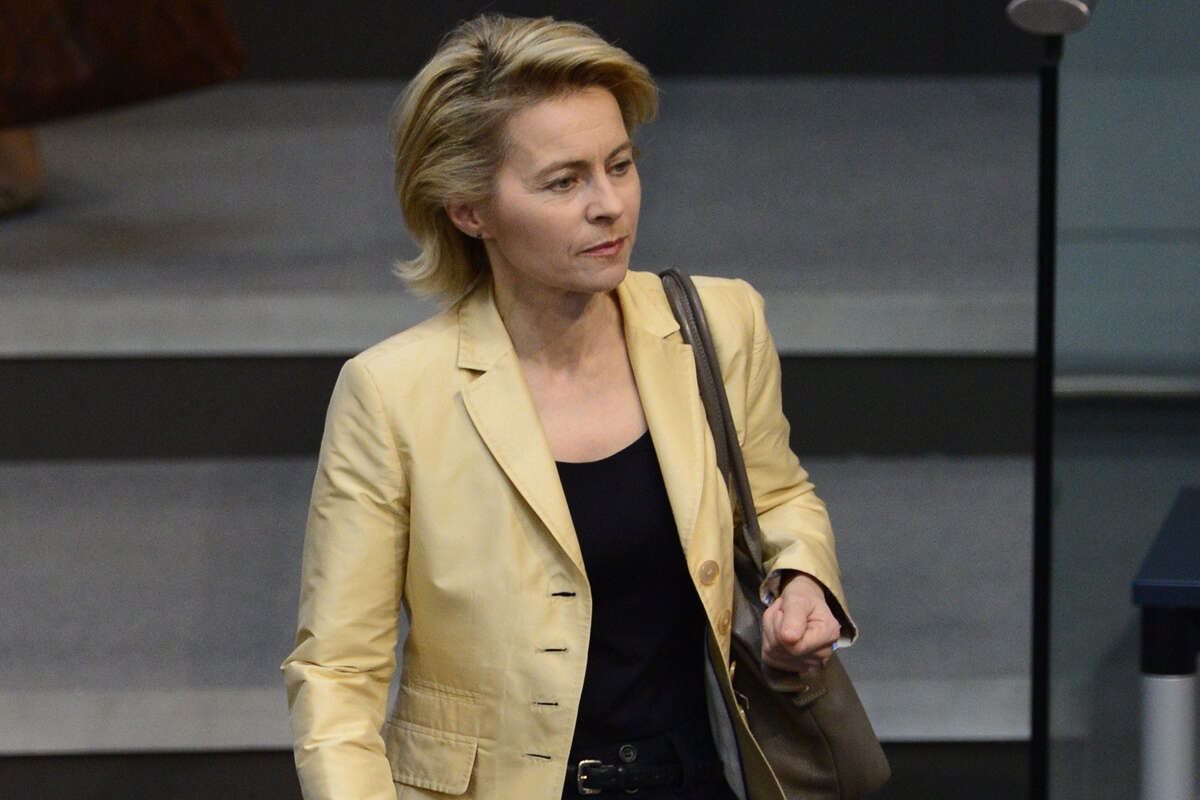
And if we are discussing office air conditioning and hypocrisy, how could we not pause over European Commission President Ursula von der Leyen? At the start of the week, it was reported that an order had been issued to disconnect the first seven floors of the commission's offices in Brussels from air conditioning "due to extreme weather."
But the building has 13 floors. Senior commission officials, including von der Leyen herself, all sit on floors eight through 13. Naturally, the French internet did not let this pass, and the political debate spread across it like wildfire. Alongside videos of the fiery minister and wild parodies at the expense of the head of the European Commission, one especially outrageous meme also starred: "Adolf Airconditioner," a portable air conditioner of the kind snatched up frantically whenever an electrical appliance store opens to the public, whose front had been altered to look like the face of the Nazi tyrant. This is the French Right's counter to the Left's arguments that everyone who wants air conditioning is essentially a despicable far-right figure.
Airconditioning the country
Since President Emmanuel Macron dissolved parliament on the eve of the Paris Olympic Games, the Left in fractured France has entrenched itself in quite a few local authorities. One of them is the capital, Paris, where Socialist Mayor Emmanuel Grégoire joined forces with the Greens to purchase modern buses entirely free of any air-conditioning system. In the boiling city, the greenhouse effect created by the large windows, most of which cannot be opened, pushed the heat inside the buses to levels far above 40 degrees Celsius (104 degrees Fahrenheit). In at least one case, this caused a serious accident at the large Porte de Saint-Cloud bus terminal, when a driver fainted at the wheel and crashed into a tree. By a miracle, there were no fatalities.
By contrast, Éric Ciotti, one of the princes of the Right, the current mayor of Nice and a former leader of The Republicans party, rushed to enact a municipal bylaw making the installation of air conditioners in schools and hospitals mandatory across the jewel of the French Riviera.
The situation in the National Assembly is not bright either. Macron's governments, ever since the tantrum of summer 2024 that led him to dissolve the French parliament unnecessarily, have been standing on chicken legs. The current prime minister, Sébastien Lecornu, has been forced to walk a very thin political tightrope to prevent a no-confidence vote, one that was already threatened only two days ago. A large part of his government relies on support from the Left and the Greens, including Barbut's faction. None of these threats prevented him from taking a brave and necessary step in response to her pathos-laden remarks about animals, forest fires and vanishing crops: he ordered the immediate purchase and installation of 30,000 air-conditioning units in hospitals across France. A drop in the ocean.
Will the French manage to forget the current heat wave, and the one expected next week, by the time of the next French presidential election, whose second round will be held in May of next year? Or will the strange question of air conditioning become one of the hottest issues in France?
Marine Tondelier, leader of The Ecologists and their candidate for the French presidency, has already armed herself with a political platform and with an idea she has been toying with ever since the deadly floods that hit the Valencia region in Spain in October 2024. Some of the 230 people killed had been on their way to work, and so Pedro Sánchez's government approved in November of that year a "climate leave" mechanism that would adapt Spanish labor laws to disaster situations. For Tondelier, a clear woman of the Left, this is a treasure trove, an idea likely to appeal to her flock. If it is too hot, you will simply get your own "climate leave." Who needs air conditioners at all? It is simpler to roast from the heat in apartments while doing nothing, as the French economy continues to limp along.
This idea is, of course, very appealing to the French far Left, and the person leading it is Manuel Bompard, the right-hand man of the antisemitic Jean-Luc Mélenchon of France Unbowed, who is taking part in calls for the creation of "dedicated leave." On the other side, Patrick Martin, president of France's main employers' organization, is horrified to the depths of his soul by the idea of a vacation that would further reduce the already low number of working days in France. In his view, it is a solution that would create a negative vicious circle: less work would mean less production, which in turn would thin out financial profits, leaving even less money in the state's rapidly emptying coffers. According to economists' calculations, properly "airconditioning France" would require about 40 billion euros.
The average Frenchman is hot, and if he has managed to escape the long arm of Hamza "Customs," his helpers and those like him on his way home from work, then in three out of four cases he finds himself inside a furnace, one that he is effectively forbidden to cool efficiently even if he wants to. Most of Paris, like many other historic cities, is governed by ZPPAUP regulation, the bureaucratic monster that preserves France's architectural heritage. For example, there are no fewer than 1,800 protected buildings across Paris, and within a 500-meter (1,640-foot) radius around them, no compressor, condenser, pipe or any other element that could impair the legendary beauty of the French capital may be visible.
Since the start of the heat wave, 80 French people have lost their lives trying to escape the heat by reaching one water source or another, while the rest of their countrymen are still flailing in the swamp of bureaucracy and endless debate. In France, it seems, there is nothing new under the sun.