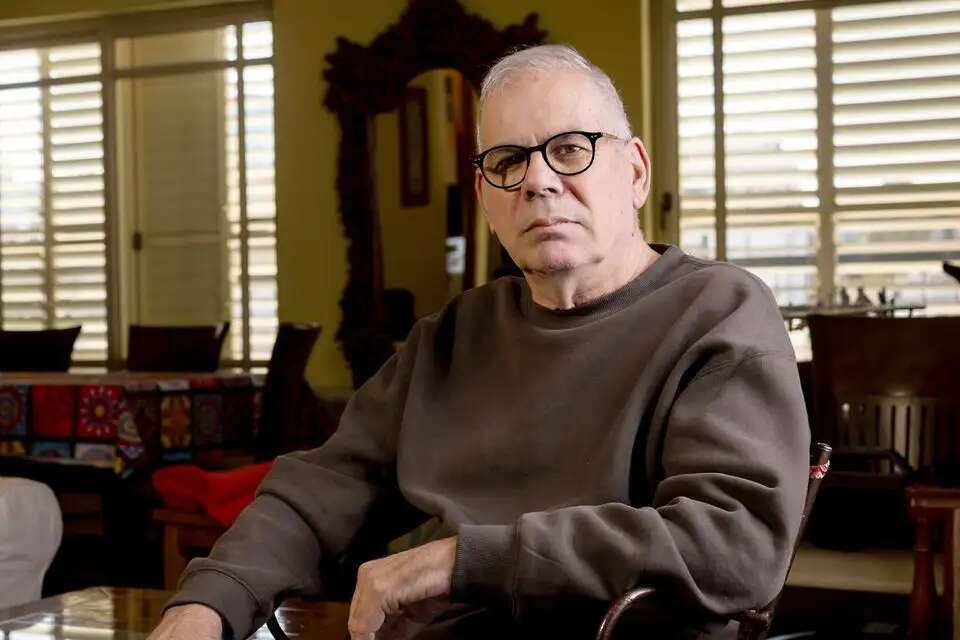
Journalist, presenter and news editor Oren Nahari has died at the age of 70 after a prolonged battle with amyotrophic lateral sclerosis (ALS).
Just last Saturday, Aug. 8, he bid farewell to his listeners in his final program on Kan Reshet Bet radio, bringing to a close decades of work in the Israeli media.
Nahari was born and raised in Haifa and served in Military Intelligence during his IDF service. After leaving the military, he studied political science and international relations at the Hebrew University of Jerusalem and worked as a security officer at Israel Television. His friend, author and director Yarin Kimor, recruited him to work in Channel 1's sports department. In 1985, after holding a variety of positions in the department, he moved to foreign news.
He was among the founders of "Seeing the World," together with Emanuel Halperin, David Witzthum and Michael Doron. He later founded and edited "Globus" and was among the presenters of "From Today to Tomorrow." From 2007 to 2013, he hosted "The International Hour" on Reshet Bet. Three years later, he left the Israel Broadcasting Authority and joined the Walla news website as a senior foreign affairs commentator.

Over the years, Nahari published several books, including "The Great Battles That Changed History," co-written with Yoav Limor; "The Encyclopedic Atlas of the World"; and "The Historical Atlas of the World." He also edited the Hebrew editions of "Speeches That Changed the World: The Speeches, Stories and People Behind the Moments That Made History," "Women Who Changed the World: The Inspiring Stories of More Than Fifty Influential Women in Israel and Around the World," and "Voyages That Changed the World: The Journeys and Expeditions of Explorers, Cultural Researchers and Conquerors."
In March 2026, Nahari revealed that he had ALS and spoke openly about living with the disease. In an interview with Israel Hayom, he said: "It's not that I don't feel bitterness, but I don't feel anger. The right word is sadness over what I didn't manage to do and what I won't get to do. But that's the way it is. Most people get ALS in their 40s or 50s, so you could say I got extra time."
In late July, Nahari recorded his farewell to the broadcast microphone. In his moving final remarks, which aired Aug. 8, he told his listeners: "I'm not saying goodbye to the world just yet. I'm only saying goodbye to the studio and the microphone. Remember that the world is vast and complex, and you need to look at it with your eyes open. That was my mission, and this is my last request of you: Keep looking, listening and asking questions, and don't take things for granted."