
It's still too early to know whether 2026 will be the new 1977. But even before the coalition packs up and goes home, one thing can already be said: October 7 sent the opposition home.
The last poll before October 7 gave Benny Gantz's camp, with Eisenkot and Sa'ar, 29 seats. Lapid was already trending down but still had 18. There was no Liberman, no Bennett, and no Golan. The poll tested what would happen if the Kaplan protest movement registered as a party. The result: 10 seats.
In the coalition, it's still the same figures and the same parties, but the opposition is almost unrecognizable. Of Lapid and Gantz's combined 47 seats, the polls now show barely five left. On the ruins of Labor and Meretz rose a unified party made up mostly of protest-movement figures, but led by a man who reinvented himself after jumping south on October 7. Naftali Bennett, though he's dropped significantly from last year's peak, is offering right-wing policy to center-left voters alongside Liberman, and together they're pulling roughly three times the votes they had before the massacre. So it used to be the State Camp, Yesh Atid, Meretz and Yisrael Beiteinu — now it's Yashar, Together, the Democrats and Yisrael Beiteinu.
Gantz has been replaced by Eisenkot, on the surface not a particularly meaningful change, one chief of staff swapping for another at the head of the Camp. And yet the shockwaves of October 7 are felt here too. Eisenkot is, as is well known, a bereaved father from the war. The opposition back then focused on judicial reform; today's opposition would be smart to focus only on the Haredi issue. The public has moved significantly away from the people who drove the protest movement, who are now all concentrated in the Democrats party. The massacre has pushed the possibility of a second change government much further out of reach, because of the wariness around the Arab parties and their refusal to call Hamas and Hezbollah terror organizations. This week's Channel corporation poll found that even within the opposition, a third support disqualifying Ra'am, the very party without which neither Bennett nor Lapid would have become prime minister.

As is well known, the assumption that the elections at the end of the month will be the most decisive in the country's history hasn't been voiced here, if anything, the opposite. One reason is the enormous gap between where the public stands and the politicians who claim to represent them. The public has shifted sharply rightward, exactly as disgust, fatigue and disappointment with right-wing leaders has peaked, and the head-on meeting of these two contradictory currents won't produce a pretty picture, or any kind of brave new world. In fact, Netanyahu did the opposition a favor by insisting on running again. Without him, it would have struggled badly to agree on a shared agenda and would have had to put forward an alternative plan of its own instead of the right's.
Netanyahu's long shadow is crowding out the need to say anything decisive, for instance, on the major challenge of the next term: the international fallout over the Palestinian question. The last term was defined by Gaza; the next will be defined by Judea and Samaria. The yes-or-no question of sitting with Netanyahu spares everyone the need to publish a clear plan for the territories' future.
A hostile Democratic administration, and ahead of it, anti-Israel European governments, won't hesitate to pile on sanction after sanction. Anyone with sense who listened to the British foreign secretary's auto-antisemitic speech and watched Israeli travelers get searched in Amsterdam in case they were carrying halva from Samaria understands that this is bearing down on us in giant strides. Right now, no one is preparing to head off the coming trouble, everyone is simply clinging to the desperate effort to grab the sixty-first seat from one side or the other.
Keeping it stable
Deep down, everyone knows it. The only stable government that could plausibly form, by most polls, is a unity government with rotation. True, Netanyahu and Gantz's last one collapsed loudly after just eight months. But one could argue the last two rotation governments, Gantz-Netanyahu and Bennett-Lapid, collapsed because they weren't truly equal: one side was a very large bloc and the other small, and the government buckled under that imbalance. If the polls hold and the two blocs end up light-years from an absolute majority, an equal government made up of both blocs, minus the Haredim and the Arabs, minus Golan and Ben Gvir, may be the way out of an endless string of elections with no end in sight.
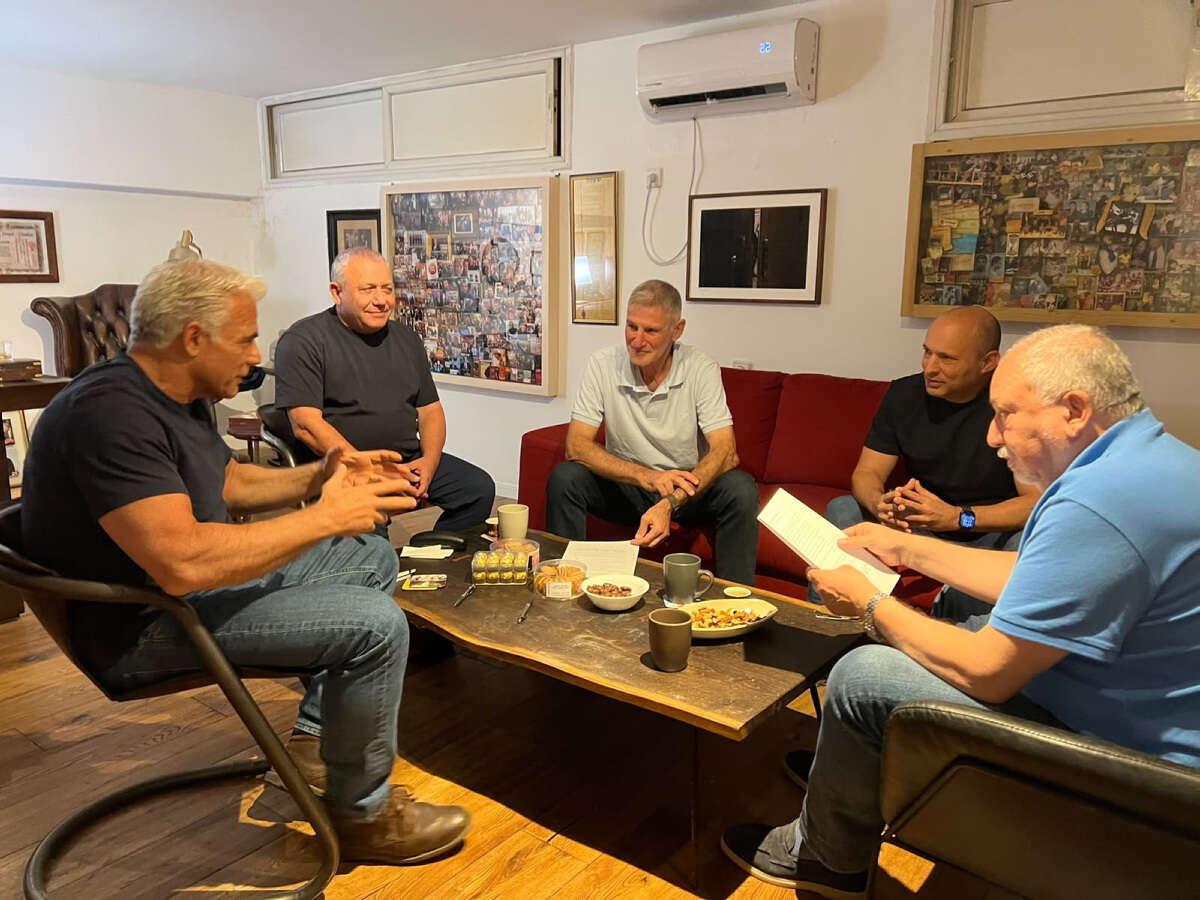
The public is less impressed, perhaps that's only natural in an election period, which tends to sharpen positions rather than convene reconciliation councils. And yet: only 17 percent support a Netanyahu-Eisenkot rotation, against 64 percent strongly opposed. In the coalition, support is a little higher (24 percent versus 45 percent), and in the opposition, lower still (16 percent to 77 percent). The most opposed, naturally, are Arab voters: only 9 percent in favor against 70 percent opposed. They understand that in a national reconciliation of this kind, they're cast as the sacrificial lamb.