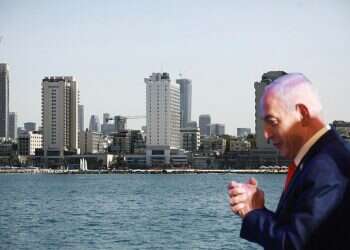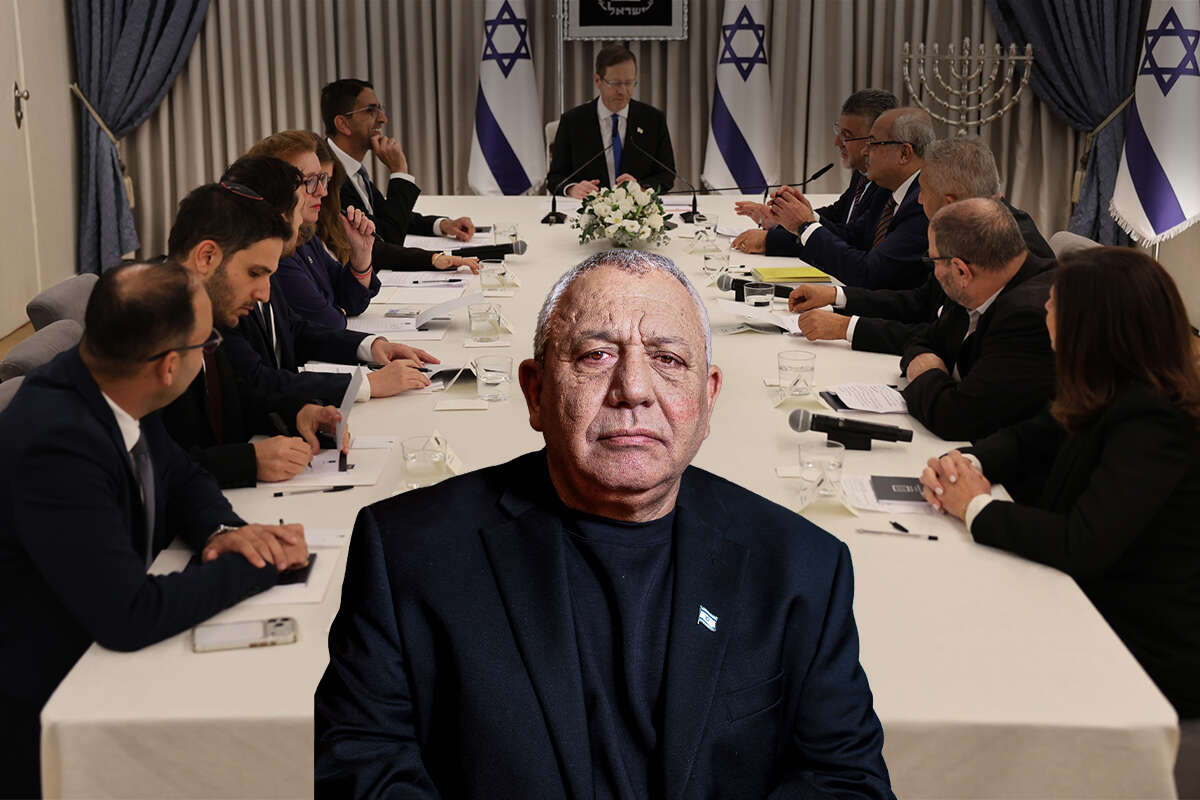
Former IDF Chief of Staff Gadi Eisenkot secured the backing of 67 MKs in consultations at the President's Residence on Thursday, compared with just 46 for Benjamin Netanyahu.
The second day of consultations followed an opening round in which three parties endorsed Prime Minister Benjamin Netanyahu, while two backed Eisenkot, chairman of the Yashar! party.
United Torah Judaism was the first faction to arrive at the President's Residence on Thursday, announcing that it would not recommend any candidate to form the next government.
MK Yitzhak Goldknopf addressed the military conscription dispute during his meeting with Herzog.
"We made it clear throughout the election campaign that we are not committed to any political bloc," Goldknopf said. "We demand that the arrangement allowing full-time Torah study in place of military service be enshrined in law. Our goal is legislation without recruitment targets or quotas, and any candidate who delivers that will receive our support. The slogan 'We will die rather than enlist' is not something we said."
Following the announcement, the anti-Netanyahu bloc sent United Torah Judaism a message: "Everything can be resolved."
Allegations of election interference
The far-right Otzma Yehudit party endorsed Netanyahu. Minister Yitzhak Wasserlauf called on Herzog to demand that every faction arriving at the President's Residence to recommend a candidate explicitly declare Hamas a terrorist organization.
Otzma Yehudit representatives also raised allegations of interference in the election. "Mr. President, this election was stolen," Wasserlauf declared. "We're talking about approximately 100 million shekels that went to voters. This is an earthquake."
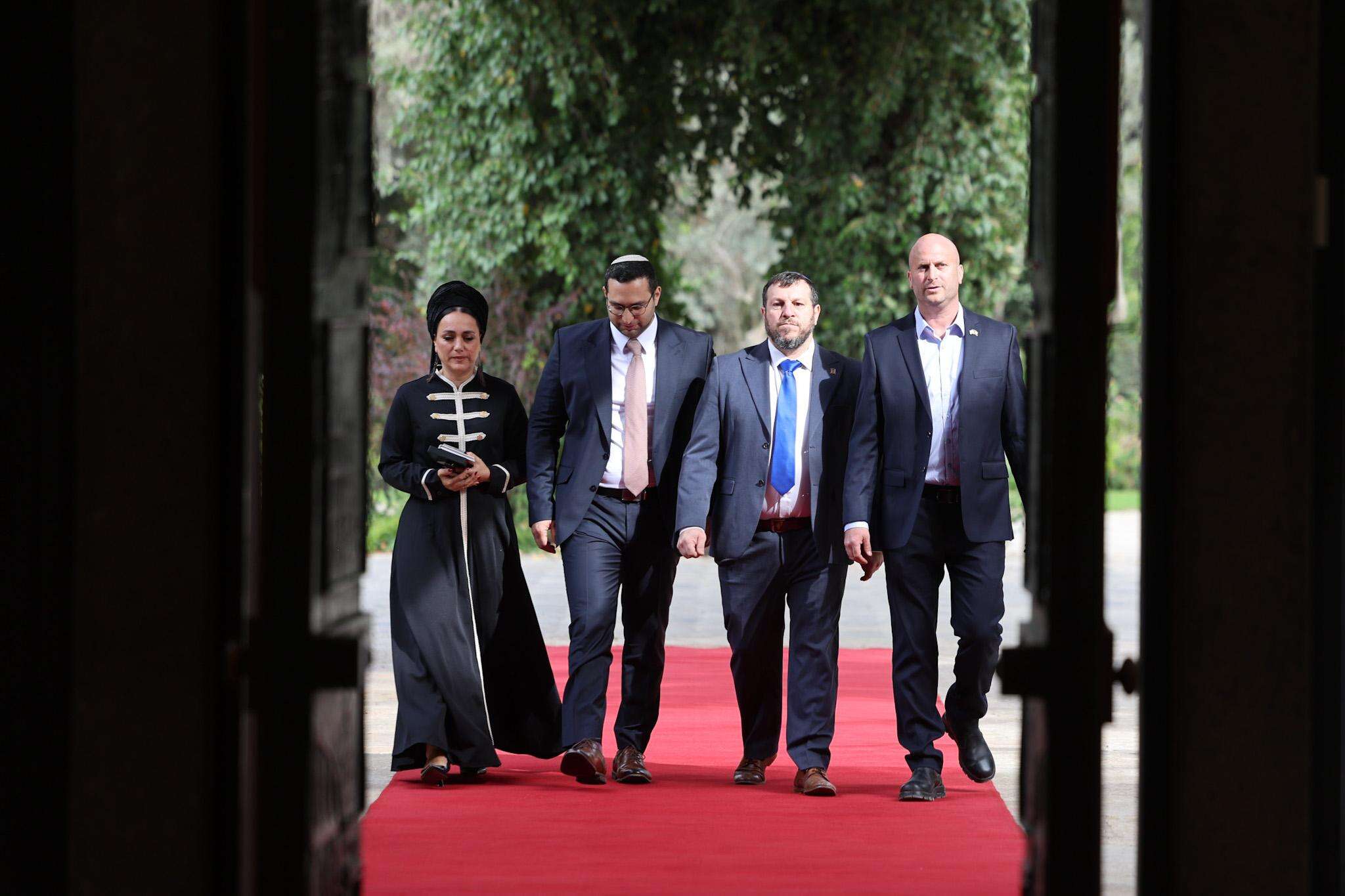
MK Limor Son Har-Melech added, "A large part of the public does not believe the election results, especially when they hear Shin Bet chief David Zini. Mr. President, this should concern you greatly, and you must act to uncover the truth."
Herzog challenged the allegations. "Could it be that your entire campaign on this issue, without questioning the importance of a thorough investigation, is intended to divert attention from the fact that large numbers of Israeli Arabs turned out to vote in response to the behavior of your party and its leader?" he asked.
The Democrats announced their support for Eisenkot as prime minister. MK Naama Lazimi said the party recognized the urgent need to replace the outgoing government, particularly in light of recent events.
"The Democrats want to replace both the current policies and the person leading them, the outgoing prime minister," Lazimi said. "We are calling for a national emergency government in light of the troubling developments of recent days: unlawful arrests, attempts to undermine the election results and a campaign to delegitimize an entire segment of Israeli society. We see all these alarming developments and understand the historic responsibility resting on our party."
The United Arab List (Ra'am) also endorsed Eisenkot to form the next government. Its delegation included MKs Mansour Abbas, Yoav Segalovitz, Walid Taha, Walid al-Hawashla and Iman Khatib-Yasin. "We are recommending him so that he can establish an emergency government," Abbas explained. "His approach is that anyone who agrees to the government's basic principles can join. That's a good approach."
Segalovitz said he had joined Ra'am out of Zionist convictions."The only minister in the government who supports terrorism is Itamar Ben-Gvir," he said. "I'm worried about what's happening inside Israel. The extremists are at the wheel."
Herzog pressed the delegation on Ra'am's position regarding Israel's national identity. "The argument against you is that Ra'am does not recognize Israel as the nation-state of the Jewish people," he said. "That is why the question arose of whether it could be a coalition partner."
Segalovitz replied, "The Declaration of Independence says this is a Jewish state, but it also sets out its values as a democratic state with equal rights for all its citizens."
MK Walid al-Hawashla added, "Netanyahu wanted our votes in the ballot on the state comptroller. We received approaches about it. But now, when we want to join the coalition, we're supporters of terrorism."
Can Ra'am improve Jewish-Arab relations?
Herzog also asked whether Ra'am could participate in a government engaged in an ongoing war against terrorism. "We didn't come here to manage security policy," Abbas replied. "We came to improve relations between Jews and Arabs, and I believe that will also help resolve the conflict.
"I sat with Netanyahu at Balfour (the former prime minister's official residence in Jerusalem), and I was astonished by his dismissive attitude toward the challenges coming from the Gaza Strip. He is the one who should stand before the president and answer for that, not us. You cannot keep subjecting us to loyalty tests."
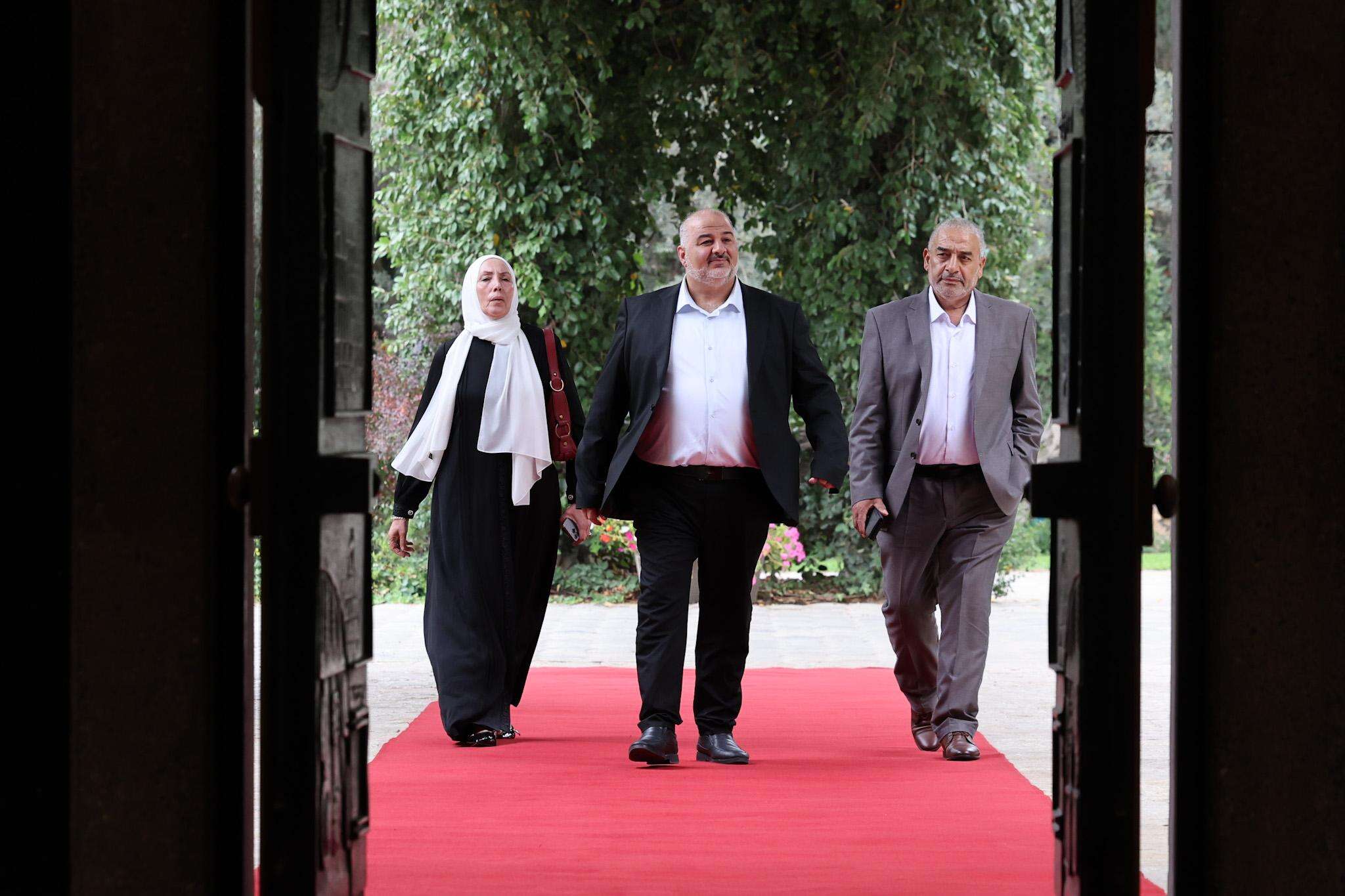
When Abbas clarified that he supported disarming Hamas, Herzog pressed him on why he would not explicitly describe the organization as a terrorist group. "I have an unequivocal answer," Abbas replied, "but allow me to protect myself and my family."
Earlier, Shas, Religious Zionism and Moshe Feiglin endorsed Netanyahu, while Yisrael Beytenu backed Eisenkot.
United Torah Judaism's decision not to endorse a candidate followed an internal dispute over which course to take. The Degel Hatorah faction announced that, on instructions from its spiritual leaders, Rabbi Dov Lando and Rabbi Moshe Hillel Hirsch, it would not recommend anyone. Agudat Yisrael chairman Yitzhak Goldknopf had likewise been instructed to refrain from making a recommendation.
By contrast, Meir Porush and Eliakim Stark had leaned toward supporting Netanyahu. Ultimately, the party decided against endorsing any candidate.
Agudat Yisrael stressed that its principal condition for supporting a government was legislation regulating the status of full-time Torah students who do not serve in the military. "The main task is to regulate the status of Torah students, and the candidate who provides a solution to this issue through legislation will receive the party's support," the faction said in a statement.
The Joint List formally announced that it would also recommend Eisenkot to President Isaac Herzog as its candidate to form the government.
The decision followed "the broad public support we received from our voters, in response to the public demand to prevent Netanyahu and his government from returning to power, and out of our commitment to our promise to take every possible step to achieve that goal," the party said.
Party chairman Prof. Yousef Jabareen accused Netanyahu and Ben-Gvir of fostering an atmosphere of persistent incitement. "There is an atmosphere of ongoing incitement led by the prime minister and Ben-Gvir," Jabareen said. "If you heard these statements in a European country and replaced the word 'Arab' with 'Jew,' we would call them antisemitic, and rightly so."
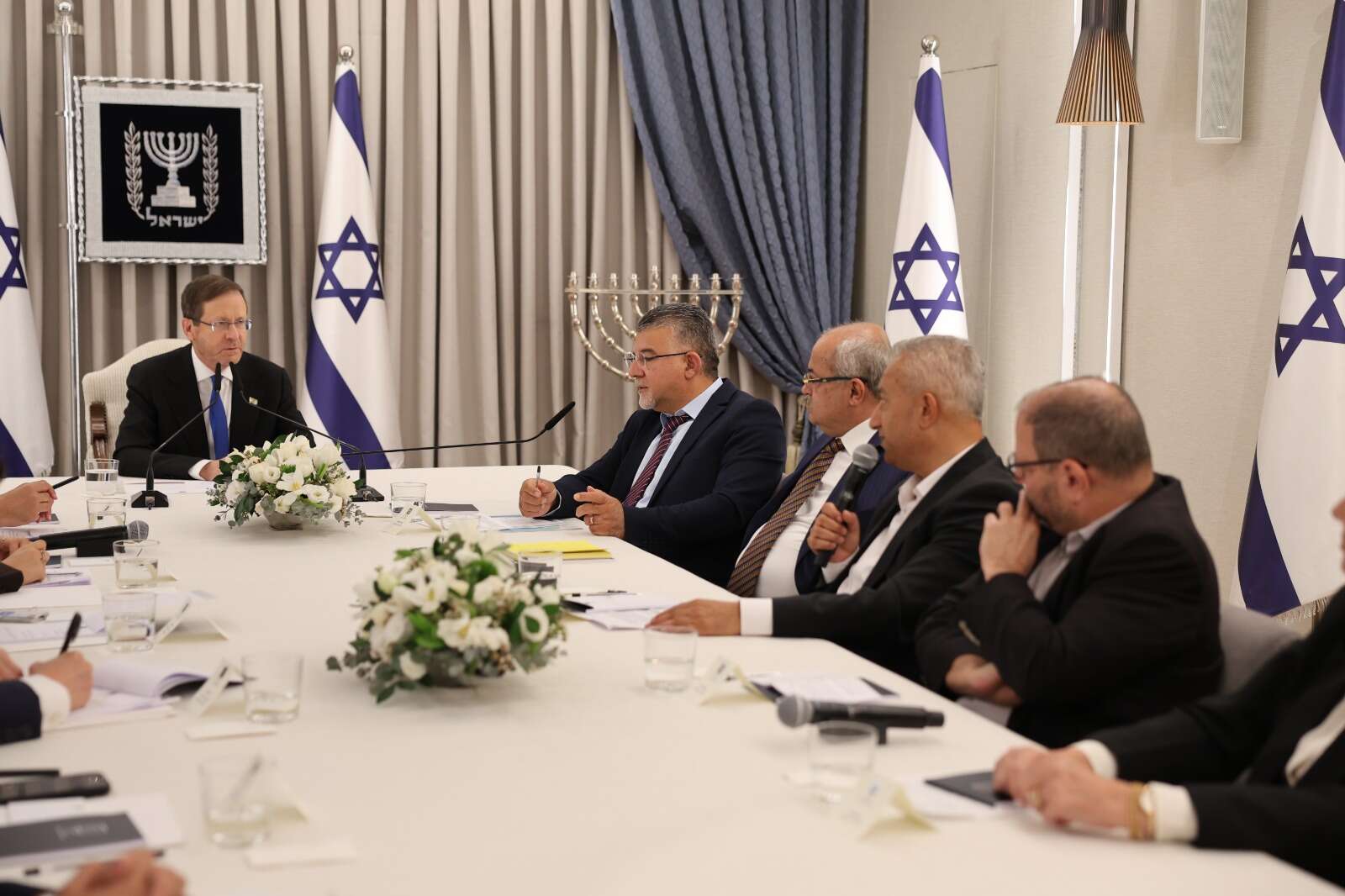
Jabareen also criticized statements attributed to Netanyahu's son. "The prime minister's son, who is in Miami, writes that Arab citizens will carry out the next October 7," he said. "These are statements that cannot simply be ignored. We expected greater involvement from you as president.
"When the finance minister announces a plan called 'Judaizing the Negev and Galilee,' the plan is racist by its very name. It gives preference to one population at the expense of another."
"Our safety net is for our community"
Herzog asked Joint List representatives whether they would withdraw their support for a government over a war. "We are not providing a safety net," MK Ahmad Tibi replied. "The safety net is for our community. We are not providing it so that the government falls after two or three months because of disagreements."
Jabareen elaborated on the party's approach. "We will make strategic decisions," he said. "The public did not elect us to bring Netanyahu down only to bring him back. We will therefore make decisions that serve our strategy of advancing the values we believe in, and we will strive for a path of peace."
Tibi emphasized that the Joint List's endorsement of Eisenkot did not mean it agreed with his positions. "Our support for Eisenkot is not out of affection for him," Tibi said. "We disagree with Eisenkot on many issues. We are not choosing between good and better, but between bad and less bad."
Tibi also challenged what he described as the exclusion of Arab voters from political influence. "There is no basis in this country's founding principles for a situation in which all Arabs are eligible to vote but are disqualified from having influence," he said.
"All citizens are equal in my eyes," Herzog replied.
"That's not true. I disagree," Tibi responded. "In reality, not all citizens are equal in the State of Israel."
Herzog later addressed the deep disagreements between the sides. "The differences are profound," he said. "After October 7, peace-loving people and Muslims were among those massacred."
Tibi responded sharply. "Do you think anyone needs to lecture us about morality? This is appalling," he said. "Ayman Odeh and I attended Vivian Silver's funeral. Netanyahu did not."
Tibi went on to accuse the coalition of attacking the families of hostages, while noting that those families had visited his office and that he and his colleagues had listened to them.
"Why is it so difficult to say that you oppose terrorism?" Herzog asked.
"There was an unequivocal condemnation of terrorism," Tibi replied. "You are no more humane than we are. You keep trying to back us into a corner. You're not running a school, are you? When two children from my family were murdered, not one of them came to comfort me."
The Beyachad faction also endorsed Eisenkot during the consultations. Its delegation included MKs Ram Ben-Barak, Meirav Cohen and Eitan Ginzburg, along with Bruria Naim Arman and Liran Avishar Ben-Horin.
Cohen opposed the prospect of renewed political cooperation with Netanyahu's bloc, invoking the fable of the frog and the scorpion. "To me, sitting with people who think differently from me is not a constraint but a goal," she said. "But trust matters. When I hear talk of a unity government, I'm reminded of the fable of the frog and the scorpion. I don't do business with scorpions."
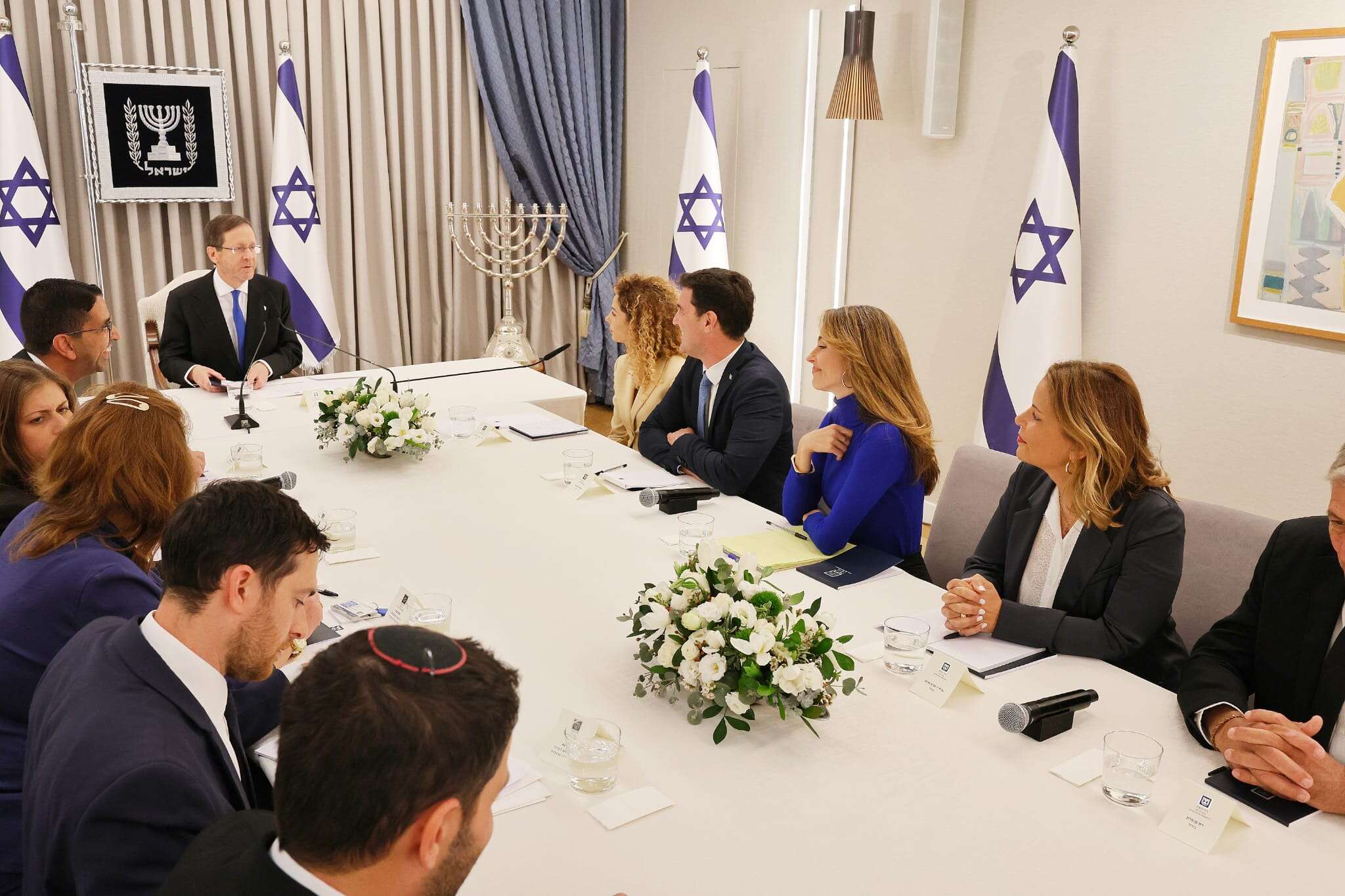
Cohen, who served in the unity government formed during the COVID-19 pandemic, said her position was shaped by that experience. "I was part of a unity government, and then every agreement was broken," she said. "Instead of doing good for the State of Israel, I caused it harm."
Ben-Barak was equally emphatic. "There can be no unity with people who don't believe everyone is equal. There can be no unity with fascists," he said. "There cannot be separate conscription laws for different sectors, one for religious Jews and another for the ultra-Orthodox. No! There must be one conscription law."
The Yashar! faction formally recommended its chairman, Gadi Eisenkot, to form the next government.
Former Shin Bet chief Yoram Cohen warned that Israel was approaching a dangerous turning point. "Israel is at a crossroads. The situation is dangerous," Cohen said. "The current leadership crosses a new red line every day in undermining the institutions of government, while hatred and violence are increasing.
"If we continue on this course, we risk reaching dark places, a point of no return from which it will be extremely difficult for us to recover as a society and as a country. This is a time of emergency. Israel urgently needs new, responsible, stable and unifying leadership."
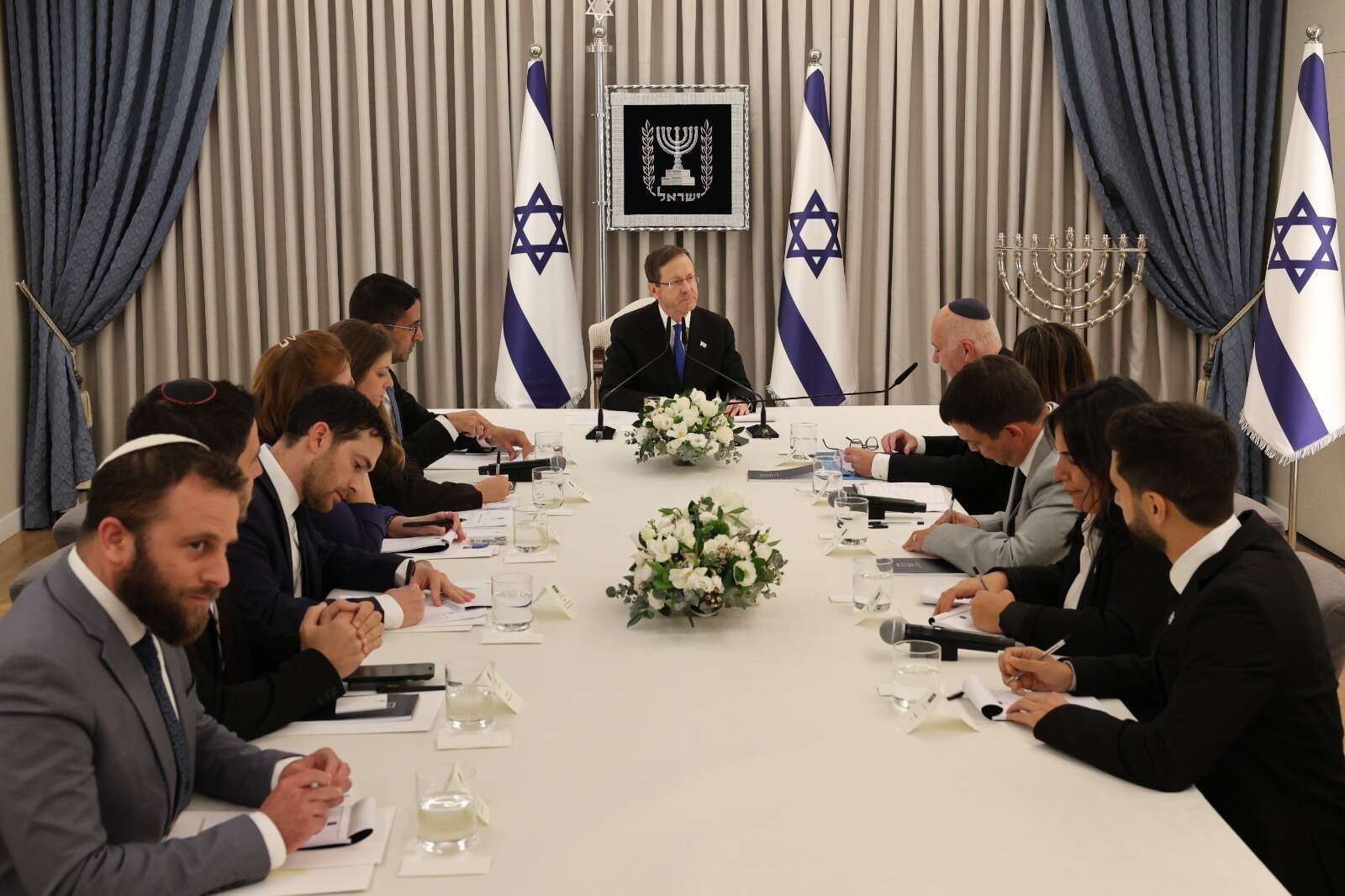
Shaul Meridor also criticized Netanyahu's conduct on Election Day. "On Election Day, Prime Minister Netanyahu chose to post on his page an image that appeared to depict an atomic bomb over an Israeli city," Meridor said. "That is not reasonable behavior for a prime minister."
Herzog concluded with a warning about the future of American military assistance. "The issue of US aid concerns me greatly, and it also came as a bolt from the blue to me," Herzog said. "We have a memorandum of understanding with the United States that is supposed to remain in effect until 2028, and this is one of our major priorities. That is why we need to form a government rather than go to another election."
"They dedicate their victory to Gaza"
Likud representatives later arrived at the President's Residence to recommend Prime Minister Benjamin Netanyahu for another term.
Education Minister Yoav Kisch criticized the Arab parties, saying, "They are dedicating their victory in Israel's elections to the residents of Gaza. These parties have no legitimate role in shaping the future of the State of Israel. It would dismantle Israel from within, and what we're seeing in Paris would pale in comparison to what could happen in Tel Aviv."
Kisch then addressed Gadi Eisenkot, Naftali Bennett and Avigdor Lieberman directly. "I appeal to the left-wing parties and tell them: You must not turn out the lights on the Jewish state. We need a unity government that brings together all of Israel's political forces around a Jewish or democratic state. We must form the broadest possible government."