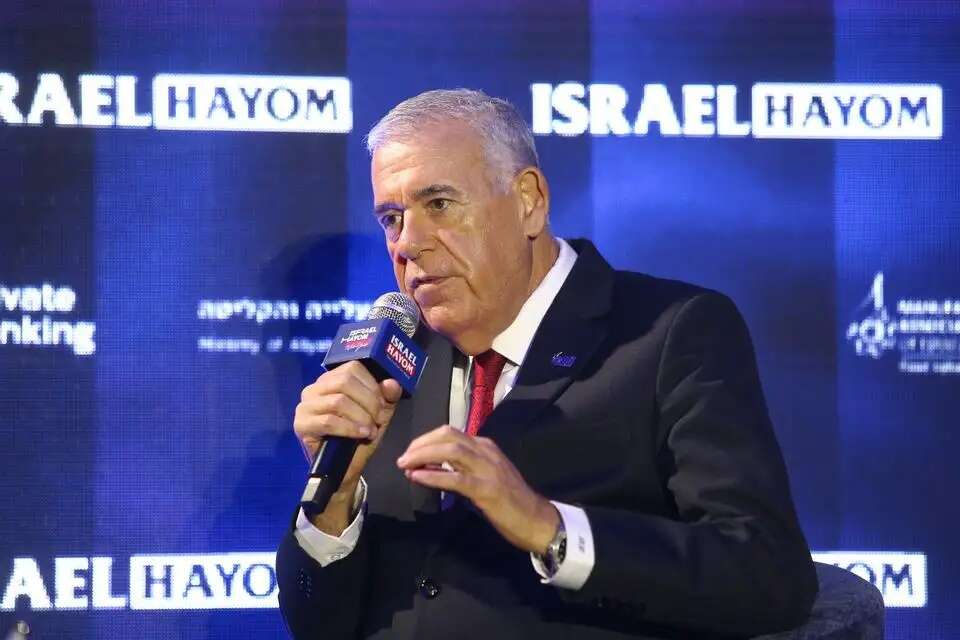
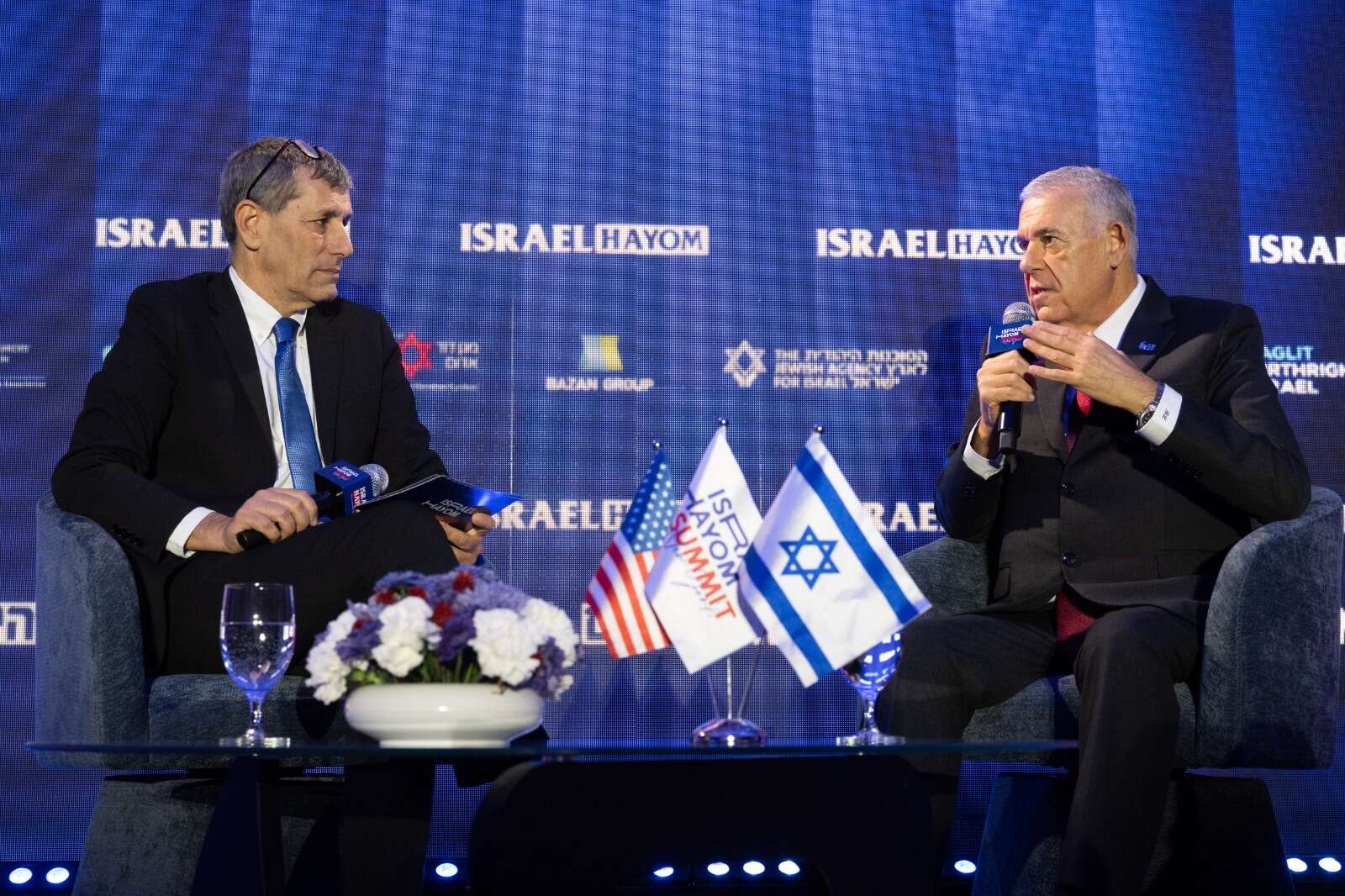
The Israel Hayom summit in New York opened Wednesday, bringing together senior figures from Israel and the United States, government officials, business leaders, heads of organizations and prominent members of the Jewish world. Held for the second year at the InterContinental hotel in Manhattan, the summit, attended by Israel Hayom publisher Prof. Miriam Adelson, will feature discussions, interviews and panel sessions addressing the major issues facing Israel, the US and the Jewish world.
In a special interview at the summit with Israel Hayom's analyst Yoav Limor, Israel Aerospace Industries Chairman Boaz Levy discussed Iran's unprecedented missile attacks on Israel and the historic success of the Arrow missile defense system. He also issued a stark warning about the next confrontation with Tehran. "We learned a great deal, but the Iranians learned a great deal too. We cannot look only at what has happened so far. We must prepare for the next war, and there will be another war, without a doubt. The question is no longer 'if,' but only 'when.' Our technology, developed in full partnership with our friends in the US with equal funding, must be ready."
Levy, who has been involved in developing the Arrow system since its inception, reflected on the system's performance against Iranian missile barrages. "I was a systems engineer. I grew up with Arrow, and I'm very proud. In the past, we thought the Iranians would launch 10 or 20 missiles. Nobody in the industry anticipated that hundreds of ballistic missiles would be fired at us within a matter of hours. Yet the system performed flawlessly, achieving a 92% interception success rate. That is an extraordinary figure against barrages of this magnitude, and it is precisely what we mean by national resilience."
"The battle is moving into space"
Asked by Limor about the arms race, production costs and interceptor stockpiles in the face of the ballistic missile threat, Levy described the challenges of an asymmetric confrontation. "As long as they have ballistic missiles aimed at Israel, we must have interceptors. An interceptor is neither easy nor cheap to manufacture. It is a complex platform equipped with sensors and autonomous navigation capabilities in space. The only place where ballistic missiles should be intercepted and neutralized is outer space, and doing so requires enormous preparation in advance. We are producing more and more interceptors, while constantly looking for ways to do it better, reach higher into space and intercept threats at the greatest possible altitude."
Against the backdrop of discussions in Jerusalem and Washington over the future of American military assistance, Levy stressed that the security relationship between the two countries runs much deeper than any particular funding arrangement. "This is an excellent time to redefine the relationship not as aid, but as a strategic partnership built on technology," he explained. "Future wars will be technology-driven. Over the years, Israel and the US have built a shared technological community that will be very difficult to stop. The question of aid exists, but it is not the main issue. What matters most is continuing to develop the future together."
Levy also discussed Golden Dome, the ambitious US missile defense initiative, expressing confidence that Israeli capabilities would be incorporated into the project. "Arrow began as a joint venture, and today it is the most advanced ballistic missile interception system in the world. Everyone understands how this threat must be addressed. Gen. Michael Guetlein, who is responsible for the project in the US, agrees with me, and I am confident he will take our proven capabilities into account."

"For the first time in history, a satellite guided a pilot in the cockpit"
During the interview, Levy expanded on two of the most significant challenges shaping the future of warfare: space operations and the drone revolution. "We built our first drone back in the 1980s," Levy recalled. "Today, anyone can build a drone in their garage, but designing the right aircraft for a complex mission requires Israeli talent and ingenuity, capabilities we share with our allies."
"When it comes to space, we're talking about a different league altogether. Israel entered the space arena in 1979, around the time of the peace agreement with Egypt, to gather intelligence. Today, space is the command center, and the entire war is managed from there. We have brought the future into the present. For the first time, a satellite in space sent a message directly to a fighter pilot's cockpit, guiding him in real time during a special mission."
Addressing the integration of artificial intelligence into the battlefield, Levy cautioned against uncritical enthusiasm and emphasized the continued importance of human judgment. "Artificial intelligence is an excellent supporting tool, but it cannot stand alone. To win future wars, we will have to think outside the box, and that requires human intelligence. In our laboratories, we are thinking two steps ahead to develop tailored solutions, particularly given that in modern warfare, the front line has shifted to the home front and into cities. That requires broad protection for population centers, airports and infrastructure."

"Preparing for a partial IPO as early as next year"
Alongside its ongoing defense operations, Levy outlined the business and international expansion plans of Israel's aerospace and defense giant, which has seen surging global demand amid wars in the Middle East and Europe. "Our first mission is to defend our home and ensure the country's security, but Israel cannot do that alone. It needs international support. Our business model follows a 70-30 split: 30% of our activity is directed toward the IDF and Israel's defense establishment, while 70% goes to exports overseas. Our products have been proven in combat under fire, and demand from countries around the world is enormous."
Asked by Limor about the historic prospect of opening the government-owned company to public investors, Levy confirmed plans for a partial initial public offering. "As a government-owned company, if we want to continue leading, growing, raising capital and operating in the global market, we must be part of the capital markets. We are going to carry out a partial IPO of Israel Aerospace Industries, hopefully and, in our estimation, as early as next year. There are still regulatory and bureaucratic hurdles to overcome, but we will get there, and I am very optimistic."