The Israel Hayom Summit in New York opened Wednesday, bringing together senior figures from Israel and the United States, government officials, business leaders, heads of organizations and prominent members of the Jewish world. The summit, being held for the second year at the InterContinental hotel in Manhattan in the presence of Israel Hayom publisher Prof. Miriam Adelson, will feature discussions, interviews and panel sessions on the major issues facing Israel, the US and the Jewish world.
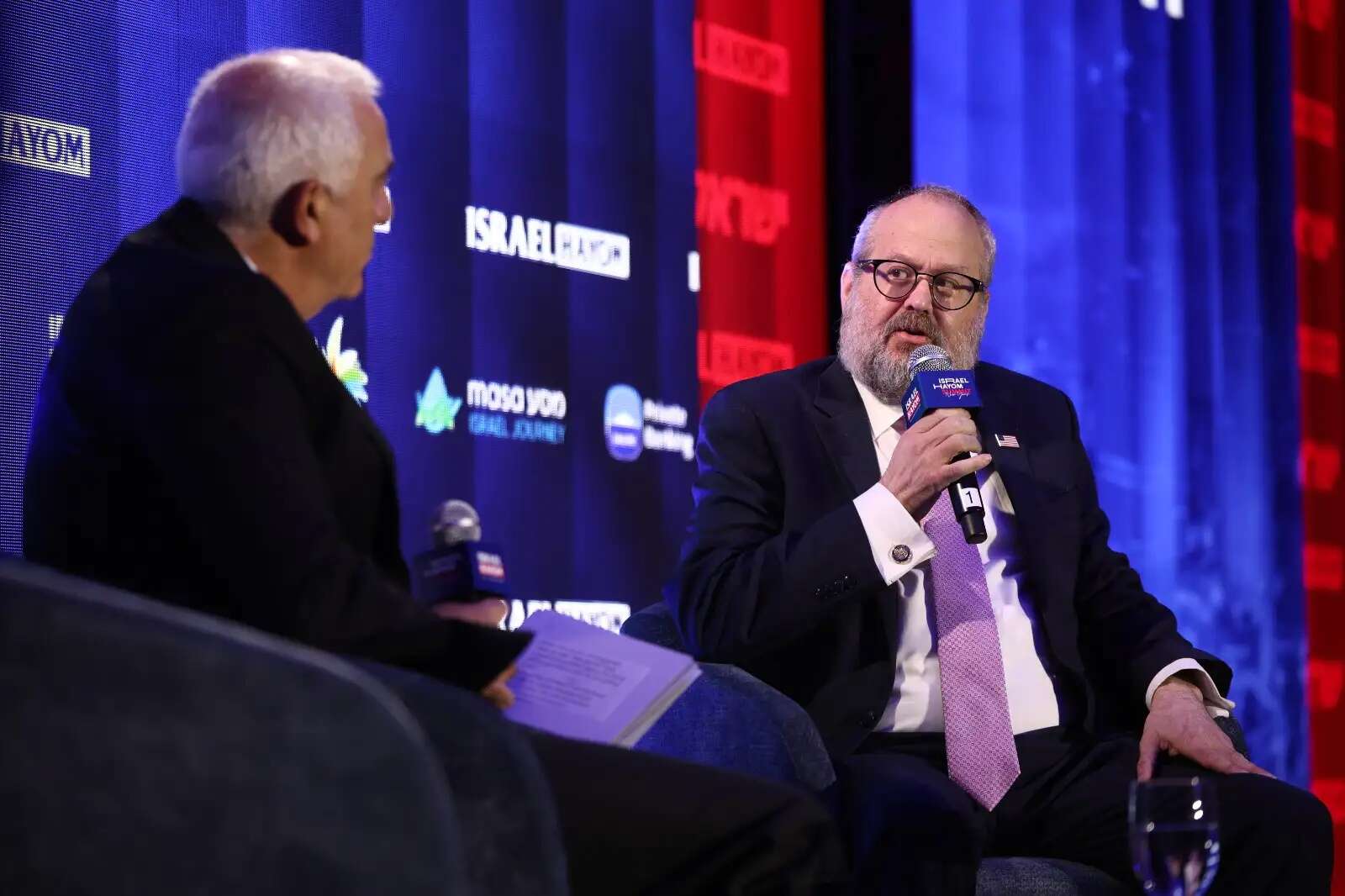
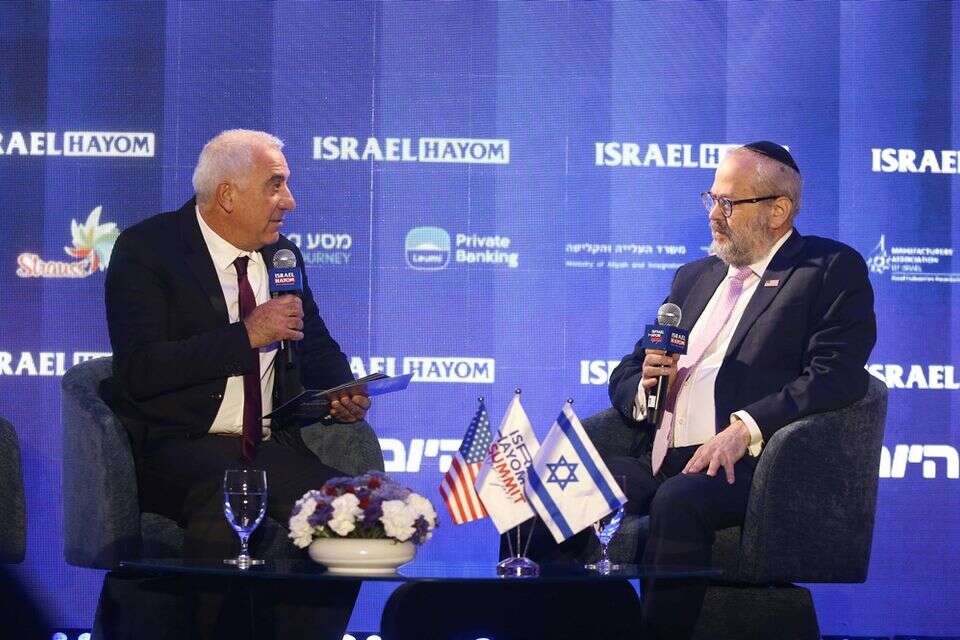
In the opening session, "Between Washington and Jerusalem," Danny Zaken spoke with Ambassador Rabbi Yehuda Kaploun, President Donald Trump's special envoy to monitor and combat antisemitism. Their discussion focused on the rising tide of antisemitism around the world, which reflects a global assault on Israel, attempts to equate Zionism with racism and the ways international media outlets distort reality.
The conversation began with a question about the "blue wave" that swept across the United States. Asked whether American Jewry was in danger, Kaploun replied, "The whole world is in danger because of antisemitism." He pointed to an alliance between socialists, Hezbollah and the Muslim Brotherhood, describing it as "an alliance that is not only antisemitic but also anti-Western civilization."
"We are at a point where people need to understand that socialism is an enormous danger," he warned.
Kaploun criticized candidates whose political platforms are built around opposition to Israel. He argued that they were pursuing such positions "not necessarily for the benefit of the American public, but to advance an agenda that is not good for any American."
The envoy stressed that the administration was taking action on the issue on an ongoing basis, citing President Trump and Secretary of State Marco Rubio. He said the State Department had held a summit on terrorism that addressed left-wing extremism, a phenomenon he described as having "flown under the radar."
"This is a battle. It's not something simple," he added. "Every day, the administration takes action and imposes sanctions on countries, nonprofits and groups. Every three weeks, we see another aspect of the Muslim Brotherhood subjected to additional sanctions."
As an example, Kaploun cited charges announced by the US the previous day against Mohammed Baqer Saad Dawood al-Saadi. According to Kaploun, al-Saadi was responsible for 23 separate terrorist attacks in Europe and had also planned an attack on US military bases.
Kaploun said al-Saadi was awaiting trial in Brooklyn and that two additional contacts had also been identified. "This is a battle that will continue every day to keep the Jewish community safe, not just in America but around the world," he said.
Zaken then turned the discussion toward the Jewish community itself. Noting that some support for members of Congress who oppose Israel and for antisemitic figures comes from Jewish voters, he asked Kaploun to address the issue.
The envoy did not mince words. "I think that if the Jewish community is willing to take a deep look inward, which is not always a pleasant thing to do, it will discover that we are failing," he said.
Kaploun referred to remarks by Prof. Adelson, who had spoken at the opening of the summit about the importance of Jewish pride. He said that 70% of Michigan's Jewish voters might support El-Sayed, while 30% of New York's Jewish voters might back Mamdani. "What you're seeing is a failure of Jewish education," he said.
Jewish education, he argued, had failed "to give Jewish children an identity they can be proud of, on campus, in the workplace, in schools and on the street."
Kaploun urged the community to rethink its priorities. "We need to set our priorities so that the next generation of Jews is not educated by TikTok and Qatar about what it means to be Jewish," he said, "but by the Jewish community itself, and about how much pride there is in being Jewish."
140 million shekels versus $6 billion from Qatar
Zaken noted that the Israeli government allocates 140 million shekels to Jewish education in the Diaspora. Kaploun responded with a stark comparison. "140 million shekels? There is $6 billion from Qatar in American universities. You need to be effective in how you prioritize and use your money."
He also criticized divisions within Jewish leadership. "We are all community leaders. We are all here for a reason," he said. "Just today, there are four different Jewish leadership events. Four different groups are going to decide the best way to fight antisemitism, but none of them are talking to one another."
According to Kaploun, those divisions persist even when the administration launches initiatives to combat antisemitism. "For the first time in history, we have a president who declares zero tolerance for antisemitism, and yet there are groups within the Jewish community that say, 'If it's President Trump's idea or the secretary of state's idea, we won't support it.'"
"We have to overcome our differences," he stressed. "Hitler did not distinguish between Jews, and we cannot distinguish between Jews. There is one message in this battle: to destroy Israel and all Jews."
Zaken noted that the fight against antisemitism was deeply personal for Kaploun. His relative, Adi Kaploun, was murdered on Oct. 7 while protecting her two children. Zaken asked how that tragedy had shaped the envoy's mission.
Kaploun revealed that she was not the only member of his family to have been killed. "Before Passover, lone soldier Moshe Yitzhak Katz was killed in Lebanon. He was my cousin."
"Their memory drives the legacy we must preserve. We do not live only for ourselves," he said.
He also spoke of the families of hostages who had not returned and those who lost loved ones on Oct. 7, noting that 46 Americans were killed that day. "Our message is to live in a way that honors their legacy, so they would be proud of us. We do not walk in shame. We walk with Jewish pride. We are a nation chosen by God. We are special, we are survivors, and we will live and contribute to society wherever we are in the world."
Zaken then asked how international and American pressure had changed the antisemitic narrative within the Palestinian Authority and the Arab world, and whether Europe should continue funding Palestinian education that promotes hatred of Israel.
"That's a lot for one question," Kaploun said with a smile.
"You have one minute," Zaken replied.
If Saudi Arabia can do it, no one else has an excuse
Kaploun said that, following State Department efforts, Saudi Arabia had removed approximately 84% of problematic references from its school textbooks.
He contrasted that progress with the situation in the Palestinian Authority, citing what he described as a math problem appearing in Palestinian textbooks. "Imagine you have a child in first grade. If I kill 122 Israelis in one day, how many Israelis will I kill if I do that for nine days?"
"This is acceptable to people who fund UNRWA and education in the Palestinian Authority," he said, referring to the UN agency for Palestinian refugees. "And yet we go to meetings and are told they are doing the best they can."
"If Saudi Arabia can do it, no other country has an excuse not to do it," he declared.
Kaploun said the US was also working with Syria on its new school textbooks. He acknowledged that measuring the success of such efforts was difficult. "My office and the work we do are among the least appreciated in the world, because a good day is a day when there are no attacks on the Jewish world and schools around the world are not attacked," he said.
"If we can teach a child in Saudi Arabia to grow up without hating Israel and Jews, and a decade from now that child doesn't do something foolish because he was taught not to hate, that is the victory I will take, and the one I will be proudest of."
Zaken observed that even Syria's government, which has Islamist roots, was cooperating with the initiative.
Kaploun described that cooperation as "a testament to the strength of the president and the secretary of state." He said an arrangement had been reached with the Syrian government on the sidelines of the UN General Assembly to protect and restore historic Jewish sites.
Under the arrangement, Jewish communities in the US and Syria received permission to station representatives at cemeteries that had been bombed, allowing exposed human remains to be reburied with dignity in accordance with Jewish tradition. "These are people who lived 1,500 and 2,000 years ago. They deserve the proper respect," he said.
Kaploun described the cooperation as a step toward "a stronger and better region that can lead to economic prosperity for everyone."
Zaken then returned the discussion to Europe, noting that Britain's Green Party had adopted a position equating Zionism with racism. "The situation in England right now is bleak for Jews," Zaken said. "There is a systemic problem throughout Europe," Kaploun replied.
He described the difficulties involved in expanding international cooperation against antisemitism. During a visit to Argentina, he said, unique opportunities had emerged for countries such as the United Arab Emirates, Morocco and Bahrain to join the initiative, while Paraguay had signed a declaration of intent to join. "My view is that if a country wants to fight antisemitism, we should welcome it with open arms, and it should not be a three-year process," he said.
"We reached an agreement to disarm Hamas. We did that in a week. Why does it take three years to bring in a new member? Because the Europeans showed no interest whatsoever."
Kaploun said that when he presented the American position to European officials, he made clear that nearly every European country was violating the International Holocaust Remembrance Alliance (IHRA) definition of antisemitism that it had endorsed. "One of the points in the definition is that you cannot single out Israel for condemnation. You cannot just pick Israel and condemn it."