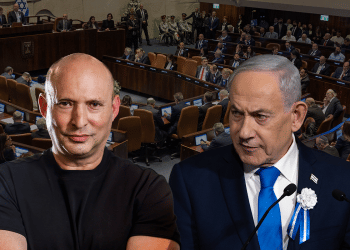
As negotiations over the formation of Israel's next government continue, Yashar Chairman Gadi Eisenkot has informed his partners in the change bloc that he intends to form a lean government with a limited number of ministers. Israel Hayom has learned that the decision has sparked discontent among Knesset members within the bloc, who see their chances of securing ministerial appointments dwindling.
Under the coalition agreement between Yisrael Beytenu and Yashar, Avigdor Lieberman's party will receive both the Defense and Justice ministries.
Under Eisenkot's proposed framework, each coalition partner will be offered only three to four ministerial portfolios. This means that Naftali Bennett's Beyahad party is expected to receive just two additional ministerial posts alongside Bennett himself, while the Democrats are expected to receive three in total.
Yisrael Beytenu Chairman Avigdor Lieberman, who was the first to reach a coalition agreement with Eisenkot, managed to secure senior portfolios. Bennett, by contrast, took longer to reach an agreement and is expected to have to compromise on the allocation of ministries. Yesh Atid Chairman Yair Lapid, who had sought to reach an agreement earlier, will also have to contend with the consequences of Eisenkot's decision to limit the number of ministers.

The battle over ministerial posts
Following the Democrats' announcement that they were suspending negotiations with Yashar, it emerged that significant disagreements also remain between the two parties over the allocation of ministerial portfolios. Yashar made clear that it had no intention of giving the Education Ministry to MK Naama Lazimi or the Justice Ministry to Democrats Chairman Yair Golan. The only portfolio offered to Golan was that of national security.
Last night, the Democrats announced they were suspending talks with Yashar in protest over Eisenkot's ongoing negotiations with Likud to form a unity government. It has now emerged that, alongside disagreements over the composition of the government, the distribution of ministerial posts is also a major source of tension between the two parties.
Under the emerging agreement with Yisrael Beytenu, the party is expected to receive the Defense Ministry, a post Lieberman resigned from in 2018. It can now be revealed that Lieberman is also expected to secure the Justice Ministry.
Those close to Eisenkot believe the new government could be sworn in as early as the beginning of next week, following progress in negotiations with United Torah Judaism and Lieberman's decision to drop his opposition to the formation of a minority government.